AQA · GCSE · Business
Course version: 8132 · Version from Sept 2017
Types of segmentation Students should understand how and why different…
Full specification wording
Segmentation: Types of segmentation Students should understand how and why different businesses use segmentation to target customers, including:
Segmentation means dividing a whole market into smaller groups of buyers who share similar characteristics or needs.
Checked against the AQA 8132 specification (opens in a new tab) on .
- Point 1 of 5
- 4 key terms
Study notes
From the checked teaching notes for this specification point.
The idea
Segmentation means dividing a whole market into smaller groups of buyers who share similar characteristics or needs. A business does this so that its marketing mix — product, price, place and promotion — can be shaped around one group rather than aimed vaguely at everyone. The method is: choose a basis for splitting the market, study what each group wants, judge which group fits the firm's resources and rivals, then target it. For example, a small bakery may split its local market by age and income, then target busy workers with a lunch meal deal. Segmentation is used because customers differ, budgets are limited and targeting raises the chance that promotion and pricing appeal. It also helps a firm avoid wasting money on buyers it cannot serve well.
What earns the marks
- Defines segmentation as splitting a market into subgroups of customers with shared characteristics or needs.
- Explains that segmentation supports targeting, so marketing focuses on a chosen group rather than the whole market.
- Links each segment to a suitable marketing mix, for example a premium price and quality promotion for higher-income buyers.
- Explains why businesses segment: customers differ, resources are limited and targeting can raise sales, loyalty or competitiveness.
- Uses a concrete example, such as a gym targeting students with off-peak membership or a supermarket targeting families with bulk packs.
- Recognises that a segment must be large enough, reachable and profitable enough to be worth targeting.
Common mistakes and how to put them right
Treating segmentation as the same as targeting.
Put it right by defining each term separately and showing the link.
Assuming every business must segment.
Put it right by saying segmentation is a choice that depends on customer differences, resources and competition.
Describing a segment only by a product feature rather than by customer characteristics or needs.
Put it right by naming the buyer group and what that group wants.
Exam tips
- Use the phrase 'because customers differ' to justify why segmentation happens, then add one specific benefit for the business.
- Apply each answer to the case study business: name the segment, state what it wants and link one element of the marketing mix to it.
- For a 'how' question, describe the steps in order: split the market, research the groups, choose a target, adapt the mix.
Try the lesson
The start of the Segmentation: Types of segmentation Students should understand how and why different businesses use segmentation to target customers, including: lesson, made from checked teaching notes for this specification point.
Have a go first
What is meant by market segmentation?
Listen
Segmentation means dividing a whole market into smaller groups of buyers who share similar characteristics or needs. A business does this so that its marketing mix — product, price, place and promotion — can be shaped around one group rather than aimed vaguely at everyone. The method is: choose a basis for splitting the market, study what each group wants, judge which group fits the firm's resources and rivals, then target it. For example, a small bakery may split its local market by age and income, then target busy workers with a lunch meal deal. Segmentation is used because customers differ, budgets are limited and targeting raises the chance that promotion and pricing appeal. It also helps a firm avoid wasting money on buyers it cannot serve well. A strong answer earns marks for these points. Defines segmentation as splitting a market into subgroups of customers with shared characteristics or needs. Explains that segmentation supports targeting, so marketing focuses on a chosen group rather than the whole market. Links each segment to a suitable marketing mix, for example a premium price and quality promotion for higher-income buyers. Explains why businesses segment: customers differ, resources are limited and targeting can raise sales, loyalty or competitiveness. A common slip: Treating segmentation as the same as targeting: segmentation is the act of dividing the market, while targeting is choosing which segment to serve. Instead, defining each term separately and showing the link. Exam tip: Use the phrase 'because customers differ' to justify why segmentation happens, then add one specific benefit for the business.
See it
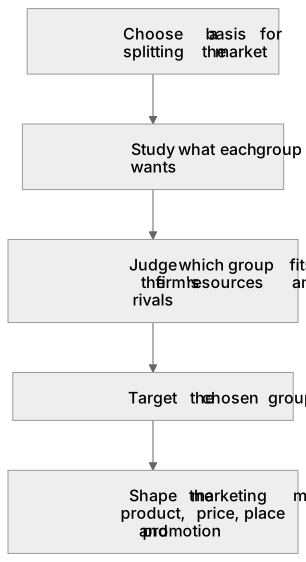
Put it in order
Put these steps in the order they happen.
- 1. Study what each group wants
- 2. Judge which group fits the firm's resources and rivals
- 3. Choose a basis for splitting the market
- 4. Shape the marketing mix: product, price, place and promotion
- 5. Target the chosen group
Key words
Say what each word means before you turn the card.
Segmentation
Try answering aloud or in your head before turning the card.
Targeting customers
Try answering aloud or in your head before turning the card.
Marketing mix
Try answering aloud or in your head before turning the card.
Customer needs and wants
Try answering aloud or in your head before turning the card.
See every definition
- Segmentation
- Dividing a whole market into smaller groups of buyers who share similar characteristics or needs.
- Targeting customers
- Choosing which group to serve so that marketing focuses on a chosen group rather than the whole market.
- Marketing mix
- Product, price, place and promotion, which can be shaped around one group rather than aimed vaguely at everyone.
- Customer needs and wants
- What each group wants, which a business studies after choosing a basis for splitting the market.
Label the diagram
Some boxes have lost their names. Pick the right name for each number.
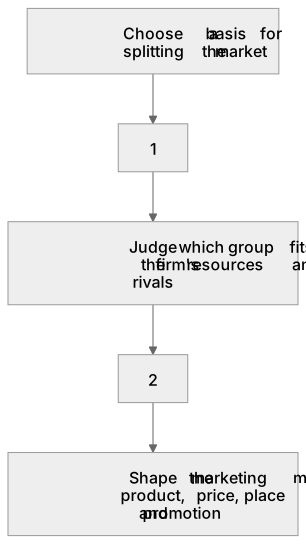
1Box 1
2Box 2
There is more to this lesson
The full lesson goes on to check your understanding and help you earn the marks. Create a free account to carry on, with your progress saved.
A week of Premium from your first lesson · Then the free plan continues · No card, no charge
Test your understanding of Segmentation: Types of segmentation Students should understand how and why different businesses use segmentation to target customers, including:
Active recall beats re-reading. Take an instant quiz now to test what you’ve learned and lock it into long-term memory.
A week of Premium from your first lesson · Then the free plan continues · No card, no charge