AQA · GCSE · Business
Course version: 8132 · Version from Sept 2017
Sources of finance: Appropriateness of sources of finance
Full specification wording
Sources of finance: Appropriateness of sources of finance
Appropriateness means judging how well a source of finance fits a business's need.
Checked against the AQA 8132 specification (opens in a new tab) on .
- Point 2 of 5
- 4 key terms
Study notes
From the checked teaching notes for this specification point.
The idea
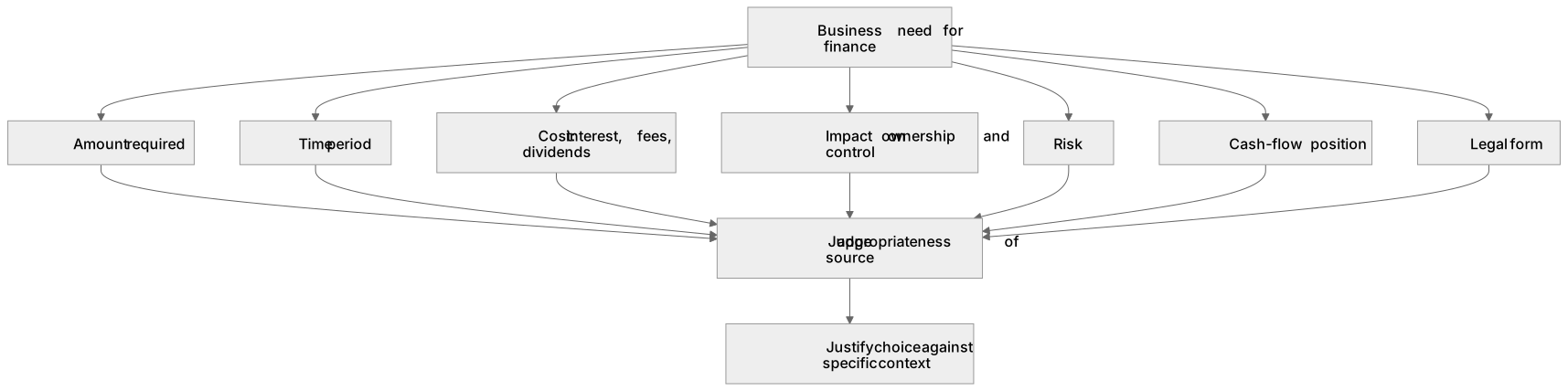
Appropriateness means judging how well a source of finance fits a business's need. Consider amount required, time period, cost (interest, fees, dividends), impact on ownership and control, risk, cash-flow position and legal form. A sole trader needing £2,000 for stock might use an overdraft; a company raising £500,000 for a factory might issue shares. Short-term needs suit overdrafts or trade credit; long-term assets suit loans, leasing or share issue. Internal funds avoid debt but may be insufficient. The best choice balances cost, control, risk and availability, and is justified against the specific context.
What earns the marks
- Applies criteria such as amount, time, cost, control and risk to a named source.
- Matches a source to a specific business need, for example trade credit for stock purchased on normal credit terms.
- Explains a drawback of a source in context, such as interest increasing costs or share issue diluting control.
- Compares two sources and reaches a supported judgement about which is more appropriate.
- Considers the legal form or size of the business when judging suitability.
Common mistakes and how to put them right
Choosing a source without linking it to the amount or time period needed.
Put it right by stating the sum and duration and matching the source.
Ignoring the cost of finance.
Put it right by explaining interest, fees or dividends and their effect on profit.
Overlooking loss of control from share issue.
Put it right by explaining that new shareholders may influence decisions.
Exam tips
- Use the data in the case to justify suitability, such as the amount, timescale or current cash position.
- Give a balanced answer with at least one advantage and one drawback before judging.
- Conclude with a clear recommendation and the main reason for it.
Try the lesson
The start of the Sources of finance: Appropriateness of sources of finance lesson, made from checked teaching notes for this specification point.
Have a go first
Which source of finance is most appropriate for a business that needs money for a few weeks to pay for raw materials?
Listen
Appropriateness means judging how well a source of finance fits a business's need. Consider amount required, time period, cost (interest, fees, dividends), impact on ownership and control, risk, cash-flow position and legal form. A sole trader needing £2,000 for stock might use an overdraft; a company raising £500,000 for a factory might issue shares. Short-term needs suit overdrafts or trade credit; long-term assets suit loans, leasing or share issue. Internal funds avoid debt but may be insufficient. The best choice balances cost, control, risk and availability, and is justified against the specific context. A strong answer earns marks for these points. Applies criteria such as amount, time, cost, control and risk to a named source. Matches a source to a specific business need, for example trade credit for stock purchased on normal credit terms. Explains a drawback of a source in context, such as interest increasing costs or share issue diluting control. Compares two sources and reaches a supported judgement about which is more appropriate. A common slip: Choosing a source without linking it to the amount or time period needed. Instead, stating the sum and duration and matching the source. Exam tip: Use the data in the case to justify suitability, such as the amount, timescale or current cash position.
See it
Key words
Say what each word means before you turn the card.
Matching finance to purpose
Try answering aloud or in your head before turning the card.
Cost versus control
Try answering aloud or in your head before turning the card.
Risk and cash-flow pressure
Try answering aloud or in your head before turning the card.
Business context and legal form
Try answering aloud or in your head before turning the card.
See every definition
- Matching finance to purpose
- Judging how well a source of finance fits a business's need by considering the amount required and the time period.
- Cost versus control
- Balancing the cost of finance, such as interest, fees or dividends, against the impact on ownership and control.
- Risk and cash-flow pressure
- Weighing risk and the cash-flow position when choosing between sources such as internal funds, which avoid debt but may be insufficient.
- Business context and legal form
- Judging suitability against the specific context, including the legal form or size of the business.
Label the diagram
Some boxes have lost their names. Pick the right name for each number.
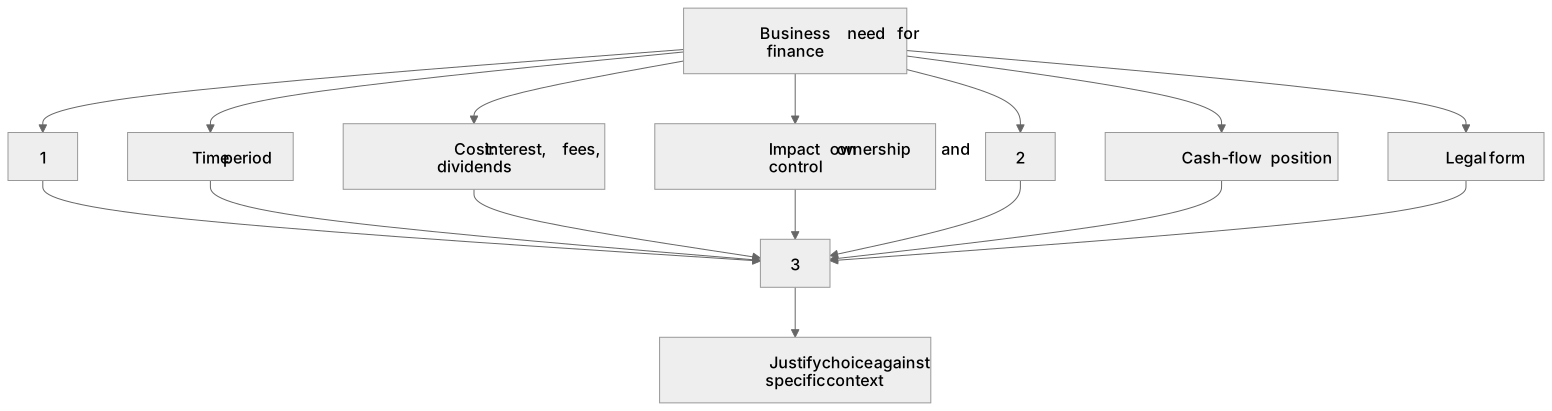
1Box 1
2Box 2
3Box 3
There is more to this lesson
The full lesson goes on to check your understanding and help you earn the marks. Create a free account to carry on, with your progress saved.
A week of Premium from your first lesson · Then the free plan continues · No card, no charge
Test your understanding of Sources of finance: Appropriateness of sources of finance
Active recall beats re-reading. Take an instant quiz now to test what you’ve learned and lock it into long-term memory.
A week of Premium from your first lesson · Then the free plan continues · No card, no charge