AQA · GCSE · Business
Course version: 8132 · Version from Sept 2017
The concept of quality: product recalls
A product recall is the process of retrieving unsafe or defective goods from customers, often coordinated with regulators.
Checked against the AQA 8132 specification (opens in a new tab) on .
- Point 12 of 13
Study notes
From the checked teaching notes for this specification point.
The idea
A product recall is the process of retrieving unsafe or defective goods from customers, often coordinated with regulators. It protects consumers, limits legal and reputational damage, and restores quality confidence. For example, a food manufacturer finding undeclared allergens in a batch would trace affected stock, notify authorities and retailers, publish a recall notice, arrange returns or disposal, and review production controls. Recalls are costly and disruptive, but delaying them can worsen harm and penalties. Effective recalls depend on batch traceability, clear communication, and corrective action to prevent recurrence.
What earns the marks
- Defines a product recall as retrieving unsafe or defective products from customers or the supply chain.
- Explains why recalls occur, such as safety defects, contamination, incorrect labelling or failure to meet legal standards.
- Describes the process: identifying affected batches, tracing distribution, notifying customers and authorities, recovering or disposing of goods, and reviewing quality controls.
- Analyses the costs of a recall, including logistics, refunds or replacements, lost sales, regulatory fines and management time.
- Evaluates the reputational effects, showing that a swift, transparent recall can preserve trust while a slow or concealed recall can damage it severely.
- Links recalls to quality assurance and quality control, showing how root-cause analysis and corrective action reduce the risk of repeat failures.
Common mistakes and how to put them right
Treating a recall as identical to a customer refund.
Put it right: A recall is a coordinated retrieval of unsafe goods, often involving regulators and multiple customers, whereas a refund is a transaction for an individual sale.
Assuming recalls only affect the business financially.
Put it right: They also affect consumer safety, brand reputation, employee morale, supplier relationships and legal compliance.
Believing that a recall automatically means the business will fail.
Put it right: A well-managed recall with clear communication and corrective action can limit damage and even strengthen trust in the long term.
Exam tips
- Use a named product or industry context to make recall effects concrete, such as food, toys or electrical goods.
- When evaluating, weigh short-term costs against long-term reputation and legal consequences rather than listing only drawbacks.
- Refer to traceability, communication and corrective action as practical steps that show understanding of how recalls are managed.
Try the lesson
The start of the The concept of quality: product recalls lesson, made from checked teaching notes for this specification point.
Have a go first
A toy manufacturer discovers that a batch of its building blocks has small parts that could break off and be swallowed by young children. What is the primary reason the business would carry out a product recall of this batch?
Listen
A product recall is the process of retrieving unsafe or defective goods from customers, often coordinated with regulators. It protects consumers, limits legal and reputational damage, and restores quality confidence. For example, a food manufacturer finding undeclared allergens in a batch would trace affected stock, notify authorities and retailers, publish a recall notice, arrange returns or disposal, and review production controls. Recalls are costly and disruptive, but delaying them can worsen harm and penalties. Effective recalls depend on batch traceability, clear communication, and corrective action to prevent recurrence. A strong answer earns marks for these points. Defines a product recall as retrieving unsafe or defective products from customers or the supply chain. Explains why recalls occur, such as safety defects, contamination, incorrect labelling or failure to meet legal standards. Describes the process: identifying affected batches, tracing distribution, notifying customers and authorities, recovering or disposing of goods, and reviewing quality controls. Analyses the costs of a recall, including logistics, refunds or replacements, lost sales, regulatory fines and management time. A common slip: Treating a recall as identical to a customer refund. Instead, a recall is a coordinated retrieval of unsafe goods, often involving regulators and multiple customers, whereas a refund is a transaction for an individual sale. Exam tip: Use a named product or industry context to make recall effects concrete, such as food, toys or electrical goods.
See it
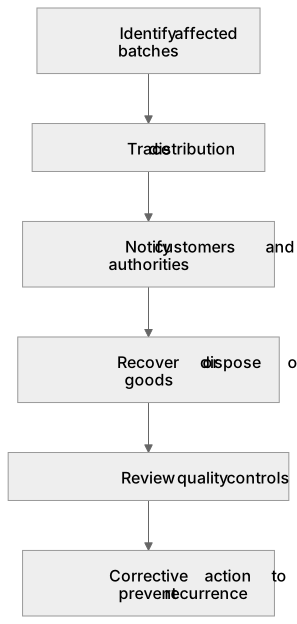
Put it in order
Put these steps in the order they happen.
- 1. Notify customers and authorities
- 2. Trace distribution
- 3. Identify affected batches
- 4. Corrective action to prevent recurrence
- 5. Review quality controls
- 6. Recover or dispose of goods
Label the diagram
Some boxes have lost their names. Pick the right name for each number.
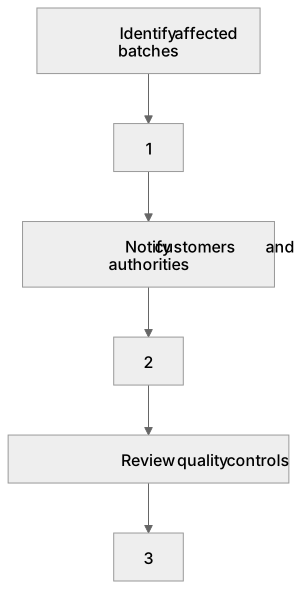
1Box 1
2Box 2
3Box 3
There is more to this lesson
The full lesson goes on to check your understanding and help you earn the marks. Create a free account to carry on, with your progress saved.
A week of Premium from your first lesson · Then the free plan continues · No card, no charge
Test your understanding of The concept of quality: product recalls
Active recall beats re-reading. Take an instant quiz now to test what you’ve learned and lock it into long-term memory.
A week of Premium from your first lesson · Then the free plan continues · No card, no charge