AQA · GCSE · Business
Course version: 8132 · Version from Sept 2017
The concept of quality: staff training
Staff training is the process of developing employees' skills, knowledge and attitudes so they can perform their roles to the required quality standard.
Checked against the AQA 8132 specification (opens in a new tab) on .
- Point 11 of 13
- 3 key terms
Study notes
From the checked teaching notes for this specification point.
The idea
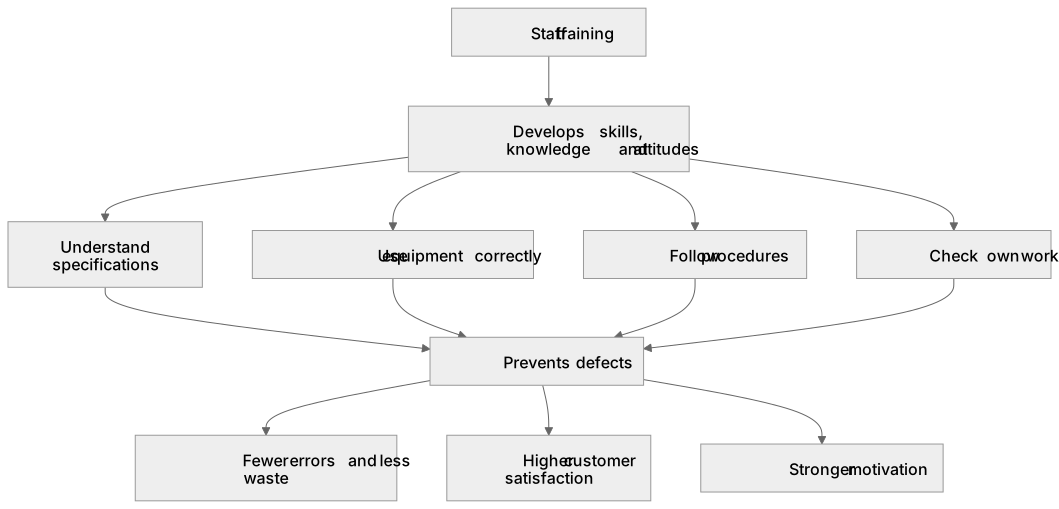
Staff training is the process of developing employees' skills, knowledge and attitudes so they can perform their roles to the required quality standard. In a quality context, training helps workers understand specifications, use equipment correctly, follow procedures and take responsibility for checking their own work. For example, a bakery might train staff in hygiene rules, weighing ingredients accurately and recognising undercooked products. Training can be induction for new staff, on-the-job coaching, or off-the-job courses. It is a prevention cost because it aims to stop defects occurring rather than finding them later. Benefits include fewer errors, less waste, higher customer satisfaction and stronger motivation, but training takes time and money and may not guarantee quality if systems or materials are poor.
What earns the marks
- Defines staff training as developing employees' skills, knowledge and attitudes to meet quality requirements.
- Gives examples such as induction, on-the-job coaching, off-the-job courses and refresher training.
- Explains how training prevents defects by improving how work is carried out, rather than detecting faults afterwards.
- Links training to quality outcomes such as fewer errors, less waste, better customer service and improved motivation.
- Recognises limitations, including cost, time away from work, and the fact that training alone cannot overcome poor systems or materials.
Common mistakes and how to put them right
Treating training as a one-off event.
Put it right by explaining that training is ongoing.
Assuming training always eliminates defects.
Put it right by stating that training is necessary but not sufficient.
Confusing training with inspection.
Put it right by distinguishing prevention from detection.
Exam tips
- Use a specific business example to show what staff are trained to do and why it matters for quality.
- Develop the chain: training improves skill, which reduces errors, which raises quality and customer satisfaction.
- For evaluation, compare the cost and disruption of training with the longer-term savings from fewer defects and returns.
Try the lesson
The start of the The concept of quality: staff training lesson, made from checked teaching notes for this specification point.
Have a go first
How can staff training help a business to improve the quality of its products?
Listen
Staff training is the process of developing employees' skills, knowledge and attitudes so they can perform their roles to the required quality standard. In a quality context, training helps workers understand specifications, use equipment correctly, follow procedures and take responsibility for checking their own work. For example, a bakery might train staff in hygiene rules, weighing ingredients accurately and recognising undercooked products. Training can be induction for new staff, on-the-job coaching, or off-the-job courses. It is a prevention cost because it aims to stop defects occurring rather than finding them later. Benefits include fewer errors, less waste, higher customer satisfaction and stronger motivation, but training takes time and money and may not guarantee quality if systems or materials are poor. A strong answer earns marks for these points. Defines staff training as developing employees' skills, knowledge and attitudes to meet quality requirements. Gives examples such as induction, on-the-job coaching, off-the-job courses and refresher training. Explains how training prevents defects by improving how work is carried out, rather than detecting faults afterwards. Links training to quality outcomes such as fewer errors, less waste, better customer service and improved motivation. A common slip: Treating training as a one-off event: quality requires refresher and update training as standards, equipment and staff change. Instead, explaining that training is ongoing. Exam tip: Use a specific business example to show what staff are trained to do and why it matters for quality.
See it
Key words
Say what each word means before you turn the card.
Staff training
Try answering aloud or in your head before turning the card.
Prevention versus detection
Try answering aloud or in your head before turning the card.
Costs and benefits
Try answering aloud or in your head before turning the card.
See every definition
- Staff training
- The process of developing employees' skills, knowledge and attitudes so they can perform their roles to the required quality standard.
- Prevention versus detection
- Training is a prevention cost because it aims to stop defects occurring rather than finding them later.
- Costs and benefits
- Benefits include fewer errors, less waste, higher customer satisfaction and stronger motivation, but training takes time and money and may not guarantee quality if systems or materials are poor.
Label the diagram
Some boxes have lost their names. Pick the right name for each number.
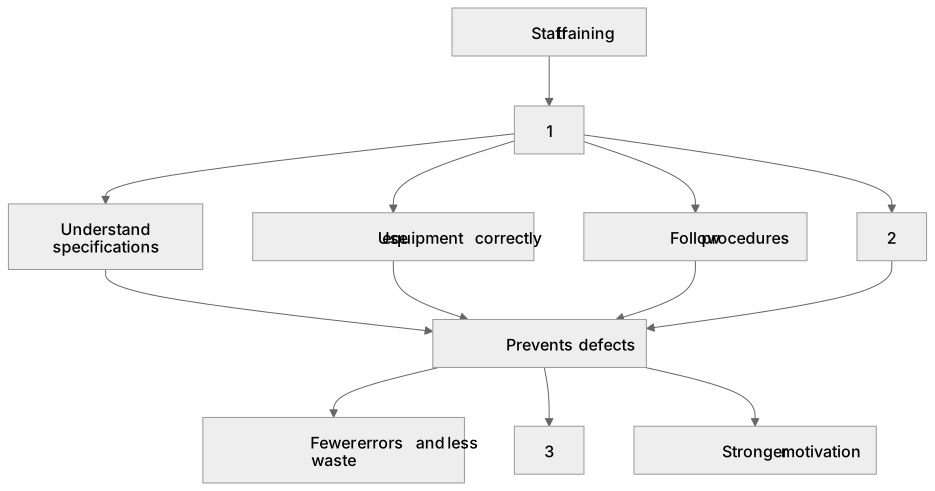
1Box 1
2Box 2
3Box 3
There is more to this lesson
The full lesson goes on to check your understanding and help you earn the marks. Create a free account to carry on, with your progress saved.
A week of Premium from your first lesson · Then the free plan continues · No card, no charge
Test your understanding of The concept of quality: staff training
Active recall beats re-reading. Take an instant quiz now to test what you’ve learned and lock it into long-term memory.
A week of Premium from your first lesson · Then the free plan continues · No card, no charge