AQA · GCSE · Business
Course version: 8132 · Version from Sept 2017
Price, product, promotion and place (4Ps): The product life cycle:
Full specification wording
The elements of the marketing mix: price, product, promotion and place (4Ps): The product life cycle:
The product life cycle is a model showing how demand for a product or service changes over time.
Checked against the AQA 8132 specification (opens in a new tab) on .
- Point 21 of 80
- 4 key terms
Study notes
From the checked teaching notes for this specification point.
The idea
The product life cycle is a model showing how demand for a product or service changes over time. It has four main stages: introduction, growth, maturity and decline. In introduction, sales are low and costs high, so profit may be negative. In growth, sales rise quickly as customers adopt the product. In maturity, sales peak and competition increases, so businesses may use extension strategies such as product updates or new markets. In decline, sales fall as tastes change or substitutes appear. The model helps businesses decide on pricing, promotion and product changes at each stage.
For example: A new smartphone may be priced high initially, then lowered as it matures.
What earns the marks
- Identifies the four stages of the product life cycle: introduction, growth, maturity and decline.
- Explains how sales and demand change at each stage, from low initial sales to peak maturity and eventual fall.
- Describes how costs and profit may vary across the cycle, such as high development costs at introduction and higher profits at growth or maturity.
- Applies the model to a given product or service, showing how demand might change over time and how the business could respond.
- Evaluates the usefulness of the product life cycle for marketing decisions, including limitations such as not all products follow the same pattern.
Common mistakes and how to put them right
Confusing the growth stage with the maturity stage.
Put it right: Growth is when sales are rising quickly, while maturity is when sales peak and then level off.
Assuming all products pass through every stage in the same way.
Put it right: Some products may fail at introduction or stay in maturity for a long time due to extension strategies.
Thinking that decline means the product is immediately withdrawn.
Put it right: Businesses may continue to sell a declining product to loyal customers or in niche markets.
Forgetting that the product life cycle shows demand over time, not just sales revenue.
Put it right: Demand can change due to fashion, technology or competitor actions.
Exam tips
- When asked to explain the product life cycle, always name and describe each stage in order, using a specific product example to show how demand changes.
- Use connectives such as 'therefore' or 'this leads to' to link each stage to a change in demand or marketing mix decision.
- If a question asks how demand might change over time, refer to the shape of the curve and give reasons for the changes, such as increased competition or changing tastes.
- For higher marks, consider limitations of the model, such as products that are relaunched or that have very short life cycles.
Try the lesson
The start of the The elements of the marketing mix: price, product, promotion and place (4Ps): The product life cycle: lesson, made from checked teaching notes for this specification point.
Have a go first
A product life cycle model shows the sales of a product over time. Which stage of the product life cycle is shown by the point at which sales are at their highest?
Listen
The product life cycle is a model showing how demand for a product or service changes over time. It has four main stages: introduction, growth, maturity and decline. In introduction, sales are low and costs high, so profit may be negative. In growth, sales rise quickly as customers adopt the product. In maturity, sales peak and competition increases, so businesses may use extension strategies such as product updates or new markets. In decline, sales fall as tastes change or substitutes appear. The model helps businesses decide on pricing, promotion and product changes at each stage. For example, a new smartphone may be priced high initially, then lowered as it matures. A strong answer earns marks for these points. Identifies the four stages of the product life cycle: introduction, growth, maturity and decline. Explains how sales and demand change at each stage, from low initial sales to peak maturity and eventual fall. Describes how costs and profit may vary across the cycle, such as high development costs at introduction and higher profits at growth or maturity. Applies the model to a given product or service, showing how demand might change over time and how the business could respond. Exam tip: When asked to explain the product life cycle, always name and describe each stage in order, using a specific product example to show how demand changes.
See it
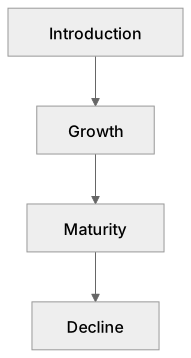
Put it in order
Put these steps in the order they happen.
- 1. Maturity
- 2. Decline
- 3. Growth
- 4. Introduction
Key words
Say what each word means before you turn the card.
Stages of the product life cycle
Try answering aloud or in your head before turning the card.
Changes in demand over time
Try answering aloud or in your head before turning the card.
Marketing mix decisions at each stage
Try answering aloud or in your head before turning the card.
Extension strategies and product decline
Try answering aloud or in your head before turning the card.
See every definition
- Stages of the product life cycle
- The model has four main stages: introduction, growth, maturity and decline.
- Changes in demand over time
- Demand for a product or service changes over time, from low initial sales to peak maturity and eventual fall.
- Marketing mix decisions at each stage
- The model helps businesses decide on pricing, promotion and product changes at each stage.
- Extension strategies and product decline
- In maturity, businesses may use extension strategies such as product updates or new markets; in decline, sales fall as tastes change or substitutes appear.
Label the diagram
Some boxes have lost their names. Pick the right name for each number.
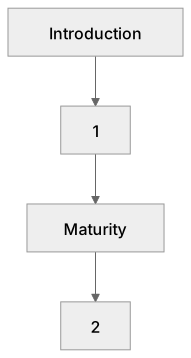
1Box 1
2Box 2
There is more to this lesson
The full lesson goes on to check your understanding and help you earn the marks. Create a free account to carry on, with your progress saved.
A week of Premium from your first lesson · Then the free plan continues · No card, no charge
Test your understanding of The elements of the marketing mix: price, product, promotion and place (4Ps): The product life cycle:
Active recall beats re-reading. Take an instant quiz now to test what you’ve learned and lock it into long-term memory.
A week of Premium from your first lesson · Then the free plan continues · No card, no charge