AQA · GCSE · Business
Course version: 8132 · Version from Sept 2017
The purpose and nature of businesses: Dynamic nature of business
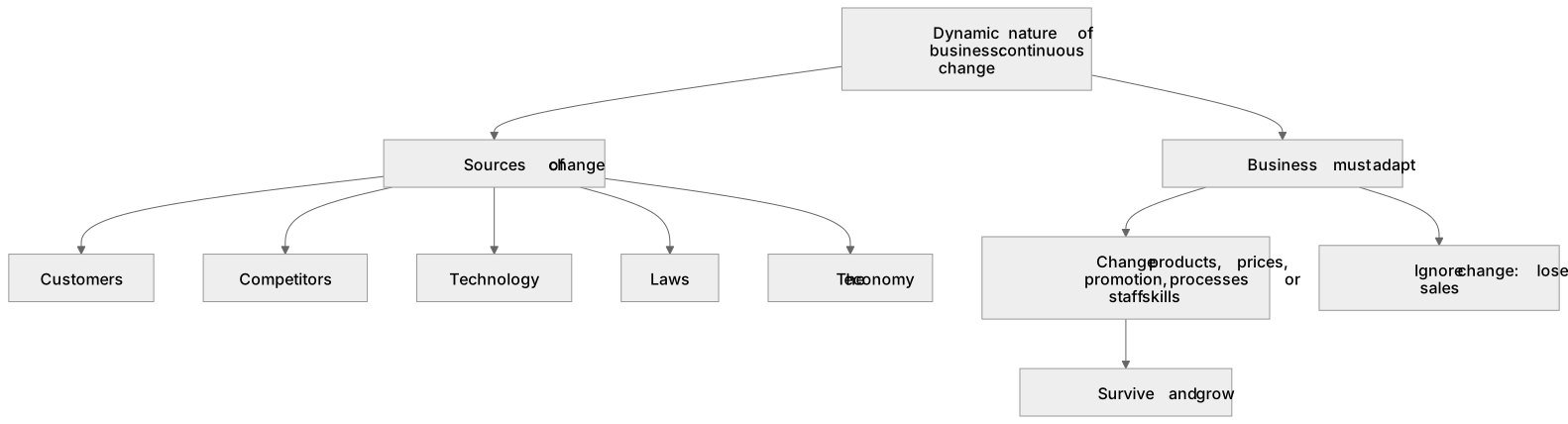
The dynamic nature of business means that businesses operate in a constantly changing environment, so they must adapt to survive and grow.
Checked against the AQA 8132 specification (opens in a new tab) on .
- Point 5 of 14
- 4 key terms
Study notes
From the checked teaching notes for this specification point.
The idea
The dynamic nature of business means that businesses operate in a constantly changing environment, so they must adapt to survive and grow. Change comes from customers, competitors, technology, laws and the economy. A business that ignores change can lose sales; one that responds can gain an advantage. For example, a shop facing falling footfall might launch an online store, while a manufacturer may switch to recyclable packaging as customer attitudes shift. Dynamism also means new products, new markets and new ways of working appear over time, so owners review their plans regularly. Adapting may mean changing products, prices, promotion, processes or the skills of staff. The pace of change varies by market, but no business is fully static. Understanding this helps students explain why business decisions are rarely final and why flexibility matters.
What earns the marks
- Defines the dynamic nature of business as continuous change in the business environment rather than a one-off event.
- Identifies sources of change such as customer tastes, competitor actions, technology, legislation and economic conditions.
- Explains that businesses must adapt their products, prices, promotion, processes or staff skills to remain competitive.
- Uses a concrete example, such as a retailer adding online sales or a manufacturer changing packaging, to show adaptation.
- Links adaptation to survival, growth or competitive advantage, and notes that failing to adapt risks lost sales or closure.
Common mistakes and how to put them right
Treating dynamism as a single change event.
Put it right: Describe it as ongoing and continuous.
Assuming all businesses face identical change.
Put it right: Recognise that the pace and type of change vary by market.
Listing changes without explaining a business response.
Put it right: Connect each change to a specific adaptation.
Exam tips
- Use the word dynamic to signal continuous change, then give one named source and one business response.
- Apply your point to a real or invented business so the explanation is concrete rather than abstract.
- Check that each paragraph answers how the business adapts, not just what changed.
Try the lesson
The start of the The purpose and nature of businesses: Dynamic nature of business lesson, made from checked teaching notes for this specification point.
Have a go first
Which term describes the way businesses must change and adapt over time as customer tastes, technology and competitors alter?
Listen
The dynamic nature of business means that businesses operate in a constantly changing environment, so they must adapt to survive and grow. Change comes from customers, competitors, technology, laws and the economy. A business that ignores change can lose sales; one that responds can gain an advantage. For example, a shop facing falling footfall might launch an online store, while a manufacturer may switch to recyclable packaging as customer attitudes shift. Dynamism also means new products, new markets and new ways of working appear over time, so owners review their plans regularly. Adapting may mean changing products, prices, promotion, processes or the skills of staff. The pace of change varies by market, but no business is fully static. Understanding this helps students explain why business decisions are rarely final and why flexibility matters. A strong answer earns marks for these points. Defines the dynamic nature of business as continuous change in the business environment rather than a one-off event. Identifies sources of change such as customer tastes, competitor actions, technology, legislation and economic conditions. Explains that businesses must adapt their products, prices, promotion, processes or staff skills to remain competitive. Uses a concrete example, such as a retailer adding online sales or a manufacturer changing packaging, to show adaptation. A common slip: Treating dynamism as a single change event. Instead, describe it as ongoing and continuous. Exam tip: Use the word dynamic to signal continuous change, then give one named source and one business response.
See it
Key words
Say what each word means before you turn the card.
Change and adaptation
Try answering aloud or in your head before turning the card.
Competitive environment
Try answering aloud or in your head before turning the card.
Customer and market shifts
Try answering aloud or in your head before turning the card.
Business survival and growth
Try answering aloud or in your head before turning the card.
See every definition
- Change and adaptation
- Businesses operate in a constantly changing environment, so they must adapt to survive and grow.
- Competitive environment
- Change comes from customers, competitors, technology, laws and the economy, and a business that ignores change can lose sales.
- Customer and market shifts
- New products, new markets and new ways of working appear over time as customer attitudes shift, so owners review their plans regularly.
- Business survival and growth
- Adapting may mean changing products, prices, promotion, processes or the skills of staff, and one that responds can gain an advantage.
Label the diagram
Some boxes have lost their names. Pick the right name for each number.
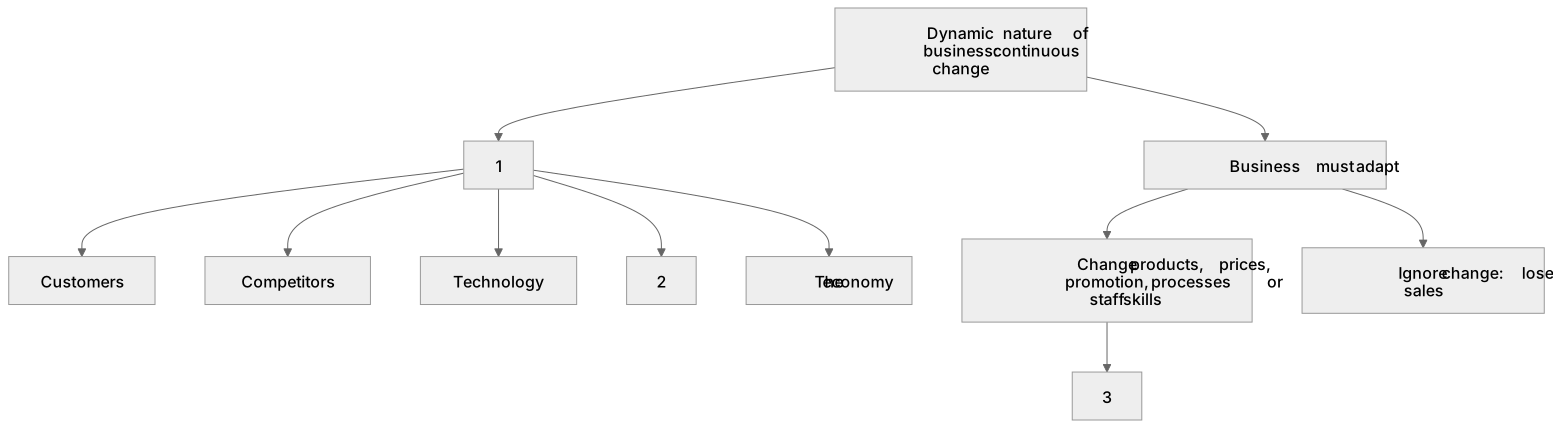
1Box 1
2Box 2
3Box 3
There is more to this lesson
The full lesson goes on to check your understanding and help you earn the marks. Create a free account to carry on, with your progress saved.
A week of Premium from your first lesson · Then the free plan continues · No card, no charge
Test your understanding of The purpose and nature of businesses: Dynamic nature of business
Active recall beats re-reading. Take an instant quiz now to test what you’ve learned and lock it into long-term memory.
A week of Premium from your first lesson · Then the free plan continues · No card, no charge