AQA · GCSE · Business
Course version: 8132 · Version from Sept 2017
Understand the meaning of factors of production – land, labour, capital,…
Full specification wording
The purpose and nature of businesses: understand the meaning of factors of production – land, labour, capital, enterprise
Factors of production are the resources a business combines to produce goods or services.
Checked against the AQA 8132 specification (opens in a new tab) on .
- Point 8 of 14
- 4 key terms
Study notes
From the checked teaching notes for this specification point.
The idea
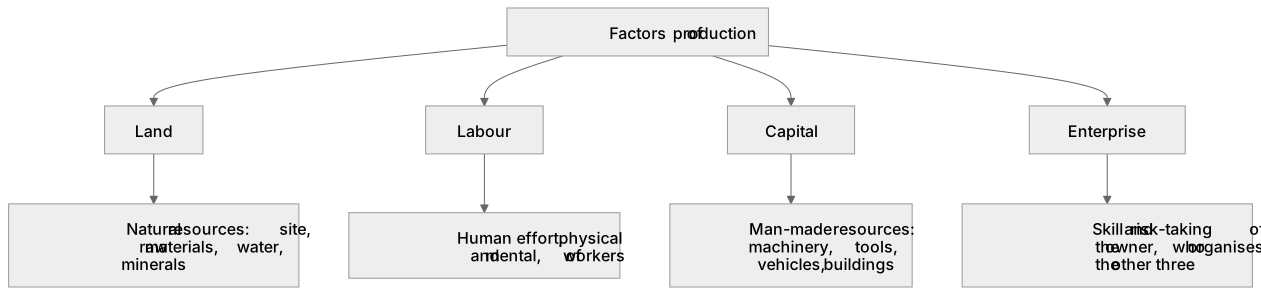
Factors of production are the resources a business combines to produce goods or services. Land covers all natural resources, including the physical site, raw materials, water and minerals. Labour is the human effort, physical and mental, provided by workers. Capital means the man-made resources used in production, such as machinery, tools, vehicles, buildings and money invested in the business. Enterprise is the skill and risk-taking of the owner or entrepreneur who organises the other three factors and decides what to produce. A bakery illustrates this: land provides the site and flour, labour is the baker, capital is the oven and delivery van, and enterprise is the owner who sets up the business and accepts the risk of loss.
What earns the marks
- Names all four factors of production: land, labour, capital and enterprise.
- Defines land as natural resources, including the site, raw materials, water and minerals, not just the ground itself.
- Defines labour as the human effort, both physical and mental, contributed by employees.
- Defines capital as man-made resources used in production, such as machinery, tools, vehicles and buildings, and distinguishes it from money in everyday use.
- Defines enterprise as the skill, initiative and risk-taking of the owner or entrepreneur who organises the other factors.
- Applies all four factors correctly to a given business example, such as a bakery or a car factory.
Common mistakes and how to put them right
Confusing capital with money in the everyday sense.
Put it right by defining capital as man-made resources used in production, such as machinery and tools.
Restricting land to the ground or site only.
Put it right by including all natural resources, such as raw materials, water and minerals.
Treating enterprise as just another word for a business.
Put it right by defining it as the skill, initiative and risk-taking of the entrepreneur who organises the other factors.
Exam tips
- Learn a single business example, such as a bakery, and practise naming all four factors within it to prepare for application questions.
- When asked to identify a factor, name it and add one sentence explaining its role in production to secure the mark.
- In longer answers, link each factor to how it helps the business produce output, rather than listing the four terms alone.
Try the lesson
The start of the The purpose and nature of businesses: understand the meaning of factors of production – land, labour, capital, enterprise lesson, made from checked teaching notes for this specification point.
Have a go first
Which factor of production is represented by the natural resources, such as land and raw materials, used by a business?
Listen
Factors of production are the resources a business combines to produce goods or services. Land covers all natural resources, including the physical site, raw materials, water and minerals. Labour is the human effort, physical and mental, provided by workers. Capital means the man-made resources used in production, such as machinery, tools, vehicles, buildings and money invested in the business. Enterprise is the skill and risk-taking of the owner or entrepreneur who organises the other three factors and decides what to produce. A bakery illustrates this: land provides the site and flour, labour is the baker, capital is the oven and delivery van, and enterprise is the owner who sets up the business and accepts the risk of loss. A strong answer earns marks for these points. Names all four factors of production: land, labour, capital and enterprise. Defines land as natural resources, including the site, raw materials, water and minerals, not just the ground itself. Defines labour as the human effort, both physical and mental, contributed by employees. Defines capital as man-made resources used in production, such as machinery, tools, vehicles and buildings, and distinguishes it from money in everyday use. A common slip: Confusing capital with money in the everyday sense. Instead, defining capital as man-made resources used in production, such as machinery and tools. Exam tip: Learn a single business example, such as a bakery, and practise naming all four factors within it to prepare for application questions.
See it
Key words
Say what each word means before you turn the card.
Land
Try answering aloud or in your head before turning the card.
Labour
Try answering aloud or in your head before turning the card.
Capital
Try answering aloud or in your head before turning the card.
Enterprise
Try answering aloud or in your head before turning the card.
See every definition
- Land
- All natural resources, including the physical site, raw materials, water and minerals, not just the ground itself.
- Labour
- The human effort, both physical and mental, provided by workers.
- Capital
- The man-made resources used in production, such as machinery, tools, vehicles, buildings and money invested in the business.
- Enterprise
- The skill and risk-taking of the owner or entrepreneur who organises the other three factors and decides what to produce.
Label the diagram
Some boxes have lost their names. Pick the right name for each number.
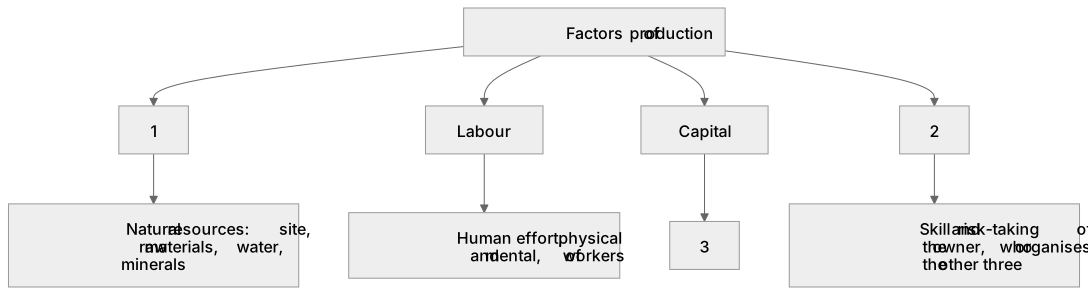
1Box 1
2Box 2
3Box 3
There is more to this lesson
The full lesson goes on to check your understanding and help you earn the marks. Create a free account to carry on, with your progress saved.
A week of Premium from your first lesson · Then the free plan continues · No card, no charge
Test your understanding of The purpose and nature of businesses: understand the meaning of factors of production – land, labour, capital, enterprise
Active recall beats re-reading. Take an instant quiz now to test what you’ve learned and lock it into long-term memory.
A week of Premium from your first lesson · Then the free plan continues · No card, no charge