AQA · GCSE · Business
Course version: 8132 · Version from Sept 2017
The role of procurement: price
Price in procurement is the amount a business pays a supplier for each unit of a resource, such as raw materials, components or finished stock.
Checked against the AQA 8132 specification (opens in a new tab) on .
- Point 9 of 21
- 4 key terms
Study notes
From the checked teaching notes for this specification point.
The idea
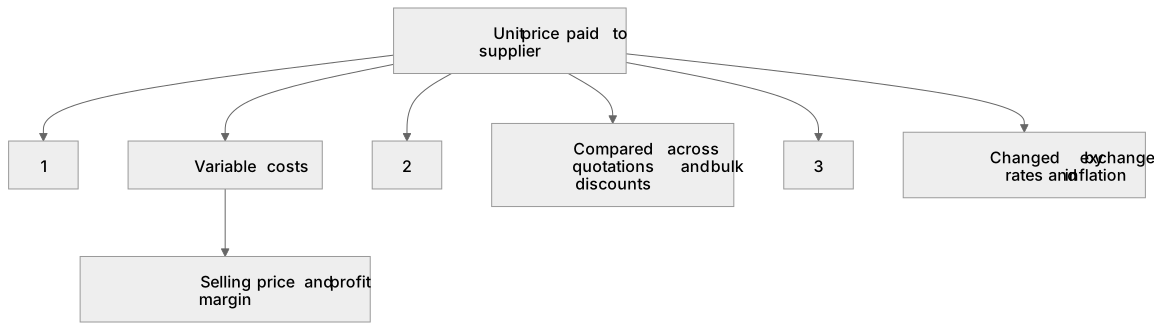
Price in procurement is the amount a business pays a supplier for each unit of a resource, such as raw materials, components or finished stock. It directly affects unit cost and therefore the price a business can charge and its profit margin. For example, if a supplier charges £4 per component and a business needs 10,000 components, the total purchase cost is £40,000. A lower price per unit reduces variable costs, allowing either lower selling prices to compete or higher margins. However, price must be balanced against quality, reliability and delivery, because the cheapest supplier may cause production delays or returns. Procurement managers compare quotations, negotiate discounts for bulk orders and consider total cost of ownership, not just the headline price. Exchange rates and inflation can also change the price of imported materials over time.
What earns the marks
- Defines price as the amount paid per unit of a procured resource, distinguishing it from total purchase cost.
- Explains how a lower purchase price reduces variable costs and can improve profit margins or allow competitive pricing.
- Calculates total purchase cost by multiplying unit price by quantity, for example £4 × 10,000 = £40,000.
- Analyses the trade-off between low price and other procurement factors such as quality, reliability and delivery time.
- Evaluates how external factors such as exchange rates or inflation can change the price of imported resources.
- Applies price to a business context, showing how procurement decisions affect unit cost and competitiveness.
Common mistakes and how to put them right
Confusing price with total cost.
Put it right: Multiply unit price by quantity to find total purchase cost.
Assuming the lowest price is always best.
Put it right: Consider total cost of ownership and operational impact.
Forgetting that price can change over time.
Put it right: Recognise that exchange rates, inflation and supplier negotiations can alter price.
Exam tips
- When calculating, show the unit price, quantity and multiplication clearly so the method is visible.
- Use a specific business example, such as a car manufacturer buying steel, to make the price effect concrete.
- In evaluation questions, weigh price against quality and reliability before recommending a supplier.
Try the lesson
The start of the The role of procurement: price lesson, made from checked teaching notes for this specification point.
Have a go first
In the role of procurement, what does the term price mean when a business chooses a supplier?
Listen
Price in procurement is the amount a business pays a supplier for each unit of a resource, such as raw materials, components or finished stock. It directly affects unit cost and therefore the price a business can charge and its profit margin. For example, if a supplier charges £4 per component and a business needs 10,000 components, the total purchase cost is £40,000. A lower price per unit reduces variable costs, allowing either lower selling prices to compete or higher margins. However, price must be balanced against quality, reliability and delivery, because the cheapest supplier may cause production delays or returns. Procurement managers compare quotations, negotiate discounts for bulk orders and consider total cost of ownership, not just the headline price. Exchange rates and inflation can also change the price of imported materials over time. A strong answer earns marks for these points. Defines price as the amount paid per unit of a procured resource, distinguishing it from total purchase cost. Explains how a lower purchase price reduces variable costs and can improve profit margins or allow competitive pricing. Calculates total purchase cost by multiplying unit price by quantity, for example £4 × 10,000 = £40,000. Analyses the trade-off between low price and other procurement factors such as quality, reliability and delivery time. A common slip: Confusing price with total cost: the error is treating the unit price as the total amount paid. Instead, multiply unit price by quantity to find total purchase cost. Exam tip: When calculating, show the unit price, quantity and multiplication clearly so the method is visible.
See it

Key words
Say what each word means before you turn the card.
Price
Try answering aloud or in your head before turning the card.
Total cost of ownership
Try answering aloud or in your head before turning the card.
Profit margin
Try answering aloud or in your head before turning the card.
Supplier selection
Try answering aloud or in your head before turning the card.
See every definition
- Price
- The amount a business pays a supplier for each unit of a resource, such as raw materials, components or finished stock.
- Total cost of ownership
- A consideration in procurement that looks beyond the headline price, balancing price against quality, reliability and delivery.
- Profit margin
- Something directly affected by price, because price affects unit cost and therefore the price a business can charge.
- Supplier selection
- Choosing a supplier by comparing quotations, negotiating discounts for bulk orders and weighing price against quality, reliability and delivery.
Label the diagram
Some boxes have lost their names. Pick the right name for each number.
1Box 1
2Box 2
3Box 3
There is more to this lesson
The full lesson goes on to check your understanding and help you earn the marks. Create a free account to carry on, with your progress saved.
A week of Premium from your first lesson · Then the free plan continues · No card, no charge
Test your understanding of The role of procurement: price
Active recall beats re-reading. Take an instant quiz now to test what you’ve learned and lock it into long-term memory.
A week of Premium from your first lesson · Then the free plan continues · No card, no charge