AQA · GCSE · Business
Course version: 8132 · Version from Sept 2017
Students should be able to analyse the factors that affect the choice of…
Full specification wording
The role of procurement: Students should be able to analyse the factors that affect the choice of supplier for a given business.
Analysis means breaking the choice of supplier into factors and showing how each affects the given business.
Checked against the AQA 8132 specification (opens in a new tab) on .
- Point 8 of 21
- 4 key terms
Study notes
From the checked teaching notes for this specification point.
The idea
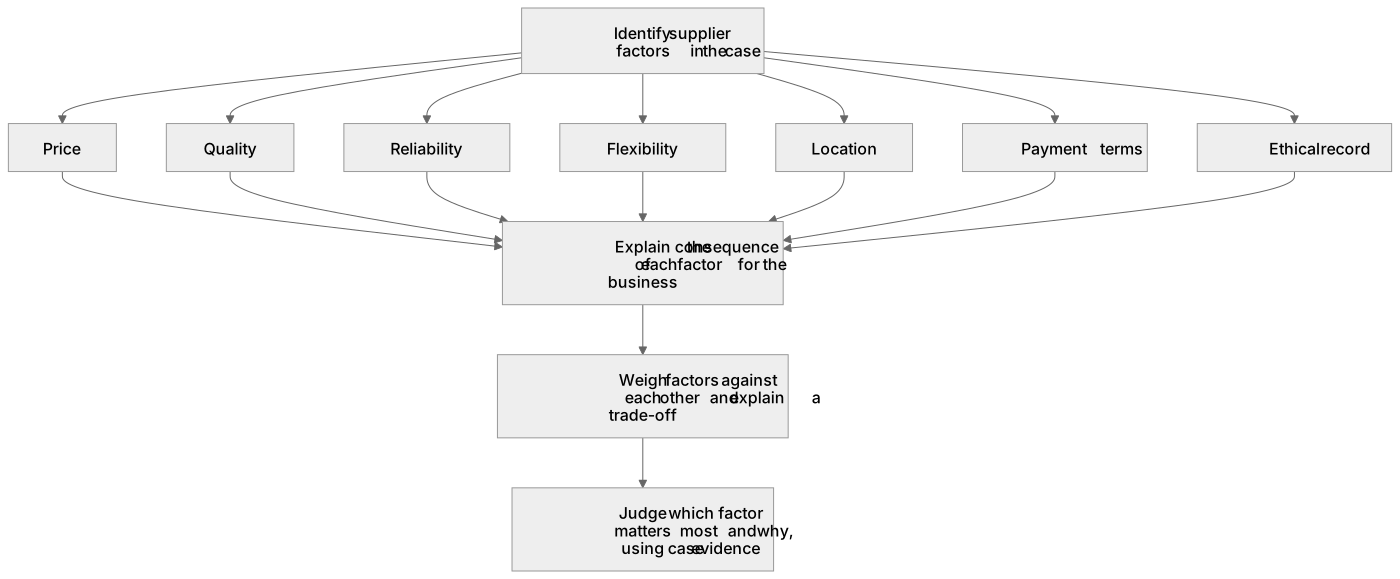
Analysis means breaking the choice of supplier into factors and showing how each affects the given business. Start by identifying the factors in the case, such as price, quality, reliability, flexibility, location, payment terms and ethical record. Then explain the consequence of each for that business. For example, a hotel choosing a laundry supplier may accept a higher price for daily collection, because dirty linen loses bookings. Weigh factors against each other: low price may mean slower delivery, raising stockholding costs. Consider the business's own context, such as whether it competes on speed, quality or price. Finally, judge which factor matters most and why, using evidence from the case.
What earns the marks
- Selects factors relevant to the business in the case rather than listing all possible factors.
- Explains the consequence of a factor, for example poor reliability causes lost output and late customer orders.
- Uses context from the case, such as the business's product, market or production method.
- Compares factors and explains a trade-off, for example lower price against slower or less flexible delivery.
- Reaches a justified conclusion about the most important factor for that business.
Common mistakes and how to put them right
Describing factors generally without applying them to the named business.
Put it right by using the case details in each point.
Giving a conclusion with no reasoning.
Put it right by stating why that factor outweighs the others for this business.
Confusing analysis with a long list.
Put it right by developing fewer factors in depth with consequences.
Exam tips
- Underline the business context in the case before planning your answer.
- Structure each paragraph as factor, effect on the business, and why it matters.
- Use the final paragraph to compare factors and justify your overall choice.
Try the lesson
The start of the The role of procurement: Students should be able to analyse the factors that affect the choice of supplier for a given business. lesson, made from checked teaching notes for this specification point.
Have a go first
Which factor means a supplier allows a business to pay for goods several weeks after delivery?
Listen
Analysis means breaking the choice of supplier into factors and showing how each affects the given business. Start by identifying the factors in the case, such as price, quality, reliability, flexibility, location, payment terms and ethical record. Then explain the consequence of each for that business. For example, a hotel choosing a laundry supplier may accept a higher price for daily collection, because dirty linen loses bookings. Weigh factors against each other: low price may mean slower delivery, raising stockholding costs. Consider the business's own context, such as whether it competes on speed, quality or price. Finally, judge which factor matters most and why, using evidence from the case. A strong answer earns marks for these points. Selects factors relevant to the business in the case rather than listing all possible factors. Explains the consequence of a factor, for example poor reliability causes lost output and late customer orders. Uses context from the case, such as the business's product, market or production method. Compares factors and explains a trade-off, for example lower price against slower or less flexible delivery. A common slip: Describing factors generally without applying them to the named business. Instead, using the case details in each point. Exam tip: Underline the business context in the case before planning your answer.
See it
Key words
Say what each word means before you turn the card.
Analysing supplier choice in context
Try answering aloud or in your head before turning the card.
Consequences for operations and costs
Try answering aloud or in your head before turning the card.
Trade-offs between supplier factors
Try answering aloud or in your head before turning the card.
Evidence-based judgement
Try answering aloud or in your head before turning the card.
See every definition
- Analysing supplier choice in context
- Breaking the choice of supplier into factors and showing how each affects the given business, using context from the case.
- Consequences for operations and costs
- Explaining the effect of each factor for that business, for example poor reliability causes lost output and late customer orders.
- Trade-offs between supplier factors
- Weighing factors against each other, for example low price may mean slower delivery, raising stockholding costs.
- Evidence-based judgement
- Judging which factor matters most and why, using evidence from the case to reach a justified conclusion.
Label the diagram
Some boxes have lost their names. Pick the right name for each number.
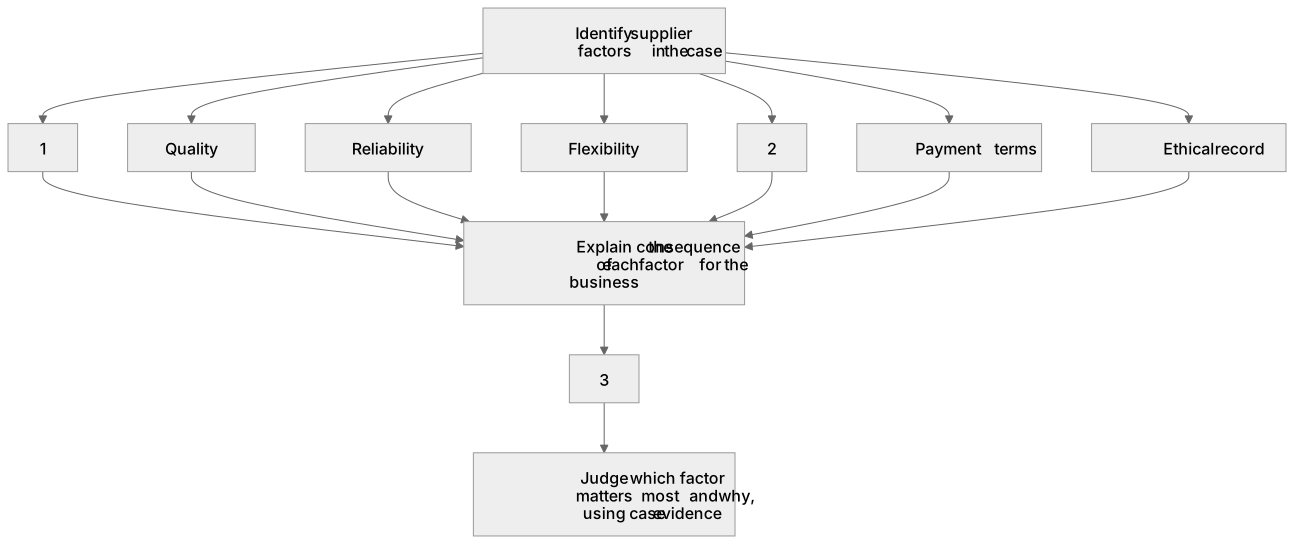
1Box 1
2Box 2
3Box 3
There is more to this lesson
The full lesson goes on to check your understanding and help you earn the marks. Create a free account to carry on, with your progress saved.
A week of Premium from your first lesson · Then the free plan continues · No card, no charge
Test your understanding of The role of procurement: Students should be able to analyse the factors that affect the choice of supplier for a given business.
Active recall beats re-reading. Take an instant quiz now to test what you’ve learned and lock it into long-term memory.
A week of Premium from your first lesson · Then the free plan continues · No card, no charge