AQA · GCSE · Chemistry
Course version: 8462 · Version from Sept 2018
Bioleaching uses bacteria to produce leachate solutions that contain metal…
Full specification wording
Alternative methods of extracting metals (HT only): Bioleaching uses bacteria to produce leachate solutions that contain metal compounds.
Bioleaching uses bacteria that feed on low-grade copper ore.
Checked against the AQA 8462 specification (opens in a new tab) on .
- Point 5 of 8
- 4 key terms
Study notes
From the checked teaching notes for this specification point.
The idea
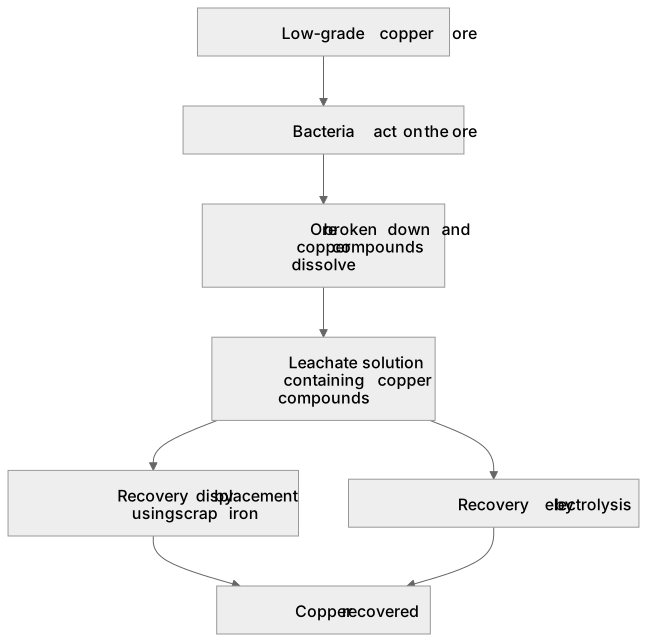
Bioleaching uses bacteria that feed on low-grade copper ore. As the bacteria break down the ore, copper compounds dissolve into a solution called leachate. The leachate contains copper compounds, which can be recovered by displacement using scrap iron or by electrolysis. Bioleaching avoids digging, moving and disposing of large amounts of rock because the bacteria act on the ore in situ or in heaps, and the copper is carried in a relatively small volume of solution. The process is slower than traditional mining and depends on conditions that suit the bacteria, but it can make low-grade ores economically useful and reduces landscape disturbance.
What earns the marks
- Bioleaching uses bacteria that act on low-grade copper ore.
- The bacteria help break down the ore so copper compounds dissolve.
- The solution produced is called leachate.
- Leachate contains copper compounds, not pure copper metal.
- Copper can be recovered from leachate by displacement using scrap iron or by electrolysis.
- Bioleaching avoids digging, moving and disposing of large amounts of rock and can make low-grade ores economic.
Common mistakes and how to put them right
Saying bacteria produce copper metal.
Put it right: Bacteria produce leachate containing copper compounds, and the metal is obtained by further processing.
Confusing leachate with a pure copper solution.
Put it right: Leachate is a solution containing copper compounds and other dissolved substances.
Thinking bioleaching is fast like traditional mining.
Put it right: Bioleaching is slower and depends on bacterial activity.
Exam tips
- Define leachate as the solution containing metal compounds produced by bacteria.
- Name a suitable recovery method, such as displacement with scrap iron or electrolysis.
- Link bioleaching to low-grade ores and explain why it avoids large-scale rock movement.
Try the lesson
The start of the Alternative methods of extracting metals (HT only): Bioleaching uses bacteria to produce leachate solutions that contain metal compounds. lesson, made from checked teaching notes for this specification point.
Have a go first
In bioleaching, which organisms are used to produce leachate solutions containing metal compounds?
Listen
Bioleaching uses bacteria that feed on low-grade copper ore. As the bacteria break down the ore, copper compounds dissolve into a solution called leachate. The leachate contains copper compounds, which can be recovered by displacement using scrap iron or by electrolysis. Bioleaching avoids digging, moving and disposing of large amounts of rock because the bacteria act on the ore in situ or in heaps, and the copper is carried in a relatively small volume of solution. The process is slower than traditional mining and depends on conditions that suit the bacteria, but it can make low-grade ores economically useful and reduces landscape disturbance. A strong answer earns marks for these points. Bioleaching uses bacteria that act on low-grade copper ore. The bacteria help break down the ore so copper compounds dissolve. The solution produced is called leachate. Leachate contains copper compounds, not pure copper metal. A common slip: Saying bacteria produce copper metal. Instead, bacteria produce leachate containing copper compounds, and the metal is obtained by further processing. Exam tip: Define leachate as the solution containing metal compounds produced by bacteria.
See it
Key words
Say what each word means before you turn the card.
Bioleaching
Try answering aloud or in your head before turning the card.
Leachate
Try answering aloud or in your head before turning the card.
Recovery from leachate
Try answering aloud or in your head before turning the card.
Low-grade ores
Try answering aloud or in your head before turning the card.
See every definition
- Bioleaching
- Uses bacteria that act on low-grade copper ore, helping to break down the ore so copper compounds dissolve.
- Leachate
- The solution produced by bacteria, containing copper compounds and other dissolved substances, not pure copper metal.
- Recovery from leachate
- Copper can be recovered from leachate by displacement using scrap iron or by electrolysis.
- Low-grade ores
- Bioleaching can make low-grade ores economically useful and avoids digging, moving and disposing of large amounts of rock.
Label the diagram
Some boxes have lost their names. Pick the right name for each number.
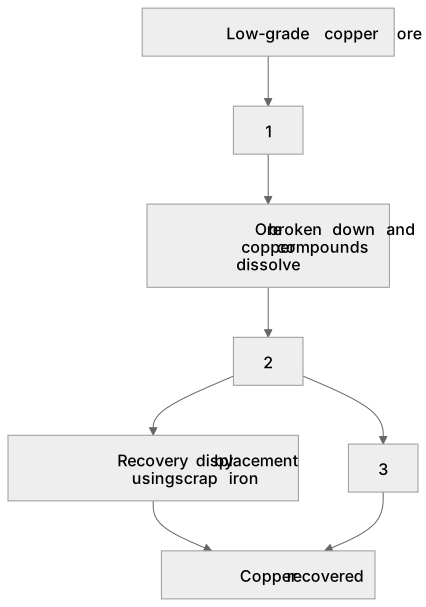
1Box 1
2Box 2
3Box 3
There is more to this lesson
The full lesson goes on to check your understanding and help you earn the marks. Create a free account to carry on, with your progress saved.
A week of Premium from your first lesson · Then the free plan continues · No card, no charge
Test your understanding of Alternative methods of extracting metals (HT only): Bioleaching uses bacteria to produce leachate solutions that contain metal compounds.
Active recall beats re-reading. Take an instant quiz now to test what you’ve learned and lock it into long-term memory.
A week of Premium from your first lesson · Then the free plan continues · No card, no charge