AQA · GCSE · Chemistry
Course version: 8462 · Version from Sept 2018
Phytomining uses plants to absorb metal compounds. The plants are…
Full specification wording
Alternative methods of extracting metals (HT only): Phytomining uses plants to absorb metal compounds. The plants are harvested and then burned to produce ash that contains metal compounds.
Phytomining uses plants that grow in soil containing low-grade copper ore.
Checked against the AQA 8462 specification (opens in a new tab) on .
- Point 4 of 8
Study notes
From the checked teaching notes for this specification point.
The idea
Phytomining uses plants that grow in soil containing low-grade copper ore. The plants absorb copper compounds through their roots and store them in their tissues. After a period of growth, the plants are harvested. The harvested plant material is burned, and the ash that remains contains concentrated copper compounds. Because the copper has been concentrated from a large volume of soil into a small mass of ash, the ash can be processed further, for example by displacement using scrap iron or by electrolysis, to obtain copper metal. The method is slow and depends on plant growth, but it can make low-grade or contaminated land economically useful.
What earns the marks
- Plants absorb copper compounds from the soil through their roots.
- The absorbed copper compounds are stored in the plant tissues.
- The plants are harvested after they have taken up copper compounds.
- The harvested plants are burned to produce ash.
- The ash contains concentrated copper compounds.
- The ash is processed further, for example by displacement or electrolysis, to obtain copper metal.
Common mistakes and how to put them right
Saying plants absorb copper metal.
Put it right: Plants absorb copper compounds, and the metal is obtained only after further processing.
Thinking the plants are burned to release energy for extraction.
Put it right: Burning produces ash that concentrates the copper compounds.
Believing phytomining produces pure copper directly.
Put it right: The ash contains copper compounds that must be processed.
Exam tips
- Sequence the method clearly: absorb, harvest, burn, ash, process.
- State that the ash contains metal compounds, not pure metal, and name a suitable further process.
- Explain the advantage of concentration: a large volume of low-grade soil becomes a small mass of ash.
Try the lesson
The start of the Alternative methods of extracting metals (HT only): Phytomining uses plants to absorb metal compounds. The plants are harvested and then burned to produce ash that contains metal compounds. lesson, made from checked teaching notes for this specification point.
Have a go first
Which statement describes the main steps used to recover metal compounds from plants during phytomining?
Listen
Phytomining uses plants that grow in soil containing low-grade copper ore. The plants absorb copper compounds through their roots and store them in their tissues. After a period of growth, the plants are harvested. The harvested plant material is burned, and the ash that remains contains concentrated copper compounds. Because the copper has been concentrated from a large volume of soil into a small mass of ash, the ash can be processed further, for example by displacement using scrap iron or by electrolysis, to obtain copper metal. The method is slow and depends on plant growth, but it can make low-grade or contaminated land economically useful. A strong answer earns marks for these points. Plants absorb copper compounds from the soil through their roots. The absorbed copper compounds are stored in the plant tissues. The plants are harvested after they have taken up copper compounds. The harvested plants are burned to produce ash. A common slip: Saying plants absorb copper metal. Instead, plants absorb copper compounds, and the metal is obtained only after further processing. Exam tip: Sequence the method clearly: absorb, harvest, burn, ash, process.
See it
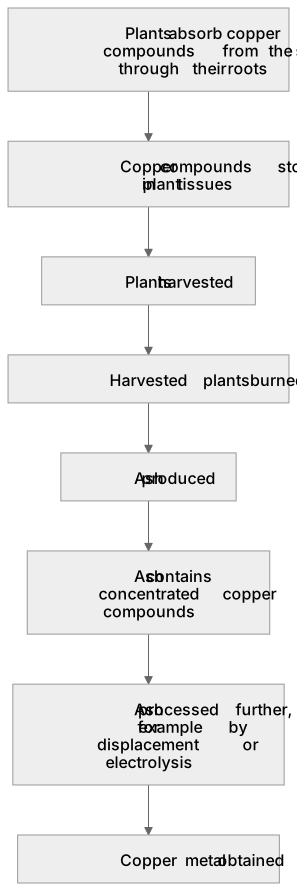
Put it in order
Put these steps in the order they happen.
- 1. Ash produced
- 2. Copper metal obtained
- 3. Ash contains concentrated copper compounds
- 4. Plants absorb copper compounds from the soil through their roots
- 5. Copper compounds stored in plant tissues
- 6. Ash processed further, for example by displacement or electrolysis
- 7. Plants harvested
- 8. Harvested plants burned
Label the diagram
Some boxes have lost their names. Pick the right name for each number.
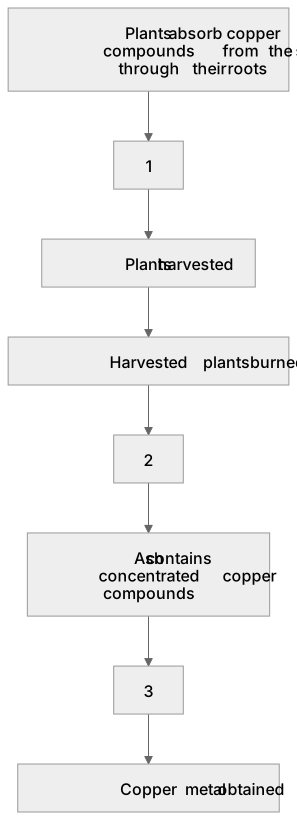
1Box 1
2Box 2
3Box 3
There is more to this lesson
The full lesson goes on to check your understanding and help you earn the marks. Create a free account to carry on, with your progress saved.
A week of Premium from your first lesson · Then the free plan continues · No card, no charge
Test your understanding of Alternative methods of extracting metals (HT only): Phytomining uses plants to absorb metal compounds. The plants are harvested and then burned to produce ash that contains metal compounds.
Active recall beats re-reading. Take an instant quiz now to test what you’ve learned and lock it into long-term memory.
A week of Premium from your first lesson · Then the free plan continues · No card, no charge