AQA · GCSE · Chemistry
Course version: 8462 · Version from Sept 2018
Carboxylic acids: Carboxylic acids have the functional group –COOH.
A functional group is the reactive part of a molecule that gives a homologous series its characteristic properties.
Checked against the AQA 8462 specification (opens in a new tab) on .
- Point 1 of 4
- 3 key terms
Study notes
From the checked teaching notes for this specification point.
The idea
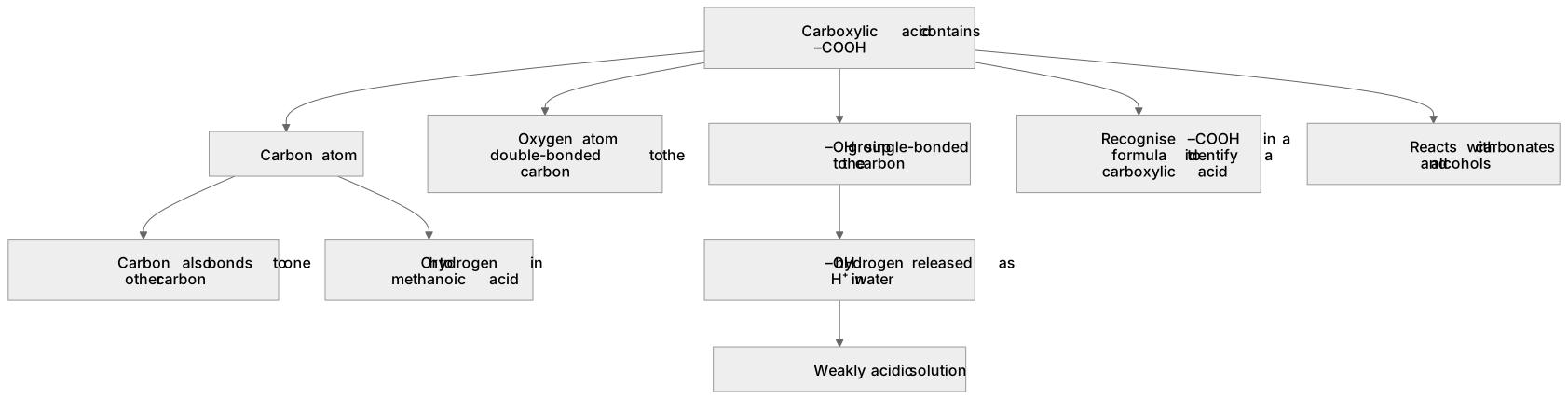
A functional group is the reactive part of a molecule that gives a homologous series its characteristic properties. In carboxylic acids the functional group is –COOH, a carbon atom joined to an oxygen by a double bond and to an –OH group. The carbon of –COOH is bonded to one other carbon (or to hydrogen in methanoic acid), so the group sits at the end of a chain. Recognising –COOH lets you identify a carboxylic acid from a displayed, structural or molecular formula, and it explains the acidic reactions you meet later: the –OH hydrogen is released as H⁺ in water, giving a weakly acidic solution, and the group reacts with carbonates and alcohols.
For example: CH₃COOH contains the –COOH group, so it is ethanoic acid.
What earns the marks
- State that –COOH is the functional group present in every carboxylic acid.
- Identify the group as a carbon atom double-bonded to an oxygen atom and single-bonded to an –OH group.
- Explain that the –COOH carbon also bonds to one carbon of the rest of the molecule, or to hydrogen in methanoic acid.
- Recognise –COOH within a displayed, structural or molecular formula and name the compound as a carboxylic acid.
- Link the –OH part of –COOH to the release of H⁺ ions in water, giving a weakly acidic solution.
- Use the group to predict reactions with carbonates and, at higher tier, with alcohols.
Common mistakes and how to put them right
Treating –COOH as an alcohol –OH group.
Put it right by noting that the –OH is attached to a carbon that is also double-bonded to oxygen, which makes the compound acidic rather than an alcohol.
Writing the group as COOH without showing the double bond to oxygen.
Put it right by drawing C double-bonded to O and single-bonded to O–H.
Assuming every molecule containing oxygen is a carboxylic acid.
Put it right by checking for the complete –COOH unit, since esters and alcohols contain oxygen but not this group.
Exam tips
- When asked to identify a functional group, circle the whole –COOH unit in the formula before naming it.
- Practise converting between displayed, structural and molecular formulae of the first four carboxylic acids so recognition is quick.
- If a question asks why a compound is acidic, refer to the –COOH group releasing H⁺ ions in water rather than saying it 'contains acid'.
Try the lesson
The start of the Carboxylic acids: Carboxylic acids have the functional group –COOH. lesson, made from checked teaching notes for this specification point.
Have a go first
What group of atoms is the characteristic functional group in every carboxylic acid?
Listen
A functional group is the reactive part of a molecule that gives a homologous series its characteristic properties. In carboxylic acids the functional group is –COOH, a carbon atom joined to an oxygen by a double bond and to an –OH group. The carbon of –COOH is bonded to one other carbon (or to hydrogen in methanoic acid), so the group sits at the end of a chain. Recognising –COOH lets you identify a carboxylic acid from a displayed, structural or molecular formula, and it explains the acidic reactions you meet later: the –OH hydrogen is released as H⁺ in water, giving a weakly acidic solution, and the group reacts with carbonates and alcohols. For example, CH₃COOH contains the –COOH group, so it is ethanoic acid. A strong answer earns marks for these points. State that –COOH is the functional group present in every carboxylic acid. Identify the group as a carbon atom double-bonded to an oxygen atom and single-bonded to an –OH group. Explain that the –COOH carbon also bonds to one carbon of the rest of the molecule, or to hydrogen in methanoic acid. Recognise –COOH within a displayed, structural or molecular formula and name the compound as a carboxylic acid. A common slip: Treating –COOH as an alcohol –OH group. Instead, noting that the –OH is attached to a carbon that is also double-bonded to oxygen, which makes the compound acidic rather than an alcohol. Exam tip: When asked to identify a functional group, circle the whole –COOH unit in the formula before naming it.
See it
Key words
Say what each word means before you turn the card.
Functional group
Try answering aloud or in your head before turning the card.
–COOH
Try answering aloud or in your head before turning the card.
Carboxylic acid
Try answering aloud or in your head before turning the card.
See every definition
- Functional group
- The reactive part of a molecule that gives a homologous series its characteristic properties.
- –COOH
- A carbon atom joined to an oxygen by a double bond and to an –OH group, sitting at the end of a chain.
- Carboxylic acid
- A compound containing the –COOH functional group, which can be identified from a displayed, structural or molecular formula.
Label the diagram
Some boxes have lost their names. Pick the right name for each number.
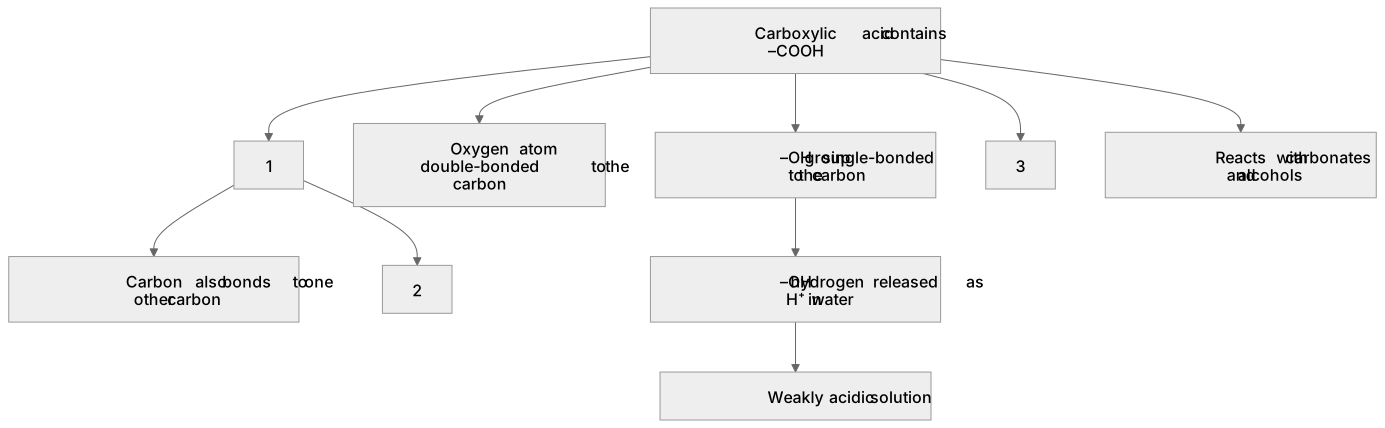
1Box 1
2Box 2
3Box 3
There is more to this lesson
The full lesson goes on to check your understanding and help you earn the marks. Create a free account to carry on, with your progress saved.
A week of Premium from your first lesson · Then the free plan continues · No card, no charge
Test your understanding of Carboxylic acids: Carboxylic acids have the functional group –COOH.
Active recall beats re-reading. Take an instant quiz now to test what you’ve learned and lock it into long-term memory.
A week of Premium from your first lesson · Then the free plan continues · No card, no charge