AQA · GCSE · Chemistry
Course version: 8462 · Version from Sept 2018
The first four members of a homologous series of carboxylic acids are…
Full specification wording
Carboxylic acids: The first four members of a homologous series of carboxylic acids are methanoic acid, ethanoic acid, propanoic acid and butanoic acid.
A homologous series is a family of compounds with the same functional group, in which each member differs from the next by a CH₂ unit.
Checked against the AQA 8462 specification (opens in a new tab) on .
- Point 2 of 4
- 3 key terms
Study notes
From the checked teaching notes for this specification point.
The idea
A homologous series is a family of compounds with the same functional group, in which each member differs from the next by a CH₂ unit. For carboxylic acids the first four members are methanoic acid (HCOOH), ethanoic acid (CH₃COOH), propanoic acid (CH₃CH₂COOH) and butanoic acid (CH₃CH₂CH₂COOH). Their names use the stem meth-, eth-, prop- or but- for one, two, three or four carbon atoms, followed by '-anoic acid'. Counting carbons includes the carbon of the –COOH group, so ethanoic acid has two carbons in total. As the chain lengthens, the molecules have greater intermolecular forces, so boiling points rise and solubility in water decreases, while the –COOH group still gives the same acidic reactions.
What earns the marks
- Name the first four carboxylic acids as methanoic, ethanoic, propanoic and butanoic acid.
- State that they form a homologous series with the same –COOH functional group.
- Explain that successive members differ by a CH₂ unit.
- Use the prefixes meth-, eth-, prop- and but- to show one, two, three and four carbon atoms.
- Count the –COOH carbon as part of the chain when working out the name.
- Write the molecular formulae HCOOH, CH₃COOH, CH₃CH₂COOH and CH₃CH₂CH₂COOH.
Common mistakes and how to put them right
Naming CH₃COOH as methanoic acid by counting only the carbon outside –COOH.
Put it right by counting the –COOH carbon too, giving ethanoic acid.
Writing formulae that omit the –COOH carbon from the chain length.
Put it right by checking the total carbon count against the prefix.
Assuming all members have identical physical properties.
Put it right by noting that boiling point and solubility change as the chain lengthens, even though the functional group is the same.
Exam tips
- Count every carbon atom, including the one in –COOH, before choosing the stem of the name.
- Learn the four names and formulae as a sequence so you can move up or down the series by adding or removing CH₂.
- When comparing members, separate chemical similarity (same –COOH reactions) from physical trends (boiling point and solubility).
Try the lesson
The start of the Carboxylic acids: The first four members of a homologous series of carboxylic acids are methanoic acid, ethanoic acid, propanoic acid and butanoic acid. lesson, made from checked teaching notes for this specification point.
Have a go first
Which of these is the first member of the homologous series of carboxylic acids?
Listen
A homologous series is a family of compounds with the same functional group, in which each member differs from the next by a CH₂ unit. For carboxylic acids the first four members are methanoic acid (HCOOH), ethanoic acid (CH₃COOH), propanoic acid (CH₃CH₂COOH) and butanoic acid (CH₃CH₂CH₂COOH). Their names use the stem meth-, eth-, prop- or but- for one, two, three or four carbon atoms, followed by '-anoic acid'. Counting carbons includes the carbon of the –COOH group, so ethanoic acid has two carbons in total. As the chain lengthens, the molecules have greater intermolecular forces, so boiling points rise and solubility in water decreases, while the –COOH group still gives the same acidic reactions. A strong answer earns marks for these points. Name the first four carboxylic acids as methanoic, ethanoic, propanoic and butanoic acid. State that they form a homologous series with the same –COOH functional group. Explain that successive members differ by a CH₂ unit. Use the prefixes meth-, eth-, prop- and but- to show one, two, three and four carbon atoms. A common slip: Naming CH₃COOH as methanoic acid by counting only the carbon outside –COOH. Instead, counting the –COOH carbon too, giving ethanoic acid. Exam tip: Count every carbon atom, including the one in –COOH, before choosing the stem of the name.
See it
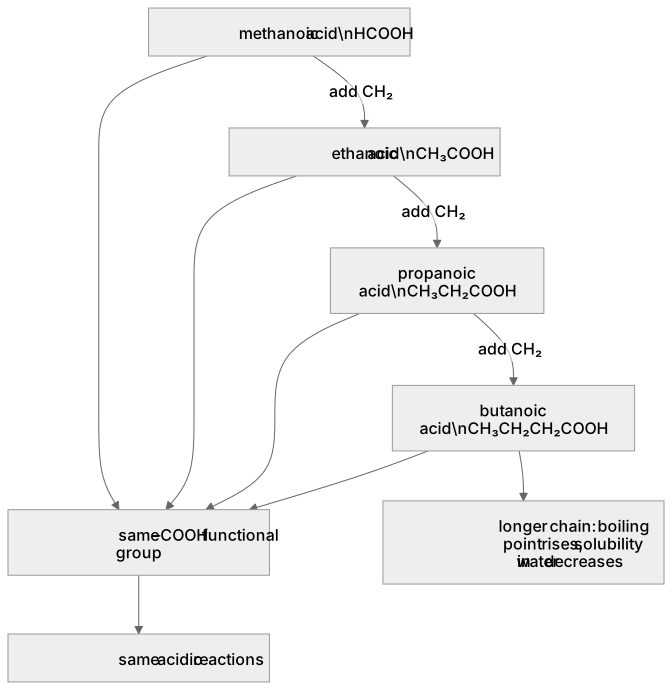
Key words
Say what each word means before you turn the card.
Homologous series
Try answering aloud or in your head before turning the card.
Prefixes meth-, eth-, prop- and but-
Try answering aloud or in your head before turning the card.
Trends in physical properties
Try answering aloud or in your head before turning the card.
See every definition
- Homologous series
- A family of compounds with the same functional group, in which each member differs from the next by a CH₂ unit.
- Prefixes meth-, eth-, prop- and but-
- Stems used in the names to show one, two, three or four carbon atoms, counting the carbon of the –COOH group.
- Trends in physical properties
- As the chain lengthens, the molecules have greater intermolecular forces, so boiling points rise and solubility in water decreases.
Label the diagram
Some boxes have lost their names. Pick the right name for each number.
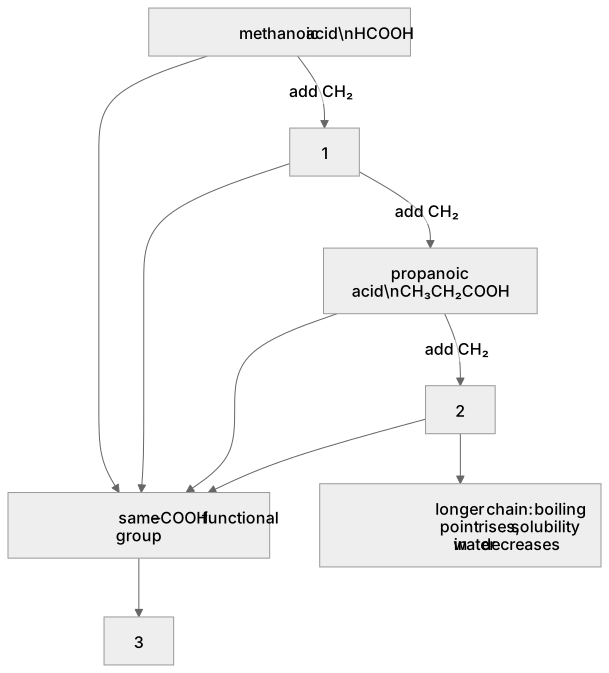
1Box 1
2Box 2
3Box 3
There is more to this lesson
The full lesson goes on to check your understanding and help you earn the marks. Create a free account to carry on, with your progress saved.
A week of Premium from your first lesson · Then the free plan continues · No card, no charge
Test your understanding of Carboxylic acids: The first four members of a homologous series of carboxylic acids are methanoic acid, ethanoic acid, propanoic acid and butanoic acid.
Active recall beats re-reading. Take an instant quiz now to test what you’ve learned and lock it into long-term memory.
A week of Premium from your first lesson · Then the free plan continues · No card, no charge