AQA · GCSE · Chemistry
Course version: 8462 · Version from Sept 2018
Students should be able to interpret data for relative reactivity of…
Full specification wording
Cells and batteries: Students should be able to interpret data for relative reactivity of different metals and evaluate the use of cells.
The voltage of a simple cell depends on the difference in reactivity between its two electrodes.
Checked against the AQA 8462 specification (opens in a new tab) on .
- Point 7 of 7
Study notes
From the checked teaching notes for this specification point.
The idea
The voltage of a simple cell depends on the difference in reactivity between its two electrodes. A more reactive metal and a less reactive metal in an electrolyte give a larger voltage than two metals close in the reactivity series. For example, a cell with magnesium and copper gives a higher voltage than one with zinc and copper because magnesium is further from copper in the series. Evaluating the use of cells means weighing practical factors such as voltage, cost, lifetime, rechargeability and environmental impact to judge which cell suits a device.
What earns the marks
- The voltage of a cell depends on the difference in reactivity of the two electrode metals.
- A greater difference in reactivity generally gives a greater cell voltage.
- Data tables or graphs can be used to compare voltages for different metal pairs.
- The reactivity series helps explain and predict the pattern in the data.
- Evaluating cells involves considering voltage, cost, lifetime, rechargeability and environmental impact.
- A justified choice of cell links the device's needs to the cell's properties.
Common mistakes and how to put them right
Assuming the most reactive metal alone gives the highest voltage.
Put it right by comparing the difference between the two metals.
Ignoring the electrolyte when interpreting data.
Put it right by noting that the electrolyte is part of the cell and affects its behaviour.
Choosing a cell only on voltage.
Put it right: Also considering cost, lifetime, rechargeability and environmental impact.
Exam tips
- Quote values from the data table when comparing voltages.
- Use the reactivity series to explain why one pair gives a higher voltage than another.
- When evaluating, give a balanced judgement with at least one advantage and one disadvantage.
Try the lesson
The start of the Cells and batteries: Students should be able to interpret data for relative reactivity of different metals and evaluate the use of cells. lesson, made from checked teaching notes for this specification point.
Have a go first
A student measures the voltage of simple cells using a copper electrode and an electrode of another metal in an electrolyte. The voltages are: metal W and copper = 0.4 V; metal X and copper = 1.1 V; metal Y and copper = 2.7 V; metal Z and copper = 0.9 V. Assuming copper is the least reactive metal in all pairs, which metal is the most reactive?
Listen
The voltage of a simple cell depends on the difference in reactivity between its two electrodes. A more reactive metal and a less reactive metal in an electrolyte give a larger voltage than two metals close in the reactivity series. For example, a cell with magnesium and copper gives a higher voltage than one with zinc and copper because magnesium is further from copper in the series. Evaluating the use of cells means weighing practical factors such as voltage, cost, lifetime, rechargeability and environmental impact to judge which cell suits a device. A strong answer earns marks for these points. The voltage of a cell depends on the difference in reactivity of the two electrode metals. A greater difference in reactivity generally gives a greater cell voltage. Data tables or graphs can be used to compare voltages for different metal pairs. The reactivity series helps explain and predict the pattern in the data. A common slip: Assuming the most reactive metal alone gives the highest voltage. Instead, comparing the difference between the two metals. Exam tip: Quote values from the data table when comparing voltages.
See it
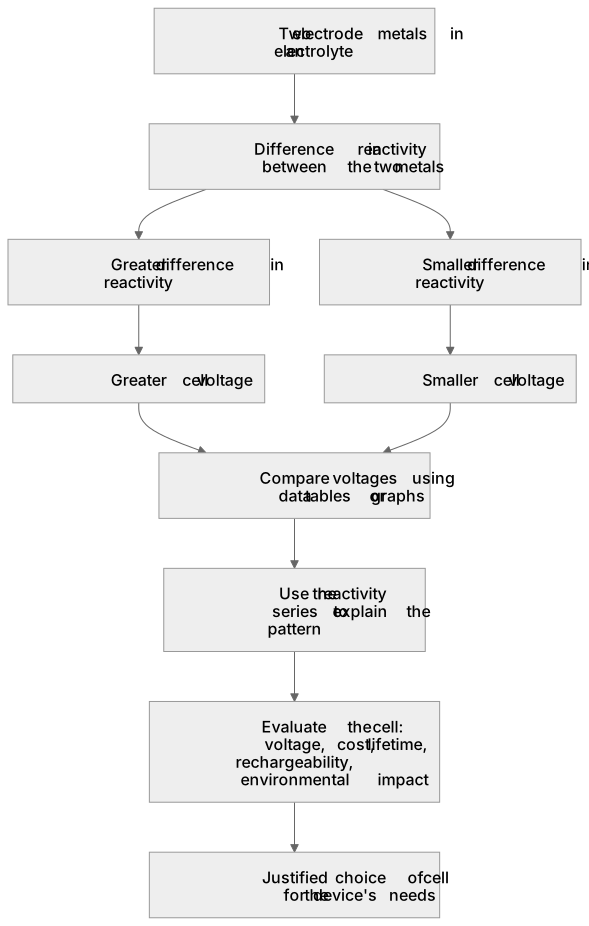
Label the diagram
Some boxes have lost their names. Pick the right name for each number.
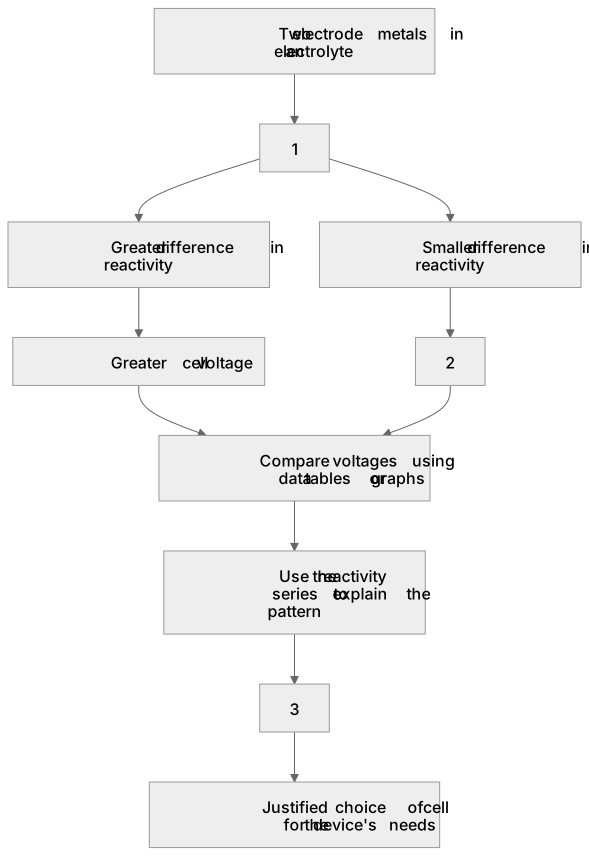
1Box 1
2Box 2
3Box 3
There is more to this lesson
The full lesson goes on to check your understanding and help you earn the marks. Create a free account to carry on, with your progress saved.
A week of Premium from your first lesson · Then the free plan continues · No card, no charge
Test your understanding of Cells and batteries: Students should be able to interpret data for relative reactivity of different metals and evaluate the use of cells.
Active recall beats re-reading. Take an instant quiz now to test what you’ve learned and lock it into long-term memory.
A week of Premium from your first lesson · Then the free plan continues · No card, no charge