AQA · GCSE · Chemistry
Course version: 8462 · Version from Sept 2018
Increasing the concentration of reactants in solution, the pressure of…
Full specification wording
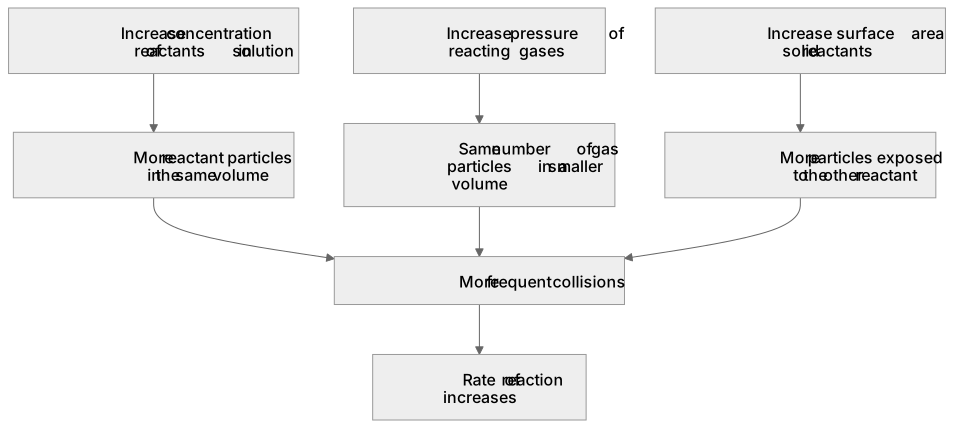
Collision theory and activation energy: Increasing the concentration of reactants in solution, the pressure of reacting gases, and the surface area of solid reactants increases the frequency of collisions and so increases the rate of reaction.
The rate of a reaction depends on how often reactant particles collide successfully.
Checked against the AQA 8462 specification (opens in a new tab) on .
- Point 4 of 7
- 4 key terms
Study notes
From the checked teaching notes for this specification point.
The idea
The rate of a reaction depends on how often reactant particles collide successfully. Increasing concentration means more reactant particles in the same volume of solution, so collisions become more frequent. Increasing the pressure of reacting gases squeezes the same number of gas particles into a smaller volume, again increasing collision frequency. Increasing the surface area of a solid, for example by using powder instead of a large lump, exposes more particles to the other reactant, so more collisions can occur. In each case, the energy of individual collisions is not necessarily changed, but the number of collisions per second rises, so the rate increases. A practical example is marble chips reacting with hydrochloric acid: powdered calcium carbonate reacts faster than large chips of the same mass.
What earns the marks
- Increasing concentration increases the number of reactant particles per unit volume in solution, raising collision frequency.
- Increasing gas pressure reduces the volume available, so gas particles collide more frequently.
- Increasing surface area of a solid exposes more reactant particles, allowing more frequent collisions with the other reactant.
- In all three cases, the increased rate is explained by more frequent collisions, not by a change in activation energy.
- A valid comparison requires the same mass or amount of reactant when surface area is changed, so that the effect is due to surface area alone.
Common mistakes and how to put them right
Saying that increasing concentration increases the energy of collisions.
Put it right: It increases the frequency of collisions, while temperature affects energy.
Confusing pressure with concentration for gases.
Put it right: Pressure changes the volume and therefore the frequency of collisions between gas particles.
Using a larger mass of solid as well as a larger surface area.
Put it right: Compare equal masses so that only surface area is changed.
Exam tips
- Link each change directly to collision frequency before stating that the rate increases.
- For surface area, mention exposing more particles rather than simply saying it is smaller.
- Use comparative language such as more frequent collisions rather than vague phrases like more collisions happen.
Try the lesson
The start of the Collision theory and activation energy: Increasing the concentration of reactants in solution, the pressure of reacting gases, and the surface area of solid reactants increases the frequency of collisions and so increases the rate of reaction. lesson, made from checked teaching notes for this specification point.
Have a go first
A student increases the concentration of a reactant in solution. What happens to the rate of reaction and why?
Listen
The rate of a reaction depends on how often reactant particles collide successfully. Increasing concentration means more reactant particles in the same volume of solution, so collisions become more frequent. Increasing the pressure of reacting gases squeezes the same number of gas particles into a smaller volume, again increasing collision frequency. Increasing the surface area of a solid, for example by using powder instead of a large lump, exposes more particles to the other reactant, so more collisions can occur. In each case, the energy of individual collisions is not necessarily changed, but the number of collisions per second rises, so the rate increases. A practical example is marble chips reacting with hydrochloric acid: powdered calcium carbonate reacts faster than large chips of the same mass. A strong answer earns marks for these points. Increasing concentration increases the number of reactant particles per unit volume in solution, raising collision frequency. Increasing gas pressure reduces the volume available, so gas particles collide more frequently. Increasing surface area of a solid exposes more reactant particles, allowing more frequent collisions with the other reactant. In all three cases, the increased rate is explained by more frequent collisions, not by a change in activation energy. A common slip: Saying that increasing concentration increases the energy of collisions. Instead, it increases the frequency of collisions, while temperature affects energy. Exam tip: Link each change directly to collision frequency before stating that the rate increases.
See it
Key words
Say what each word means before you turn the card.
Collision frequency
Try answering aloud or in your head before turning the card.
Concentration and pressure effects
Try answering aloud or in your head before turning the card.
Surface area and reaction rate
Try answering aloud or in your head before turning the card.
Experimental control of variables
Try answering aloud or in your head before turning the card.
See every definition
- Collision frequency
- The number of collisions per second between reactant particles, which rises when concentration, pressure or surface area is increased.
- Concentration and pressure effects
- More reactant particles in the same volume of solution, or the same number of gas particles squeezed into a smaller volume, makes collisions more frequent.
- Surface area and reaction rate
- Exposing more particles of a solid to the other reactant allows more frequent collisions, so the rate increases.
- Experimental control of variables
- A valid comparison requires the same mass or amount of reactant when surface area is changed, so that the effect is due to surface area alone.
Label the diagram
Some boxes have lost their names. Pick the right name for each number.
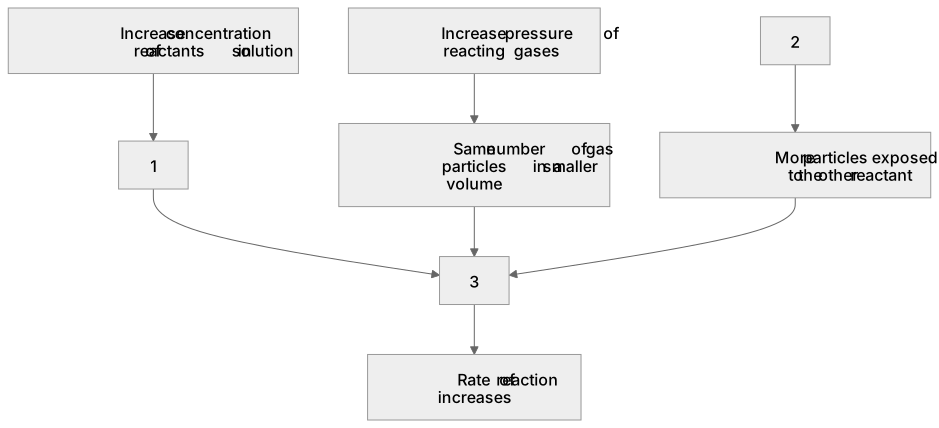
1Box 1
2Box 2
3Box 3
There is more to this lesson
The full lesson goes on to check your understanding and help you earn the marks. Create a free account to carry on, with your progress saved.
A week of Premium from your first lesson · Then the free plan continues · No card, no charge
Test your understanding of Collision theory and activation energy: Increasing the concentration of reactants in solution, the pressure of reacting gases, and the surface area of solid reactants increases the frequency of collisions and so increases the rate of reaction.
Active recall beats re-reading. Take an instant quiz now to test what you’ve learned and lock it into long-term memory.
A week of Premium from your first lesson · Then the free plan continues · No card, no charge