AQA · GCSE · Chemistry
Course version: 8462 · Version from Sept 2018
Increasing the temperature increases the frequency of collisions and makes…
Full specification wording
Collision theory and activation energy: Increasing the temperature increases the frequency of collisions and makes the collisions more energetic, and so increases the rate of reaction.
Temperature affects reaction rate in two ways.
Checked against the AQA 8462 specification (opens in a new tab) on .
- Point 5 of 7
Study notes
From the checked teaching notes for this specification point.
The idea
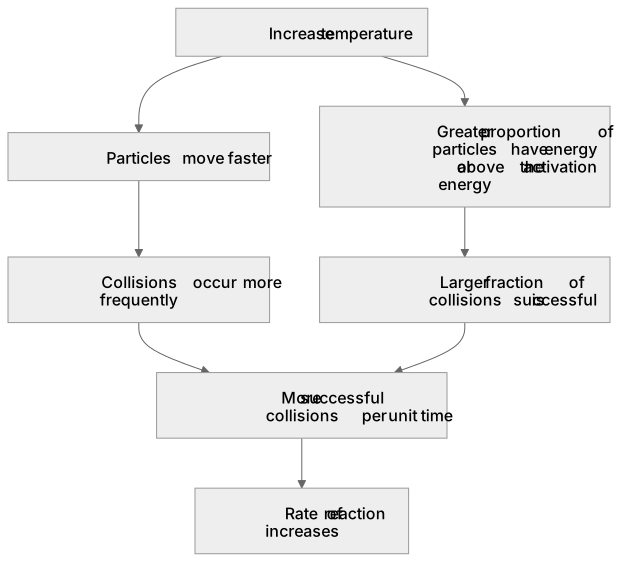
Temperature affects reaction rate in two ways. First, particles move faster at higher temperature, so they collide more often. Second, and often more importantly, a greater proportion of particles have energy equal to or greater than the activation energy, so a larger fraction of collisions is successful. Both effects increase the rate of reaction. For example, magnesium ribbon reacts slowly with cold dilute hydrochloric acid but rapidly with warm acid of the same concentration. When explaining temperature effects, it is not enough to say only that particles move faster; the key point is that more particles have enough energy to overcome the activation energy. This distinguishes temperature from concentration, pressure and surface area, which mainly change collision frequency.
What earns the marks
- Increasing temperature increases the average speed of particles, so collisions occur more frequently.
- Increasing temperature increases the proportion of particles with energy equal to or greater than the activation energy.
- More successful collisions occur per unit time, so the rate of reaction increases.
- The effect of temperature on collision energy is often more significant than the effect on collision frequency.
- A valid explanation links temperature to both collision frequency and collision energy, not to one alone.
Common mistakes and how to put them right
Stating only that particles move faster without mentioning activation energy.
Put it right: Explain that more particles have energy at or above the activation energy.
Saying that temperature lowers the activation energy.
Put it right: Temperature increases the proportion of particles that can overcome the same activation energy.
Confusing temperature with concentration by saying there are more particles.
Put it right: Temperature changes particle energy and speed, not the number of particles.
Exam tips
- Always include both collision frequency and collision energy when explaining a temperature increase.
- Use the phrase proportion of particles with energy greater than or equal to the activation energy.
- Compare hot and cold conditions at the same concentration to isolate the effect of temperature.
Try the lesson
The start of the Collision theory and activation energy: Increasing the temperature increases the frequency of collisions and makes the collisions more energetic, and so increases the rate of reaction. lesson, made from checked teaching notes for this specification point.
Have a go first
A reaction mixture is warmed up. What effect does the higher temperature have on the rate of reaction?
Listen
Temperature affects reaction rate in two ways. First, particles move faster at higher temperature, so they collide more often. Second, and often more importantly, a greater proportion of particles have energy equal to or greater than the activation energy, so a larger fraction of collisions is successful. Both effects increase the rate of reaction. For example, magnesium ribbon reacts slowly with cold dilute hydrochloric acid but rapidly with warm acid of the same concentration. When explaining temperature effects, it is not enough to say only that particles move faster; the key point is that more particles have enough energy to overcome the activation energy. This distinguishes temperature from concentration, pressure and surface area, which mainly change collision frequency. A strong answer earns marks for these points. Increasing temperature increases the average speed of particles, so collisions occur more frequently. Increasing temperature increases the proportion of particles with energy equal to or greater than the activation energy. More successful collisions occur per unit time, so the rate of reaction increases. The effect of temperature on collision energy is often more significant than the effect on collision frequency. A common slip: Stating only that particles move faster without mentioning activation energy. Instead, explain that more particles have energy at or above the activation energy. Exam tip: Always include both collision frequency and collision energy when explaining a temperature increase.
See it
Label the diagram
Some boxes have lost their names. Pick the right name for each number.
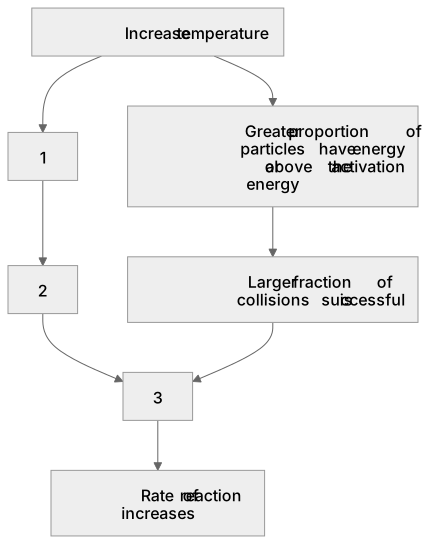
1Box 1
2Box 2
3Box 3
There is more to this lesson
The full lesson goes on to check your understanding and help you earn the marks. Create a free account to carry on, with your progress saved.
A week of Premium from your first lesson · Then the free plan continues · No card, no charge
Test your understanding of Collision theory and activation energy: Increasing the temperature increases the frequency of collisions and makes the collisions more energetic, and so increases the rate of reaction.
Active recall beats re-reading. Take an instant quiz now to test what you’ve learned and lock it into long-term memory.
A week of Premium from your first lesson · Then the free plan continues · No card, no charge