AQA · GCSE · Chemistry
Course version: 8462 · Version from Sept 2018
Both air and water are necessary for iron to rust.
Full specification wording
Corrosion and its prevention: Both air and water are necessary for iron to rust.
Rusting is the corrosion of iron, forming hydrated iron(III) oxide.
Checked against the AQA 8462 specification (opens in a new tab) on .
- Point 2 of 6
Study notes
From the checked teaching notes for this specification point.
The idea
Rusting is the corrosion of iron, forming hydrated iron(III) oxide. It requires both oxygen, supplied by air, and water. Remove either and rusting stops. Classic experiments compare four tubes: nail in water with air; nail in boiled water under oil, so no air; nail in dry air with a desiccant, so no water; nail in salt water, which rusts fastest. Only the first and fourth rust, showing both air and water are needed. Salt water speeds rusting because ions help electrons move, but salt is not itself required. The overall idea is that iron is oxidised, losing electrons to oxygen in the presence of water.
What earns the marks
- Rusting needs both oxygen from the air and water together; removing either prevents it.
- Rust is hydrated iron(III) oxide, formed when iron is oxidised.
- A control tube with both air and water rusts; tubes missing air or water do not.
- Salt water accelerates rusting but is not a requirement.
- Boiling removes dissolved air, and an oil layer stops air re-entering.
- A desiccant such as calcium chloride keeps air dry so no water is present.
Common mistakes and how to put them right
Saying only water or only air causes rust.
Put it right: Both are needed together.
Believing salt causes rust.
Put it right: Salt only speeds up rusting, which still needs oxygen and water.
Thinking rust is iron oxide only.
Put it right: It is hydrated iron(III) oxide.
Exam tips
- Describe the control and each changed variable when explaining the experiment.
- Use the phrase 'both air and water' explicitly in your answer.
- Link salt water to faster rusting, not to a different product.
Try the lesson
The start of the Corrosion and its prevention: Both air and water are necessary for iron to rust. lesson, made from checked teaching notes for this specification point.
Have a go first
A student sets up three test tubes. Tube 1 contains an iron nail in tap water open to the air. Tube 2 contains an iron nail in boiled water covered with a layer of oil. Tube 3 contains an iron nail in dry air with a drying agent. In which tube does the iron nail rust?
Listen
Rusting is the corrosion of iron, forming hydrated iron(III) oxide. It requires both oxygen, supplied by air, and water. Remove either and rusting stops. Classic experiments compare four tubes: nail in water with air; nail in boiled water under oil, so no air; nail in dry air with a desiccant, so no water; nail in salt water, which rusts fastest. Only the first and fourth rust, showing both air and water are needed. Salt water speeds rusting because ions help electrons move, but salt is not itself required. The overall idea is that iron is oxidised, losing electrons to oxygen in the presence of water. A strong answer earns marks for these points. Rusting needs both oxygen from the air and water together; removing either prevents it. Rust is hydrated iron(III) oxide, formed when iron is oxidised. A control tube with both air and water rusts; tubes missing air or water do not. Salt water accelerates rusting but is not a requirement. A common slip: Saying only water or only air causes rust. Instead, both are needed together. Exam tip: Describe the control and each changed variable when explaining the experiment.
See it
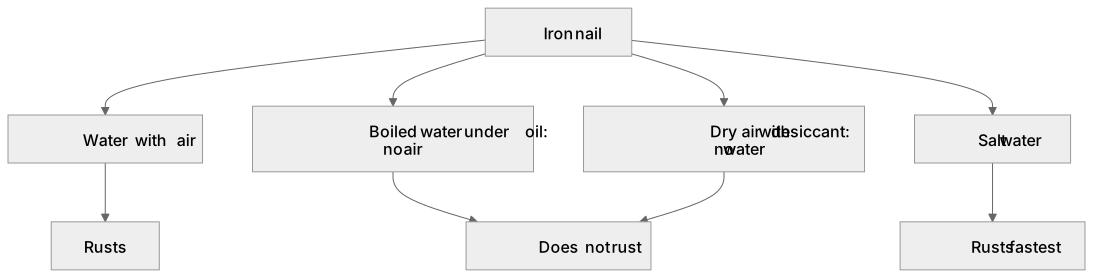
Label the diagram
Some boxes have lost their names. Pick the right name for each number.
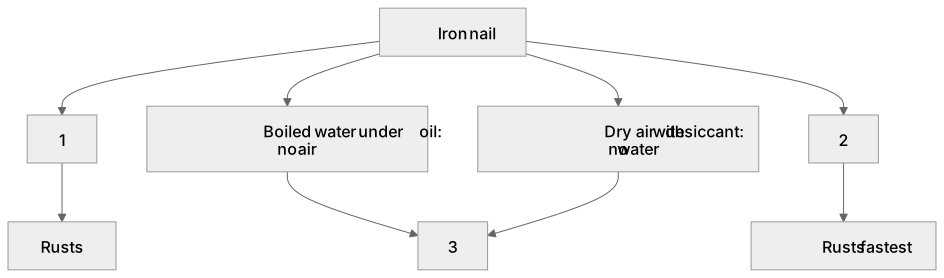
1Box 1
2Box 2
3Box 3
There is more to this lesson
The full lesson goes on to check your understanding and help you earn the marks. Create a free account to carry on, with your progress saved.
A week of Premium from your first lesson · Then the free plan continues · No card, no charge
Test your understanding of Corrosion and its prevention: Both air and water are necessary for iron to rust.
Active recall beats re-reading. Take an instant quiz now to test what you’ve learned and lock it into long-term memory.
A week of Premium from your first lesson · Then the free plan continues · No card, no charge