AQA · GCSE · Chemistry
Course version: 8462 · Version from Sept 2018
Everyday uses of exothermic reactions include self-heating cans and hand…
Full specification wording
Energy transfer during exothermic and endothermic reactions: Everyday uses of exothermic reactions include self-heating cans and hand warmers.
Self-heating cans and hand warmers use exothermic reactions to release useful heat.
Checked against the AQA 8462 specification (opens in a new tab) on .
- Point 6 of 12
- 4 key terms
Study notes
From the checked teaching notes for this specification point.
The idea
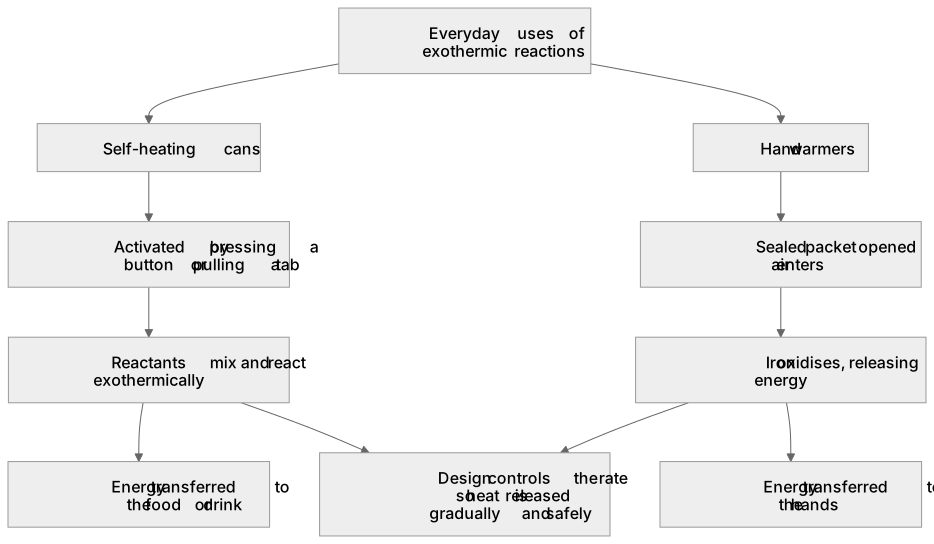
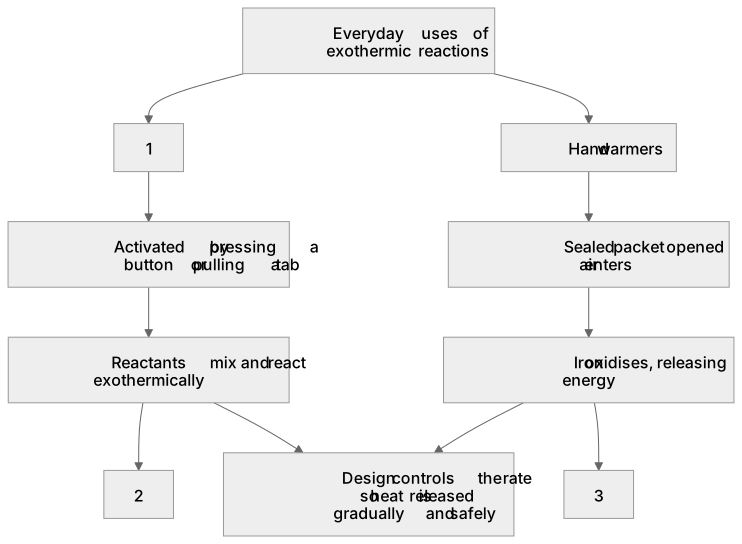
Self-heating cans and hand warmers use exothermic reactions to release useful heat. In a self-heating can, pressing a button or pulling a tab mixes reactants that then react exothermically, warming the drink or food. Hand warmers often use the oxidation of iron in air; when the sealed packet is opened, air enters and iron oxidises, releasing energy that warms the hands. The design controls the rate so heat is released safely over a useful time. These are everyday applications of exothermic change: energy transferred to the surroundings is the desired product. The reaction is not used to make a new substance for its own sake; the heat is the purpose.
What earns the marks
- Self-heating cans contain reactants that react exothermically when activated, transferring energy to the food or drink.
- Hand warmers commonly use the exothermic oxidation of iron by oxygen from the air to release heat.
- The useful outcome is energy transferred to the surroundings, not a particular product substance.
- Activation methods include removing a seal, pulling a tab or pressing a button so that reactants mix or air enters.
- Design features control the rate of reaction so heat is released gradually and safely rather than all at once.
Common mistakes and how to put them right
Thinking the can or warmer creates energy.
Put it right: Stored chemical energy is transferred to the surroundings as heat.
Assuming hand warmers work by an endothermic reaction.
Put it right: They release heat, so the reaction is exothermic.
Believing the reaction continues forever.
Put it right: Reactants are used up, so the warming effect eventually stops.
Exam tips
- Link each device to a named exothermic process, such as iron oxidation in a hand warmer, rather than saying only that it gets hot.
- Explain the purpose of the activation step, for example opening the packet lets air in so oxidation can start.
- Use the phrase energy transferred to the surroundings to show understanding of exothermic change.
Try the lesson
The start of the Energy transfer during exothermic and endothermic reactions: Everyday uses of exothermic reactions include self-heating cans and hand warmers. lesson, made from checked teaching notes for this specification point.
Have a go first
Why is an exothermic reaction useful in a hand warmer?
Listen
Self-heating cans and hand warmers use exothermic reactions to release useful heat. In a self-heating can, pressing a button or pulling a tab mixes reactants that then react exothermically, warming the drink or food. Hand warmers often use the oxidation of iron in air; when the sealed packet is opened, air enters and iron oxidises, releasing energy that warms the hands. The design controls the rate so heat is released safely over a useful time. These are everyday applications of exothermic change: energy transferred to the surroundings is the desired product. The reaction is not used to make a new substance for its own sake; the heat is the purpose. A strong answer earns marks for these points. Self-heating cans contain reactants that react exothermically when activated, transferring energy to the food or drink. Hand warmers commonly use the exothermic oxidation of iron by oxygen from the air to release heat. The useful outcome is energy transferred to the surroundings, not a particular product substance. Activation methods include removing a seal, pulling a tab or pressing a button so that reactants mix or air enters. A common slip: Thinking the can or warmer creates energy. Instead, stored chemical energy is transferred to the surroundings as heat. Exam tip: Link each device to a named exothermic process, such as iron oxidation in a hand warmer, rather than saying only that it gets hot.
See it
Key words
Say what each word means before you turn the card.
Self-heating cans
Try answering aloud or in your head before turning the card.
Hand warmers
Try answering aloud or in your head before turning the card.
Activation
Try answering aloud or in your head before turning the card.
Controlled release of heat
Try answering aloud or in your head before turning the card.
See every definition
- Self-heating cans
- Cans that contain reactants which react exothermically when activated, transferring energy to the food or drink.
- Hand warmers
- Devices that commonly use the exothermic oxidation of iron by oxygen from the air to release heat.
- Activation
- Removing a seal, pulling a tab or pressing a button so that reactants mix or air enters.
- Controlled release of heat
- Design features control the rate of reaction so heat is released gradually and safely rather than all at once.
Label the diagram
Some boxes have lost their names. Pick the right name for each number.
1Box 1
2Box 2
3Box 3
There is more to this lesson
The full lesson goes on to check your understanding and help you earn the marks. Create a free account to carry on, with your progress saved.
A week of Premium from your first lesson · Then the free plan continues · No card, no charge
Test your understanding of Energy transfer during exothermic and endothermic reactions: Everyday uses of exothermic reactions include self-heating cans and hand warmers.
Active recall beats re-reading. Take an instant quiz now to test what you’ve learned and lock it into long-term memory.
A week of Premium from your first lesson · Then the free plan continues · No card, no charge