Energy transfer during exothermic and endothermic reactions — AQA GCSE Chemistry
Verified courseTeaching note checked against the official specification.
Energy transfer during exothermic and endothermic reactions explained
Energy transfer during exothermic and endothermic reactions covers 12 specification points, including Energy is conserved in chemical reactions.
Read the full explanation
and The amount of energy in the universe at the…. Open a point below for its explanation and revision guidance.
Energy is conserved in chemical reactions.
Energy conservation means the total energy of a closed system stays constant during any chemical change. In a reaction, bonds in reactants break, absorbing energy, and new bonds in products form, releasing energy. The difference between these energy changes appears as energy transferred to or from the surroundings, often as heat. For example, burning methane releases energy to the surroundings, but the total energy of the universe remains unchanged; the chemical store decreases while the thermal store of the surroundings increases by the same amount. Students should track energy stores rather than treating energy as used up. This principle underpins exothermic and endothermic definitions and reaction profile diagrams.
The amount of energy in the universe at the end of a chemical reaction is the same as before the reaction takes place.
This statement applies energy conservation to the whole universe, treated as a closed system. During a reaction, energy may move between the reacting chemicals and the surroundings, but the total energy of the universe remains constant. For example, in an exothermic reaction, the chemical store of the reactants decreases, while the thermal store of the surroundings increases by the same amount, so the total is unchanged. Students should avoid saying energy is lost; instead, they should describe energy transfer between stores. This idea supports understanding of exothermic and endothermic reactions and reaction profile diagrams, where the energy difference is shown as a transfer to or from the surroundings.
If a reaction transfers energy to the surroundings the product molecules must have less energy than the reactants, by the amount transferred.
In an exothermic reaction, the products have lower energy than the reactants because energy is transferred to the surroundings. The difference in energy between reactants and products equals the energy transferred. For example, in the combustion of methane, the chemical energy stored in the reactants is greater than that in the products; the excess is released as heat, raising the temperature of the surroundings. Students should link this to reaction profile diagrams, where the products are shown at a lower energy level than the reactants, and the energy difference represents the energy transferred to the surroundings. This concept explains why exothermic reactions cause temperature increases.
An exothermic reaction is one that transfers energy to the surroundings so the temperature of the surroundings increases.
An exothermic reaction transfers energy to the surroundings, causing a temperature rise. This occurs because the energy released when new bonds form in the products is greater than the energy absorbed when bonds break in the reactants. The excess energy is transferred to the surroundings, often as heat, which increases the temperature. Common examples include combustion, respiration, and neutralisation. Students should be able to identify exothermic reactions from temperature changes and explain the energy transfer in terms of bond breaking and bond making. They should also be able to represent the energy change on a reaction profile diagram, with products at a lower energy level than reactants.
Exothermic reactions include combustion, many oxidation reactions and neutralisation.
Exothermic reactions transfer energy to the surroundings, so the surroundings warm up. Combustion is burning a fuel in oxygen, for example methane + oxygen → carbon dioxide + water, releasing energy as bonds form in the products. Many oxidation reactions release energy, such as reacting magnesium with oxygen or iron rusting slowly. Neutralisation is the reaction of an acid with a base or alkali to form a salt and water, for example hydrochloric acid + sodium hydroxide → sodium chloride + water, and the mixture warms. In each case, energy released when new bonds form exceeds energy taken in to break bonds, so overall energy is transferred out. Temperature rise of the surroundings is the observable evidence.
Everyday uses of exothermic reactions include self-heating cans and hand warmers.
Self-heating cans and hand warmers use exothermic reactions to release useful heat. In a self-heating can, pressing a button or pulling a tab mixes reactants that then react exothermically, warming the drink or food. Hand warmers often use the oxidation of iron in air; when the sealed packet is opened, air enters and iron oxidises, releasing energy that warms the hands. The design controls the rate so heat is released safely over a useful time. These are everyday applications of exothermic change: energy transferred to the surroundings is the desired product. The reaction is not used to make a new substance for its own sake; the heat is the purpose.
An endothermic reaction is one that takes in energy from the surroundings so the temperature of the surroundings decreases.
An endothermic reaction takes in energy from the surroundings, so the surroundings cool down. Energy is transferred from the surroundings to the reacting system. In bond terms, the energy needed to break bonds in the reactants is greater than the energy released when new bonds form in the products, so the overall change absorbs energy. A practical example is the reaction of citric acid with sodium hydrogencarbonate, where the mixture temperature falls. Thermal decomposition of calcium carbonate also requires continuous heating. The observable evidence is a temperature decrease of the surroundings, measured with a thermometer or temperature sensor.
Endothermic reactions include thermal decompositions and the reaction of citric acid and sodium hydrogencarbonate.
Thermal decomposition means breaking a compound down by heating, for example heating calcium carbonate to form calcium oxide and carbon dioxide; energy must be taken in continuously, so it is endothermic. The reaction of citric acid with sodium hydrogencarbonate is also endothermic: when the two solids or solutions mix, they fizz to produce carbon dioxide and the mixture cools. In both cases energy is taken in from the surroundings, so the temperature of the surroundings falls. These examples show that endothermic reactions are not limited to one type of chemistry; they include decomposition driven by heating and a reaction between an acid and a hydrogencarbonate.
Some sports injury packs are based on endothermic reactions.
An endothermic reaction takes in energy from its surroundings, so the surroundings cool. A sports injury pack uses this: when the pack is activated, an endothermic reaction absorbs thermal energy from the injured tissue, producing a cold pack that reduces swelling and pain. The reaction mixture and the pack feel cold because energy is transferred from the surroundings to the reacting system. For example, dissolving ammonium nitrate in water in a sealed pack absorbs energy, lowering the temperature. This is the opposite of an exothermic reaction, which releases energy and warms the surroundings. The pack must be designed so the reactants mix only when needed and the cold is safely delivered to the skin without causing ice burns.
Students should be able to: distinguish between exothermic and endothermic reactions on the basis of the temperature change of the surroundings evaluate uses and applications of exothermic and endothermic reactions given appropriate information.
Exothermic reactions release energy to the surroundings, so the surroundings warm; endothermic reactions absorb energy from the surroundings, so the surroundings cool. To distinguish them, measure the temperature change of the surroundings: a rise indicates exothermic, a fall indicates endothermic. For example, adding magnesium to hydrochloric acid raises the temperature, while dissolving ammonium nitrate in water lowers it. When evaluating uses, consider whether the energy transfer is useful, safe and controllable. Exothermic reactions suit hand warmers and self-heating cans; endothermic reactions suit cold packs. Evaluation should weigh benefits such as portability against risks such as burns, cost, reversibility and environmental impact.
Limited to measurement of temperature change. Calculation of energy changes or ΔH is not required.
In this topic, practical work and questions focus on measuring temperature change, not on calculating energy changes or enthalpy change, ΔH. You record the initial temperature of the surroundings or solution, carry out the reaction, and record the highest or lowest temperature reached. The difference between these temperatures shows whether the reaction is exothermic or endothermic and how large the change is. For example, measure the temperature before and after adding magnesium to copper sulfate solution, then subtract the initial reading from the final reading. You are not required to convert temperature change into energy in joules or to calculate ΔH. This keeps the focus on observing and interpreting energy transfer.
Required practical 4: investigate the variables that affect temperature changes in reacting solutions such as, eg acid plus metals, acid plus carbonates, neutralisations, displacement of metals.
In Required practical 4, you investigate variables that affect temperature changes in reacting solutions. Suitable reactions include acid plus metals, acid plus carbonates, neutralisation and displacement of metals. You measure the temperature change of the solution before and after reaction, then vary one factor at a time, such as concentration, volume, particle size or the metal used. For example, react different concentrations of hydrochloric acid with magnesium and record the maximum temperature rise. Control other variables to make the comparison fair. The practical develops skills in measuring temperature, controlling variables, recording data and drawing conclusions about energy transfer.
Watch and listen
Listen: Energy transfer during exothermic and endothermic reactions audio lesson
Read the full guide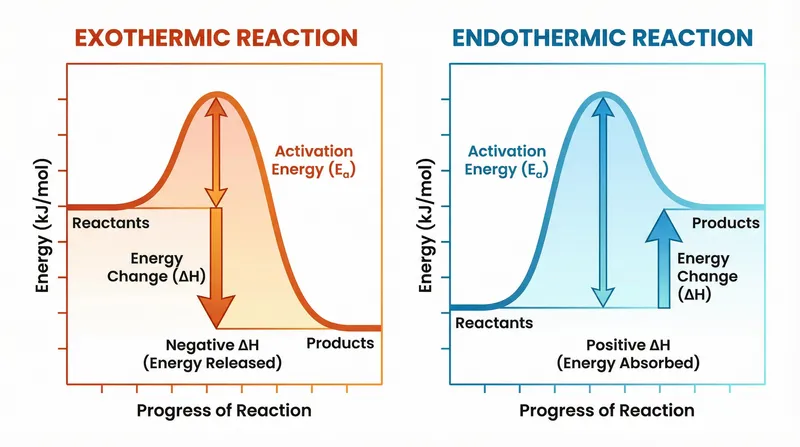
Interactive Diagrams
1 interactive diagram to visualise key concepts
Conceptual Flow Outline
Flowchart for identifying reaction types from temperature data.
Your focus
- Define energy conservation in the context of chemical reactions.
- Describe energy transfers between chemical and thermal stores during a reaction.
- Apply the principle of conservation of energy to explain temperature changes in reactions.
Show all 36 objectives
- Describe the universe as a closed system for energy changes.
- Explain that total energy is unchanged in a chemical reaction.
- Apply conservation of energy to account for temperature changes in the surroundings.
- Explain why products have less energy than reactants in an exothermic reaction.
- Interpret reaction profile diagrams to identify energy changes.
- Calculate or compare energy differences in simple exothermic reactions.
- Define an exothermic reaction in terms of energy transfer to the surroundings.
- Explain why the temperature of the surroundings increases in an exothermic reaction.
- Identify exothermic reactions from experimental temperature data.
- Identify combustion, many oxidation reactions and neutralisation as examples of exothermic reactions.
- Describe the temperature change of the surroundings when an exothermic reaction occurs.
- Explain exothermic energy transfer in terms of bond breaking and bond forming.
- Describe how self-heating cans and hand warmers use exothermic reactions.
- Explain why the heat released is useful in these everyday devices.
- Relate the design and activation of these devices to controlled exothermic reaction rates.
- Define an endothermic reaction in terms of energy taken in from the surroundings.
- Describe the temperature change of the surroundings during an endothermic reaction.
- Explain endothermic energy changes using bond breaking and bond forming.
- Identify thermal decomposition and the citric acid–sodium hydrogencarbonate reaction as endothermic.
- Describe observations that show these reactions take in energy.
- Explain why thermal decomposition requires a continuous energy input.
- Describe how an endothermic reaction affects the temperature of the surroundings.
- Explain how a sports injury pack uses an endothermic reaction to cool an injury.
- Identify a suitable endothermic process, such as dissolving ammonium nitrate, in a cold pack.
- Distinguish exothermic from endothermic reactions using temperature change of the surroundings.
- Evaluate given uses and applications of exothermic and endothermic reactions.
- Justify a judgement about the suitability of a reaction for a particular use using provided information.
- Measure initial and final temperatures in a reacting solution.
- Calculate and interpret temperature change to classify a reaction.
- Recognise that energy change calculations and ΔH are not required in this specification.
- Plan an investigation into variables affecting temperature change in reacting solutions.
- Measure temperature change accurately while controlling variables.
- Analyse results to explain how a chosen variable affects the temperature change.
Energy transfer during exothermic and endothermic reactions exam tips
Marking Points
- States that energy cannot be created or destroyed in a chemical reaction.
- Explains that energy is transferred between the chemical store of reactants/products and the thermal store of the surroundings.
- Uses the idea that bond breaking absorbs energy and bond making releases energy.
- Applies conservation to a named reaction, identifying where energy is transferred.
- Recognises that the total energy before and after a reaction is equal.
- States that the total energy of the universe is constant before and after a reaction.
- Explains that energy is transferred between the reaction mixture and the surroundings, not created or destroyed.
- Uses the universe as a closed system to account for all energy changes.
- Applies the idea to a specific reaction, identifying the energy transfer direction.
- Recognises that any apparent energy change in the chemicals is balanced by an opposite change in the surroundings.
- States that in an exothermic reaction, products have less energy than reactants.
- Explains that the energy difference equals the energy transferred to the surroundings.
- Relates the energy difference to bond breaking and bond making.
- Uses a reaction profile diagram to show products at a lower energy level than reactants.
- Applies the idea to a named exothermic reaction, such as combustion.
- Defines an exothermic reaction as one that transfers energy to the surroundings.
- States that the temperature of the surroundings increases.
- Explains that bond making releases more energy than bond breaking absorbs.
- Identifies examples of exothermic reactions, such as combustion or neutralisation.
- Uses a reaction profile diagram to show products at a lower energy level than reactants.
- Exothermic reactions transfer energy from the reacting system to the surroundings, so the temperature of the surroundings rises.
- Combustion is an exothermic reaction in which a fuel reacts with oxygen, releasing energy; a named example such as methane burning is acceptable.
- Many oxidation reactions are exothermic, including magnesium reacting with oxygen and the slow oxidation of iron as rusting.
- Neutralisation is exothermic: an acid reacts with a base or alkali to form a salt and water, and the temperature of the mixture increases.
- Energy is released overall because the energy transferred when new bonds form in the products is greater than the energy needed to break bonds in the reactants.
- Practical evidence for exothermic change is a measured temperature rise of the surroundings, for example using a thermometer or temperature sensor.
- Self-heating cans contain reactants that react exothermically when activated, transferring energy to the food or drink.
- Hand warmers commonly use the exothermic oxidation of iron by oxygen from the air to release heat.
- The useful outcome is energy transferred to the surroundings, not a particular product substance.
- Activation methods include removing a seal, pulling a tab or pressing a button so that reactants mix or air enters.
- Design features control the rate of reaction so heat is released gradually and safely rather than all at once.
- These applications show that exothermic reactions can be used for a practical purpose in everyday life.
- An endothermic reaction takes in energy from the surroundings.
- The temperature of the surroundings decreases during an endothermic change.
- Energy is transferred from the surroundings to the reacting system.
- Overall energy is absorbed because bond breaking takes in more energy than bond forming releases.
- A temperature drop measured with a thermometer or temperature sensor is evidence that a reaction is endothermic.
- Examples include thermal decomposition and the reaction of citric acid with sodium hydrogencarbonate.
- Thermal decomposition is an endothermic process in which a compound is broken down by heating.
- A named thermal decomposition, such as calcium carbonate forming calcium oxide and carbon dioxide, releases carbon dioxide and requires energy input.
- The reaction of citric acid with sodium hydrogencarbonate is endothermic and produces carbon dioxide gas.
- In both examples, energy is taken in from the surroundings, so the temperature of the surroundings decreases.
- The citric acid and sodium hydrogencarbonate reaction can be observed as fizzing and a temperature fall.
- These examples show endothermic reactions in both decomposition and acid–hydrogencarbonate contexts.
- An endothermic reaction absorbs thermal energy from the surroundings, so the temperature of the surroundings decreases.
- In a sports injury pack, the endothermic process cools the pack, which can be applied to an injury to reduce swelling and pain.
- The reaction mixture feels cold because energy is transferred from the surroundings to the reacting system.
- A named example is dissolving ammonium nitrate in water, which absorbs energy and lowers the temperature.
- The pack is designed so reactants mix only when activated, allowing controlled cooling.
- This contrasts with exothermic reactions, which release energy and raise the temperature of the surroundings.
- Exothermic reactions transfer energy to the surroundings, causing a temperature rise.
- Endothermic reactions absorb energy from the surroundings, causing a temperature fall.
- Temperature change of the surroundings is the basis for distinguishing the two types.
- Uses of exothermic reactions include hand warmers, self-heating cans and some chemical heating packs.
- Uses of endothermic reactions include sports injury cold packs and some cooling systems.
- Evaluation should consider benefits, risks, practicality, cost and environmental impact using the information given.
- Measure the initial temperature of the solution or surroundings before the reaction.
- Measure the final or maximum/minimum temperature after the reaction.
- Calculate temperature change by subtracting the initial temperature from the final temperature.
- Use the sign or direction of the temperature change to classify the reaction as exothermic or endothermic.
- No calculation of energy change in joules or ΔH is required at this level.
- Choose a reacting solution system such as acid plus metal, acid plus carbonate, neutralisation or displacement.
- Measure the initial temperature of the solution before adding the second reactant.
- Measure the maximum or final temperature after the reaction and calculate the temperature change.
- Vary one independent variable at a time, such as concentration, volume, particle size or identity of metal.
- Control other variables to ensure a fair test, for example using the same volume and starting temperature.
- Record results in a suitable table and use them to identify patterns or draw conclusions.
Examiner Tips
- 💡Use the phrase 'energy is conserved' and refer to energy transfer to or from the surroundings.
- 💡When explaining a reaction, name the energy store that decreases and the one that increases.
- 💡Avoid saying energy is 'produced' or 'used up'; say 'transferred' or 'released to the surroundings'.
- 💡Refer to the universe as a closed system when explaining conservation.
- 💡Use 'energy transferred to the surroundings' for exothermic and 'energy transferred from the surroundings' for endothermic.
- 💡Check that your explanation accounts for both the chemicals and the surroundings.
- 💡Use reaction profile diagrams to show the energy levels of reactants and products.
- 💡State that the energy difference is transferred to the surroundings, not destroyed.
- 💡When explaining, refer to the energy stored in chemical bonds.
- 💡Use the term 'transfers energy to the surroundings' rather than 'releases energy' alone.
- 💡Link temperature increase to the surroundings, not just the reaction mixture.
- 💡When drawing reaction profiles, ensure the products line is lower than the reactants line for exothermic reactions.
- 💡Name the reaction type and give a balanced equation or word equation to show the chemistry, then state that energy is transferred to the surroundings.
- 💡Link the observation to the explanation: a temperature rise of the surroundings is evidence that the reaction is exothermic.
- 💡When comparing bond energies, state clearly that energy released forming bonds is greater than energy taken in breaking bonds.
- 💡Link each device to a named exothermic process, such as iron oxidation in a hand warmer, rather than saying only that it gets hot.
- 💡Explain the purpose of the activation step, for example opening the packet lets air in so oxidation can start.
- 💡Use the phrase energy transferred to the surroundings to show understanding of exothermic change.
- 💡State clearly that energy is taken in from the surroundings, then describe the resulting temperature decrease.
- 💡Use a measured temperature fall as evidence, naming the thermometer or temperature sensor used.
- 💡When explaining in terms of bonds, compare energy taken in for bond breaking with energy released for bond forming.
- 💡Name the products in a thermal decomposition, for example calcium oxide and carbon dioxide, to show the reaction clearly.
- 💡For citric acid and sodium hydrogencarbonate, state both observations: fizzing and a decrease in temperature.
- 💡Use the phrase energy taken in from the surroundings to explain why these reactions are endothermic.
- 💡State clearly that the temperature of the surroundings falls because energy is absorbed.
- 💡Use the phrase 'energy is taken in from the surroundings' rather than vague wording such as 'cold is produced'.
- 💡Link the chemistry to the application: cooling the injury reduces swelling and pain.
- 💡Quote or describe the temperature change when distinguishing reaction types.
- 💡For evaluation questions, give both a benefit and a drawback before reaching a judgement.
- 💡Use the information provided in the question rather than relying only on general knowledge.
- 💡Record initial and final temperatures with the same thermometer and the same units.
- 💡State the temperature change clearly, including whether it is a rise or a fall.
- 💡Do not spend time on energy calculations that are not required; focus on measurement and interpretation.
- 💡Write a clear plan that identifies the independent, dependent and control variables.
- 💡Present results in a table with units and calculate temperature change consistently.
- 💡When drawing conclusions, refer to the data and explain how the variable affected the temperature change.
Common Mistakes
- Thinking energy is used up in exothermic reactions; correct by stating energy is transferred to the surroundings, not destroyed.
- Assuming energy can be lost completely; correct by explaining it is transferred to other stores, such as thermal energy in the surroundings.
- Confusing energy conservation with mass conservation; correct by distinguishing energy stores from atoms, which are also conserved but separately.
- Believing that energy disappears in an endothermic reaction; correct by stating energy is transferred from the surroundings to the chemicals.
- Thinking the universe's energy increases when a fuel burns; correct by explaining energy is redistributed, not added.
- Confusing the system (reactants and products) with the surroundings; correct by defining the system and surroundings clearly.
- Thinking products have more energy in an exothermic reaction; correct by stating products have less energy because energy is released.
- Assuming the energy transferred is lost; correct by explaining it is transferred to the surroundings, often as thermal energy.
- Confusing the energy change with activation energy; correct by distinguishing the overall energy difference from the energy needed to start the reaction.
- Confusing exothermic with endothermic; correct by remembering exothermic releases energy and raises temperature.
- Thinking the temperature of the reaction mixture always increases; correct by noting the surroundings increase in temperature, which may include the mixture itself.
- Believing energy is created; correct by stating energy is transferred from the chemical store to the thermal store of the surroundings.
- Saying that exothermic reactions destroy energy; the correction is that energy is transferred to the surroundings, not destroyed.
- Claiming that all oxidation reactions are exothermic without qualification; the correction is that many oxidation reactions are exothermic, and combustion is a rapid oxidation example.
- Describing neutralisation as taking in energy because an acid and alkali react; the correction is that neutralisation releases energy and warms the mixture.
- Thinking the can or warmer creates energy; the correction is that stored chemical energy is transferred to the surroundings as heat.
- Assuming hand warmers work by an endothermic reaction; the correction is that they release heat, so the reaction is exothermic.
- Believing the reaction continues forever; the correction is that reactants are used up, so the warming effect eventually stops.
- Saying the temperature of the reaction mixture itself decreases as the definition; the correction is that the temperature of the surroundings decreases.
- Confusing endothermic with exothermic; the correction is that endothermic takes in energy and cools the surroundings, while exothermic releases energy and warms them.
- Thinking energy is destroyed during an endothermic change; the correction is that energy is transferred from the surroundings to the system.
- Calling thermal decomposition exothermic because heat is applied; the correction is that energy is taken in overall, so it is endothermic.
- Writing that the citric acid and sodium hydrogencarbonate reaction warms the mixture; the correction is that the mixture cools as energy is taken in.
- Confusing the gas produced with the energy change; the correction is that carbon dioxide production is a chemical observation, while the temperature fall shows the endothermic energy change.
- Thinking that an endothermic reaction makes the pack hot: correct this by stating that endothermic reactions absorb energy and cool the surroundings.
- Confusing the direction of energy transfer: correct this by saying energy moves from the surroundings into the reaction, not from the reaction to the surroundings.
- Assuming any cold pack contains a reaction that releases energy: correct this by linking the cold sensation to absorption of thermal energy by an endothermic process.
- Reversing the temperature changes: correct this by stating exothermic raises temperature and endothermic lowers it.
- Judging reaction type from the reaction mixture rather than the surroundings: correct this by focusing on the temperature change of the surroundings.
- Listing a use without evaluating it: correct this by discussing advantages and disadvantages using the supplied information.
- Attempting to calculate energy in joules or ΔH when only temperature change is required: correct this by reporting the temperature change only.
- Subtracting temperatures in the wrong order: correct this by consistently using final temperature minus initial temperature.
- Ignoring the need for an initial reading: correct this by always recording the starting temperature before mixing.
- Changing more than one variable at once: correct this by altering only the chosen independent variable and keeping others constant.
- Failing to record the initial temperature: correct this by measuring and noting the starting temperature before mixing.
- Using different volumes or concentrations unintentionally: correct this by measuring volumes accurately and using the same conditions for each trial.