AQA · GCSE · Chemistry
Course version: 8462 · Version from Sept 2018
Solutions of copper(II), iron(II) and iron(III) ions form coloured…
Full specification wording
Metal hydroxides: Solutions of copper(II), iron(II) and iron(III) ions form coloured precipitates when sodium hydroxide solution is added.
Transition metal ions in aqueous solution can be identified by adding a few drops of dilute sodium hydroxide solution.
Checked against the AQA 8462 specification (opens in a new tab) on .
- Point 3 of 5
Study notes
From the checked teaching notes for this specification point.
The idea
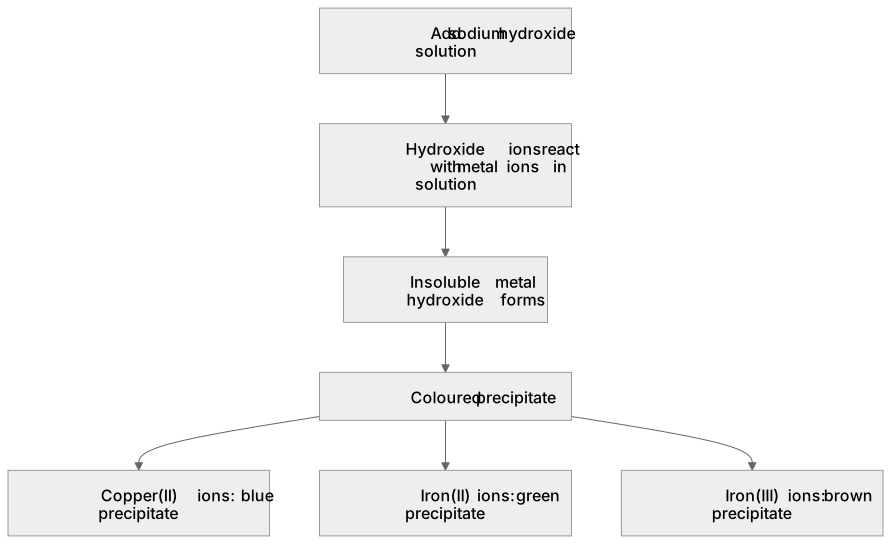
Transition metal ions in aqueous solution can be identified by adding a few drops of dilute sodium hydroxide solution. The hydroxide ions react with the metal aqua ions to form an insoluble metal hydroxide, which appears as a coloured precipitate because the solid particles are dispersed through the liquid. Copper(II) ions give a blue precipitate, iron(II) ions give a green precipitate and iron(III) ions give a brown precipitate. For example, adding NaOH(aq) to copper(II) sulfate solution produces Cu(OH)₂(s), which settles as a blue solid. The colour is characteristic of the metal ion, so this test distinguishes the three ions from each other and from ions that give no precipitate or a white precipitate.
What earns the marks
- Sodium hydroxide solution supplies hydroxide ions that react with metal ions in solution.
- The product is an insoluble metal hydroxide, so it appears as a precipitate rather than remaining dissolved.
- The colour of the precipitate depends on the identity of the metal ion present.
- Copper(II) ions produce a blue precipitate, iron(II) ions produce a green precipitate and iron(III) ions produce a brown precipitate.
- The test can be used to distinguish between solutions containing different transition metal ions.
Common mistakes and how to put them right
Describing the colour as belonging to the solution rather than the precipitate.
Put it right: The colour change is caused by the insoluble solid formed, so the observation should refer to the precipitate.
Confusing iron(II) and iron(III) colours.
Put it right: Iron(II) hydroxide is green while iron(III) hydroxide is brown, so the oxidation state must be matched to the correct colour.
Writing that sodium hydroxide dissolves in the metal solution without reaction.
Put it right: The hydroxide ions react to form a new insoluble compound, so the word reaction or precipitate should be used.
Exam tips
- State the reagent as sodium hydroxide solution and the observation as a coloured precipitate, naming the colour precisely.
- Link each colour to the correct ion, including the oxidation state in the name, for example iron(II) for green and iron(III) for brown.
- If asked to identify an unknown, describe adding sodium hydroxide solution and observing the precipitate colour before naming the ion.
Try the lesson
The start of the Metal hydroxides: Solutions of copper(II), iron(II) and iron(III) ions form coloured precipitates when sodium hydroxide solution is added. lesson, made from checked teaching notes for this specification point.
Have a go first
A student adds sodium hydroxide solution to separate solutions containing copper(II), iron(II) and iron(III) ions. What general observation is made for all three of these metal ions?
Listen
Transition metal ions in aqueous solution can be identified by adding a few drops of dilute sodium hydroxide solution. The hydroxide ions react with the metal aqua ions to form an insoluble metal hydroxide, which appears as a coloured precipitate because the solid particles are dispersed through the liquid. Copper(II) ions give a blue precipitate, iron(II) ions give a green precipitate and iron(III) ions give a brown precipitate. For example, adding NaOH(aq) to copper(II) sulfate solution produces Cu(OH)₂(s), which settles as a blue solid. The colour is characteristic of the metal ion, so this test distinguishes the three ions from each other and from ions that give no precipitate or a white precipitate. A strong answer earns marks for these points. Sodium hydroxide solution supplies hydroxide ions that react with metal ions in solution. The product is an insoluble metal hydroxide, so it appears as a precipitate rather than remaining dissolved. The colour of the precipitate depends on the identity of the metal ion present. Copper(II) ions produce a blue precipitate, iron(II) ions produce a green precipitate and iron(III) ions produce a brown precipitate. Exam tip: State the reagent as sodium hydroxide solution and the observation as a coloured precipitate, naming the colour precisely.
See it
Label the diagram
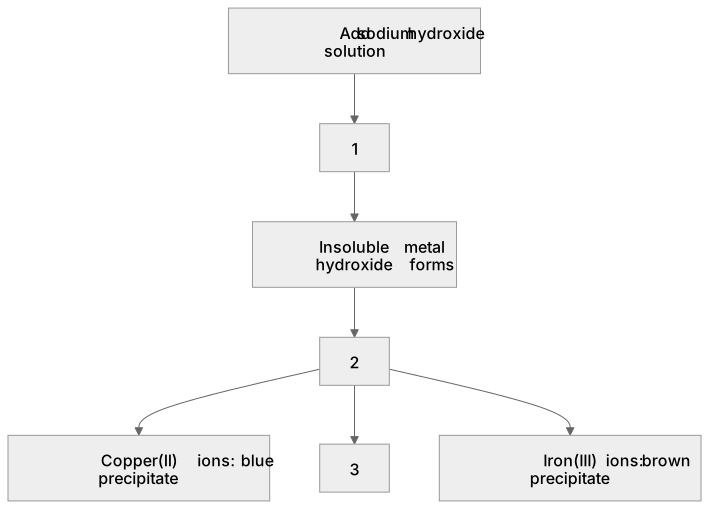
Some boxes have lost their names. Pick the right name for each number.
1Box 1
2Box 2
3Box 3
There is more to this lesson
The full lesson goes on to check your understanding and help you earn the marks. Create a free account to carry on, with your progress saved.
A week of Premium from your first lesson · Then the free plan continues · No card, no charge
Test your understanding of Metal hydroxides: Solutions of copper(II), iron(II) and iron(III) ions form coloured precipitates when sodium hydroxide solution is added.
Active recall beats re-reading. Take an instant quiz now to test what you’ve learned and lock it into long-term memory.
A week of Premium from your first lesson · Then the free plan continues · No card, no charge