AQA · GCSE · Chemistry
Course version: 8462 · Version from Sept 2018
Atoms can be represented as shown in this example: Students should be able…
Full specification wording
Size and mass of atoms: Atoms can be represented as shown in this example: Students should be able to calculate the numbers of protons, neutrons and electrons in an atom or ion, given its atomic number and mass number.
Every atom is defined by two numbers.
Checked against the AQA 8462 specification (opens in a new tab) on .
- Point 5 of 6
Study notes
From the checked teaching notes for this specification point.
The idea
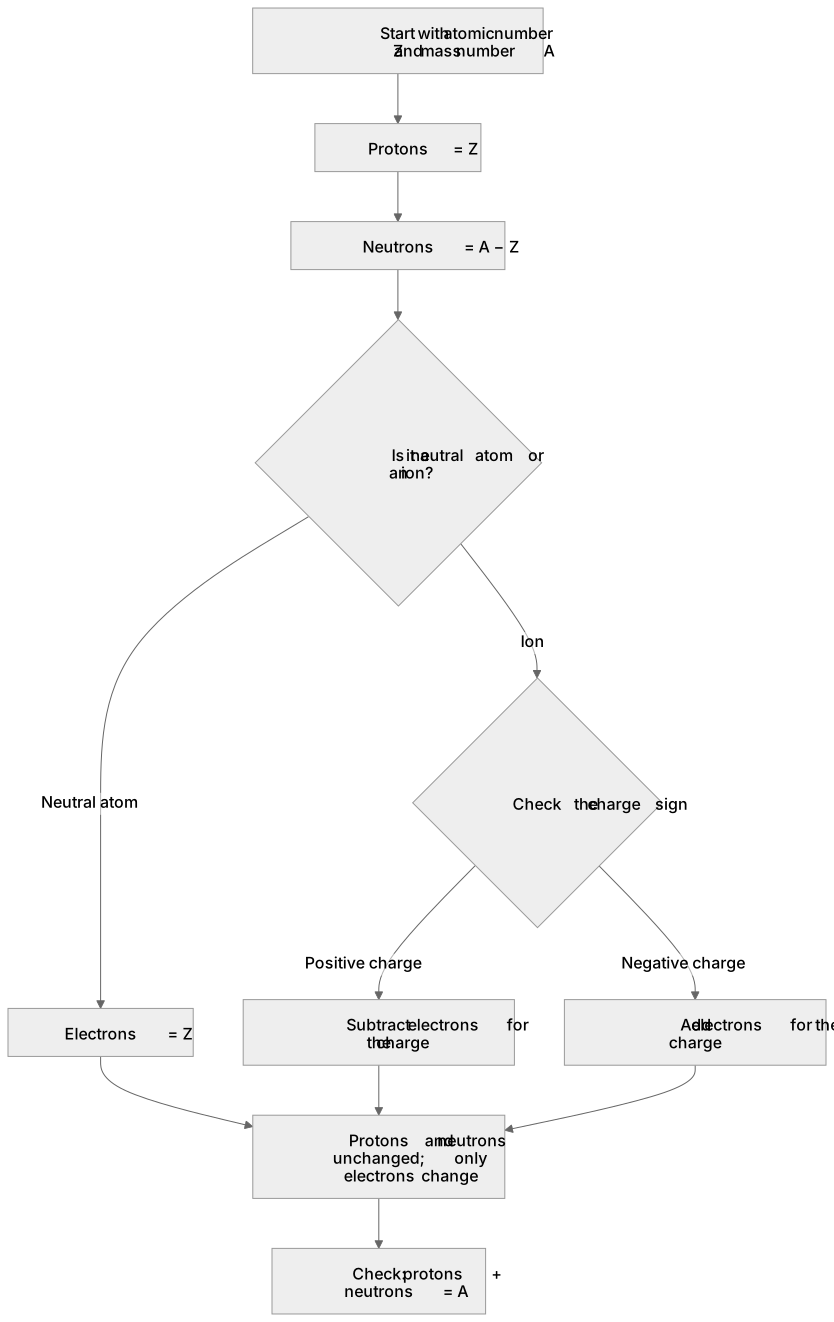
Every atom is defined by two numbers. The atomic number (Z) is the number of protons and fixes the element's identity. The mass number (A) is the total of protons and neutrons, so neutrons = A − Z. In a neutral atom, electrons equal protons. In an ion, the charge tells you the electron change: a 2⁺ ion has lost two electrons, so electrons = Z − 2; a 1⁻ ion has gained one, so electrons = Z + 1. For example, an atom with Z = 17 and A = 35 has 17 protons, 35 − 17 = 18 neutrons and 17 electrons; the ion with charge 1⁻ has 18 electrons. Always check the charge sign before adjusting the electron count.
What earns the marks
- Atomic number equals the number of protons and identifies the element.
- Mass number equals protons plus neutrons, so neutrons are found by subtracting atomic number from mass number.
- In a neutral atom the number of electrons equals the number of protons.
- For an ion, adjust the electron count by the charge: subtract electrons for a positive charge and add electrons for a negative charge.
- Protons and neutrons are unchanged when an atom forms an ion; only electrons change.
- A correct answer should state all three particle counts, not just one.
Common mistakes and how to put them right
Subtracting the number of electrons from the mass number to find neutrons.
Put it right: Subtract the atomic number from the mass number.
Treating a positive charge as extra electrons.
Put it right: A 2⁺ ion has lost two electrons.
Assuming ions have different proton numbers from their atoms.
Put it right: Keep the proton number fixed and change only the electron count.
Exam tips
- Write the values of Z and A first, then work through protons, neutrons and electrons in that order.
- Underline the charge on an ion before calculating electrons so you do not miss it.
- Check that protons plus neutrons equals the mass number as a final consistency check.
Try the lesson
The start of the Size and mass of atoms: Atoms can be represented as shown in this example: Students should be able to calculate the numbers of protons, neutrons and electrons in an atom or ion, given its atomic number and mass number. lesson, made from checked teaching notes for this specification point.
Have a go first
An atom of sodium has an atomic number of 11 and a mass number of 23. How many protons are in this atom?
Listen
Every atom is defined by two numbers. The atomic number (Z) is the number of protons and fixes the element's identity. The mass number (A) is the total of protons and neutrons, so neutrons = A − Z. In a neutral atom, electrons equal protons. In an ion, the charge tells you the electron change: a 2⁺ ion has lost two electrons, so electrons = Z − 2; a 1⁻ ion has gained one, so electrons = Z + 1. For example, an atom with Z = 17 and A = 35 has 17 protons, 35 − 17 = 18 neutrons and 17 electrons; the ion with charge 1⁻ has 18 electrons. Always check the charge sign before adjusting the electron count. A strong answer earns marks for these points. Atomic number equals the number of protons and identifies the element. Mass number equals protons plus neutrons, so neutrons are found by subtracting atomic number from mass number. In a neutral atom the number of electrons equals the number of protons. For an ion, adjust the electron count by the charge: subtract electrons for a positive charge and add electrons for a negative charge. A common slip: Subtracting the number of electrons from the mass number to find neutrons. Instead, subtract the atomic number from the mass number. Exam tip: Write the values of Z and A first, then work through protons, neutrons and electrons in that order.
See it
There is more to this lesson
The full lesson goes on to check your understanding and help you earn the marks. Create a free account to carry on, with your progress saved.
A week of Premium from your first lesson · Then the free plan continues · No card, no charge
Test your understanding of Size and mass of atoms: Atoms can be represented as shown in this example: Students should be able to calculate the numbers of protons, neutrons and electrons in an atom or ion, given its atomic number and mass number.
Active recall beats re-reading. Take an instant quiz now to test what you’ve learned and lock it into long-term memory.
A week of Premium from your first lesson · Then the free plan continues · No card, no charge