OCR · A-Level · Chemistry
Course version: H432 · Version from Sept 2017
(i) a buffer solution as a system that minimises pH changes on addition of…
Full specification wording
Acids, bases and buffers: (i) a buffer solution as a system that minimises pH changes on addition of small amounts of an acid or a base
A buffer solution is defined as a system that minimises pH changes when small amounts of an acid or a base are added.
- Point 17 of 26
- 4 key terms
Study notes
From the teaching notes for this specification point.
The idea
A buffer solution is defined as a system that minimises pH changes when small amounts of an acid or a base are added. The key idea is resistance, not complete prevention: the pH shifts only slightly because the solution contains reservoirs that remove added H⁺ or OH⁻ ions. In an acidic buffer, the weak acid removes added OH⁻ ions and the conjugate base removes added H⁺ ions. In a basic buffer, the weak base removes added H⁺ ions and its conjugate acid removes added OH⁻ ions. The buffer works until one reservoir is exhausted, after which the pH changes sharply. Recognise that the definition applies to both acidic and basic buffers and to small additions only.
What earns the marks
- Defines a buffer as a system that minimises pH change on addition of small amounts of acid or base.
- Emphasises that the pH change is minimised rather than prevented entirely.
- Explains that the buffer contains species that remove added H⁺ and OH⁻ ions.
- Applies the definition to both acidic buffers and basic buffers.
- Recognises that the buffer only works for small additions before its capacity is exceeded.
Common mistakes and how to put them right
States that a buffer keeps pH exactly constant.
Put it right: Describe it as minimising the change instead.
Restricts the definition to acidic buffers only.
Put it right: Include basic buffers such as ammonia with ammonium chloride.
Claims a buffer works for any amount of added acid or base.
Put it right: Note that capacity is limited to small additions.
Describes a buffer as simply a weak acid.
Put it right: Include the conjugate base that removes added H⁺ ions.
Exam tips
- Use the wording 'minimises pH changes' rather than 'prevents pH changes' in definitions.
- Name both components of the buffer when explaining how it works.
- Link each component to the ion it removes: conjugate base removes H⁺, weak acid removes OH⁻.
Try the lesson
The start of the Acids, bases and buffers: (i) a buffer solution as a system that minimises pH changes on addition of small amounts of an acid or a base lesson, made from teaching notes for this specification point.
Listen
A buffer solution is defined as a system that minimises pH changes when small amounts of an acid or a base are added. The key idea is resistance, not complete prevention: the pH shifts only slightly because the solution contains reservoirs that remove added H⁺ or OH⁻ ions. In an acidic buffer, the weak acid removes added OH⁻ ions and the conjugate base removes added H⁺ ions. In a basic buffer, the weak base removes added H⁺ ions and its conjugate acid removes added OH⁻ ions. The buffer works until one reservoir is exhausted, after which the pH changes sharply. Recognise that the definition applies to both acidic and basic buffers and to small additions only. A strong answer earns marks for these points. Defines a buffer as a system that minimises pH change on addition of small amounts of acid or base. Emphasises that the pH change is minimised rather than prevented entirely. Explains that the buffer contains species that remove added H⁺ and OH⁻ ions. Applies the definition to both acidic buffers and basic buffers. Exam tip: Use the wording 'minimises pH changes' rather than 'prevents pH changes' in definitions.
See it

Key words
Say what each word means before you turn the card.
Definition of a buffer solution
Try answering aloud or in your head before turning the card.
Minimising rather than preventing pH change
Try answering aloud or in your head before turning the card.
Removal of added H⁺ and OH⁻ ions
Try answering aloud or in your head before turning the card.
Limited capacity of buffers
Try answering aloud or in your head before turning the card.
See every definition
- Definition of a buffer solution
- A system that minimises pH changes on addition of small amounts of an acid or a base.
- Minimising rather than preventing pH change
- The pH shifts only slightly because the solution contains reservoirs that remove added H⁺ or OH⁻ ions.
- Removal of added H⁺ and OH⁻ ions
- In an acidic buffer, the weak acid removes added OH⁻ ions and the conjugate base removes added H⁺ ions.
- Limited capacity of buffers
- The buffer works until one reservoir is exhausted, after which the pH changes sharply.
Label the diagram
Some boxes have lost their names. Pick the right name for each number.
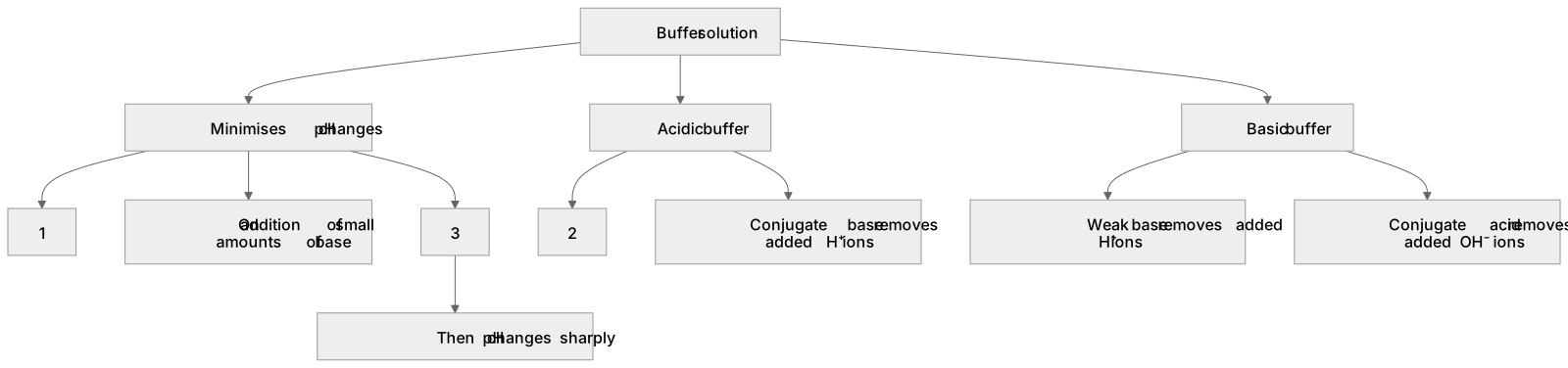
1Box 1
2Box 2
3Box 3
There is more to this lesson
The full lesson goes on to check your understanding and help you earn the marks. Create a free account to carry on, with your progress saved.
A week of Premium from your first lesson · Then the free plan continues · No card, no charge
Test your understanding of Acids, bases and buffers: (i) a buffer solution as a system that minimises pH changes on addition of small amounts of an acid or a base
Active recall beats re-reading. Take an instant quiz now to test what you’ve learned and lock it into long-term memory.
A week of Premium from your first lesson · Then the free plan continues · No card, no charge