OCR · A-Level · Chemistry
Course version: H432 · Version from Sept 2017
(d) use of the expression for pH as: pH = –log[H⁺] [H⁺] = 10^(–pH)
Full specification wording
Acids, bases and buffers: (d) use of the expression for pH as: pH = –log[H⁺] [H⁺] = 10^(–pH)
This criterion requires confident use of both forms of the pH expression: pH = –log₁₀[H⁺(aq)] and its rearrangement [H⁺(aq)] = 10^(–pH).
- Point 9 of 26
- 4 key terms
Study notes
From the teaching notes for this specification point.
The idea
This criterion requires confident use of both forms of the pH expression: pH = –log₁₀[H⁺(aq)] and its rearrangement [H⁺(aq)] = 10^(–pH). The logarithm is base 10, and the negative sign converts the negative logarithm of a dilute acid into a positive pH. For [H⁺(aq)] = 1.0 × 10⁻² mol dm⁻³, log₁₀(1.0 × 10⁻²) = –2, so pH = –(–2) = 2.00. Reversing, a pH of 2.00 gives [H⁺(aq)] = 10^(–2.00) = 1.0 × 10⁻² mol dm⁻³. Note that for concentrations below 1 mol dm⁻³ the logarithm is negative, so omitting the minus sign would report a negative pH for an ordinary acid. Practise both directions, keep concentrations in mol dm⁻³, and quote pH to two decimal places.
What earns the marks
- Uses pH = –log₁₀[H⁺(aq)] correctly, applying the negative sign to give a positive pH for a dilute acid.
- Rearranges to [H⁺(aq)] = 10^(–pH) and substitutes the pH value accurately.
- Recognises that log₁₀[H⁺(aq)] is negative when [H⁺(aq)] is below 1 mol dm⁻³, so the minus sign is needed.
- Converts between pH and [H⁺(aq)] in both directions and keeps units consistent.
- Interprets a change in pH as a logarithmic change in hydrogen ion concentration.
Common mistakes and how to put them right
Drops the negative sign in pH = –log₁₀[H⁺(aq)] and reports a negative pH for an ordinary dilute acid.
Put it right: Apply the minus sign so the value is positive.
Uses logₑ instead of log₁₀ when evaluating the expression.
Put it right: Use base-10 logarithms.
Forgets to raise 10 to the power of the negative pH and instead subtracts pH from 10.
Put it right: Apply the exponent correctly.
Mixes up the two expressions and substitutes pH into the logarithm.
Put it right: Match each expression to the quantity being found.
Exam tips
- Write out the chosen expression before substituting numbers to keep the direction of conversion clear.
- Sanity-check that an acidic solution gives pH below 7 and a positive value.
- Use the calculator's 10^x function for reverse calculations to avoid sign errors.
- State the concentration in mol dm⁻³ and pH without units.
Try the lesson
The start of the Acids, bases and buffers: (d) use of the expression for pH as: pH = –log[H⁺] [H⁺] = 10^(–pH) lesson, made from teaching notes for this specification point.
Listen
This criterion requires confident use of both forms of the pH expression: pH = –log₁₀[H⁺(aq)] and its rearrangement [H⁺(aq)] = 10^(–pH). The logarithm is base 10, and the negative sign converts the negative logarithm of a dilute acid into a positive pH. For [H⁺(aq)] = 1.0 × 10⁻² mol dm⁻³, log₁₀(1.0 × 10⁻²) = –2, so pH = –(–2) = 2.00. Reversing, a pH of 2.00 gives [H⁺(aq)] = 10^(–2.00) = 1.0 × 10⁻² mol dm⁻³. Note that for concentrations below 1 mol dm⁻³ the logarithm is negative, so omitting the minus sign would report a negative pH for an ordinary acid. Practise both directions, keep concentrations in mol dm⁻³, and quote pH to two decimal places. A strong answer earns marks for these points. Uses pH = –log₁₀[H⁺(aq)] correctly, applying the negative sign to give a positive pH for a dilute acid. Rearranges to [H⁺(aq)] = 10^(–pH) and substitutes the pH value accurately. Recognises that log₁₀[H⁺(aq)] is negative when [H⁺(aq)] is below 1 mol dm⁻³, so the minus sign is needed. Converts between pH and [H⁺(aq)] in both directions and keeps units consistent. Exam tip: Write out the chosen expression before substituting numbers to keep the direction of conversion clear.
See it
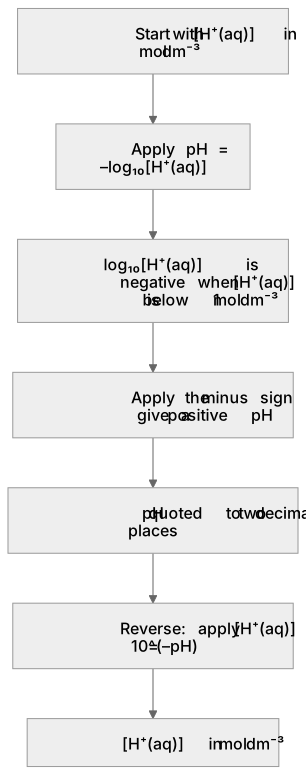
Put it in order
Put these steps in the order they happen.
- 1. [H⁺(aq)] in mol dm⁻³
- 2. Reverse: apply [H⁺(aq)] = 10^(–pH)
- 3. log₁₀[H⁺(aq)] is negative when [H⁺(aq)] is below 1 mol dm⁻³
- 4. pH quoted to two decimal places
- 5. Start with [H⁺(aq)] in mol dm⁻³
- 6. Apply pH = –log₁₀[H⁺(aq)]
- 7. Apply the minus sign to give a positive pH
Key words
Say what each word means before you turn the card.
pH expression
Try answering aloud or in your head before turning the card.
Base-10 logarithms
Try answering aloud or in your head before turning the card.
Negative sign
Try answering aloud or in your head before turning the card.
Two-way conversion
Try answering aloud or in your head before turning the card.
See every definition
- pH expression
- pH = –log[H⁺] and its rearrangement [H⁺] = 10^(–pH) are the two forms used to convert between pH and hydrogen ion concentration.
- Base-10 logarithms
- The logarithm in the pH expression is base 10, not logₑ, and for concentrations below 1 mol dm⁻³ it is negative.
- Negative sign
- The negative sign converts the negative logarithm of a dilute acid into a positive pH, so omitting it would report a negative pH for an ordinary acid.
- Two-way conversion
- Converting between pH and [H⁺(aq)] works in both directions, keeping concentrations in mol dm⁻³ and quoting pH to two decimal places.
Label the diagram
Some boxes have lost their names. Pick the right name for each number.
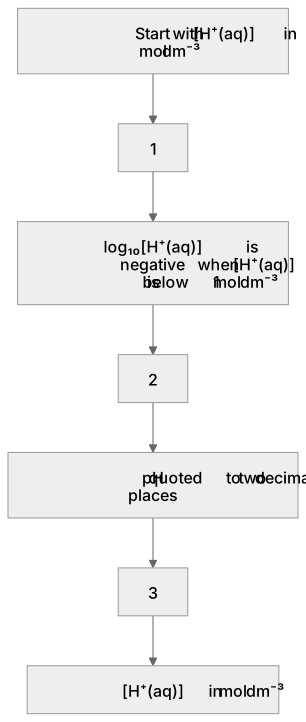
1Box 1
2Box 2
3Box 3
There is more to this lesson
The full lesson goes on to check your understanding and help you earn the marks. Create a free account to carry on, with your progress saved.
A week of Premium from your first lesson · Then the free plan continues · No card, no charge
Test your understanding of Acids, bases and buffers: (d) use of the expression for pH as: pH = –log[H⁺] [H⁺] = 10^(–pH)
Active recall beats re-reading. Take an instant quiz now to test what you’ve learned and lock it into long-term memory.
A week of Premium from your first lesson · Then the free plan continues · No card, no charge