OCR · A-Level · Chemistry
Course version: H432 · Version from Sept 2017
(a) (i) a Brønsted–Lowry acid as a species that donates a proton and a…
Full specification wording
Acids, bases and buffers: (a) (i) a Brønsted–Lowry acid as a species that donates a proton and a Brønsted–Lowry base as a species that accepts a proton (see also 2.1.4 Acids)
The Brønsted–Lowry definition classifies a species by what it does with a proton, H⁺.
- Point 2 of 26
- 4 key terms
Study notes
From the teaching notes for this specification point.
The idea
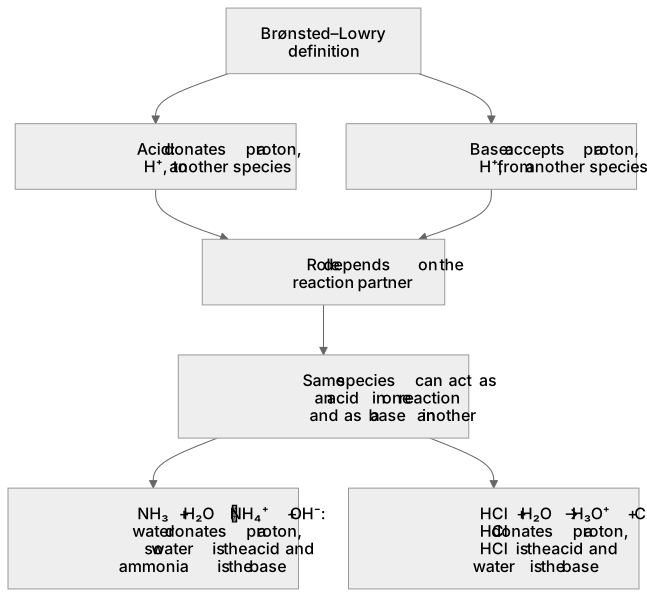
The Brønsted–Lowry definition classifies a species by what it does with a proton, H⁺. An acid donates a proton to another species; a base accepts a proton from another species. The definition is about behaviour in a reaction, not about a permanent label, so the same species can act as an acid in one reaction and as a base in another. For example, in NH₃ + H₂O ⇌ NH₄⁺ + OH⁻, water donates a proton to ammonia, so water is the acid and ammonia is the base. In HCl + H₂O → H₃O⁺ + Cl⁻, hydrogen chloride donates a proton to water, so HCl is the acid and water is the base. Notice that water changes role between the two reactions. A proton here means the H⁺ ion, a hydrogen atom that has lost its electron.
What earns the marks
- Identifies a Brønsted–Lowry acid as a species that donates a proton, H⁺, to another species.
- Identifies a Brønsted–Lowry base as a species that accepts a proton, H⁺, from another species.
- Applies the definition to a named reaction by stating which species donates the proton and which accepts it.
- Recognises that a species can act as an acid in one reaction and as a base in another, depending on the other reactant.
Common mistakes and how to put them right
Confuses the Brønsted–Lowry definition with the idea that an acid must contain hydroxide or that a base must contain OH⁻.
Put it right: State instead that the definition depends on proton donation and acceptance.
Treats the acid and base labels as fixed properties of a substance.
Put it right: Recognise instead that the role depends on the reaction partner.
Describes proton transfer without naming which species donates and which accepts.
Put it right: Specify the donor and the acceptor explicitly.
Equates a proton with a hydrogen atom or a hydrogen molecule.
Put it right: State that the proton is the H⁺ ion.
Exam tips
- Learn the definition as two matched halves: acid donates a proton, base accepts a proton, so either half can be tested.
- When a reaction is given, write the equation and mark the proton being transferred with an arrow from donor to acceptor.
- Check whether the question asks for a definition or an application, and answer in the form requested.
- Remember the cross-reference to 2.1.4 Acids, where the same proton-transfer idea is introduced.
Try the lesson
The start of the Acids, bases and buffers: (a) (i) a Brønsted–Lowry acid as a species that donates a proton and a Brønsted–Lowry base as a species that accepts a proton (see also 2.1.4 Acids) lesson, made from teaching notes for this specification point.
Listen
The Brønsted–Lowry definition classifies a species by what it does with a proton, H⁺. An acid donates a proton to another species; a base accepts a proton from another species. The definition is about behaviour in a reaction, not about a permanent label, so the same species can act as an acid in one reaction and as a base in another. For example, in NH₃ + H₂O ⇌ NH₄⁺ + OH⁻, water donates a proton to ammonia, so water is the acid and ammonia is the base. In HCl + H₂O → H₃O⁺ + Cl⁻, hydrogen chloride donates a proton to water, so HCl is the acid and water is the base. Notice that water changes role between the two reactions. A proton here means the H⁺ ion, a hydrogen atom that has lost its electron. A strong answer earns marks for these points. Identifies a Brønsted–Lowry acid as a species that donates a proton, H⁺, to another species. Identifies a Brønsted–Lowry base as a species that accepts a proton, H⁺, from another species. Applies the definition to a named reaction by stating which species donates the proton and which accepts it. Recognises that a species can act as an acid in one reaction and as a base in another, depending on the other reactant. Exam tip: Learn the definition as two matched halves: acid donates a proton, base accepts a proton, so either half can be tested.
See it
Key words
Say what each word means before you turn the card.
Brønsted–Lowry proton transfer
Try answering aloud or in your head before turning the card.
Acid as proton donor
Try answering aloud or in your head before turning the card.
Base as proton acceptor
Try answering aloud or in your head before turning the card.
Reaction-dependent roles of species
Try answering aloud or in your head before turning the card.
See every definition
- Brønsted–Lowry proton transfer
- Classifies a species by what it does with a proton, H⁺, which is a hydrogen atom that has lost its electron.
- Acid as proton donor
- A species that donates a proton, H⁺, to another species.
- Base as proton acceptor
- A species that accepts a proton, H⁺, from another species.
- Reaction-dependent roles of species
- The definition is about behaviour in a reaction, not a permanent label, so the same species can act as an acid in one reaction and as a base in another.
Label the diagram
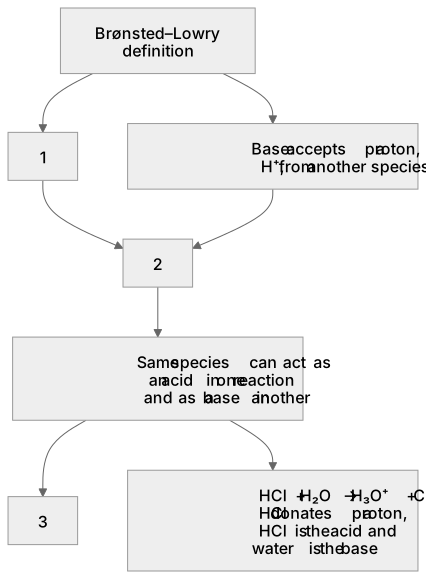
Some boxes have lost their names. Pick the right name for each number.
1Box 1
2Box 2
3Box 3
There is more to this lesson
The full lesson goes on to check your understanding and help you earn the marks. Create a free account to carry on, with your progress saved.
A week of Premium from your first lesson · Then the free plan continues · No card, no charge
Test your understanding of Acids, bases and buffers: (a) (i) a Brønsted–Lowry acid as a species that donates a proton and a Brønsted–Lowry base as a species that accepts a proton (see also 2.1.4 Acids)
Active recall beats re-reading. Take an instant quiz now to test what you’ve learned and lock it into long-term memory.
A week of Premium from your first lesson · Then the free plan continues · No card, no charge