OCR · A-Level · Chemistry
Course version: H432 · Version from Sept 2017
Acids, bases and buffers: (ii) use of the term conjugate acid–base pairs
A conjugate acid–base pair consists of two species that differ by one proton, H⁺.
- Point 3 of 26
- 4 key terms
Study notes
From the teaching notes for this specification point.
The idea
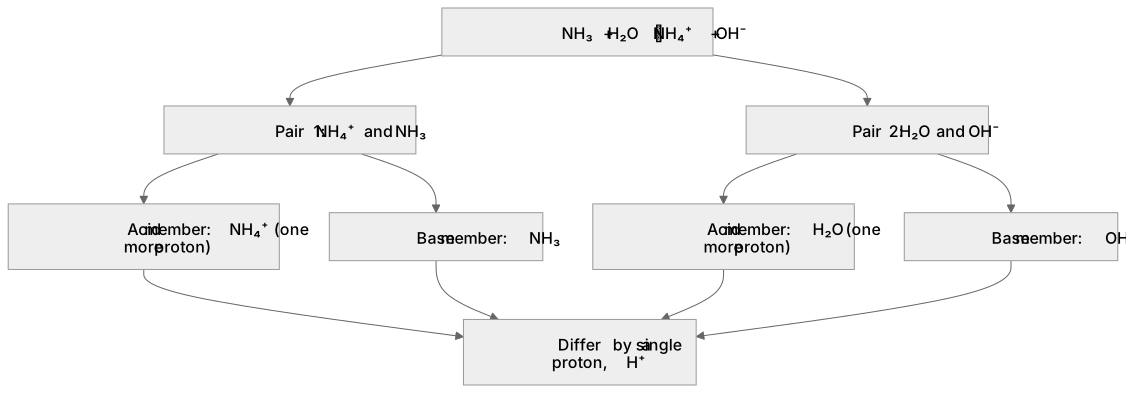
A conjugate acid–base pair consists of two species that differ by one proton, H⁺. The acid member of the pair has one more proton than the base member. When an acid donates a proton it becomes its conjugate base; when a base accepts a proton it becomes its conjugate acid. In NH₃ + H₂O ⇌ NH₄⁺ + OH⁻ there are two conjugate pairs: NH₄⁺ and NH₃ differ by one proton, and H₂O and OH⁻ differ by one proton. Label each pair by matching the species that gains or loses the single proton, and remember that the pair is written with the acid first by convention. The term lets you describe both directions of a reversible proton transfer without inventing new vocabulary.
What earns the marks
- Defines a conjugate acid–base pair as two species that differ by a single proton, H⁺.
- Identifies the acid member of a pair as the species with one more proton than its partner.
- Identifies the conjugate base formed when an acid donates a proton and the conjugate acid formed when a base accepts a proton.
- Applies the term to a given equilibrium by naming both conjugate pairs present.
Common mistakes and how to put them right
Pairs species that differ by more than one proton.
Put it right: Check that exactly one H⁺ separates the two members.
Reverses the labels by calling the proton-rich member the conjugate base.
Put it right: State that the acid member holds the extra proton.
Names only one conjugate pair in an equilibrium that contains two.
Put it right: Identify every pair present.
Treats a conjugate pair as any acid and base in the same equation.
Put it right: Match each species only with the partner it converts into by losing or gaining one proton.
Exam tips
- Count protons to check a pair: the acid member must have exactly one more H⁺ than the base member.
- Write the two members of each pair side by side and draw the single proton transfer between them.
- In a reversible proton-transfer equation, look for two pairs, one on each side of the arrow.
- Use the phrase conjugate acid–base pair precisely rather than the looser term acid and base.
Try the lesson
The start of the Acids, bases and buffers: (ii) use of the term conjugate acid–base pairs lesson, made from teaching notes for this specification point.
Listen
A conjugate acid–base pair consists of two species that differ by one proton, H⁺. The acid member of the pair has one more proton than the base member. When an acid donates a proton it becomes its conjugate base; when a base accepts a proton it becomes its conjugate acid. In NH₃ + H₂O ⇌ NH₄⁺ + OH⁻ there are two conjugate pairs: NH₄⁺ and NH₃ differ by one proton, and H₂O and OH⁻ differ by one proton. Label each pair by matching the species that gains or loses the single proton, and remember that the pair is written with the acid first by convention. The term lets you describe both directions of a reversible proton transfer without inventing new vocabulary. A strong answer earns marks for these points. Defines a conjugate acid–base pair as two species that differ by a single proton, H⁺. Identifies the acid member of a pair as the species with one more proton than its partner. Identifies the conjugate base formed when an acid donates a proton and the conjugate acid formed when a base accepts a proton. Applies the term to a given equilibrium by naming both conjugate pairs present. Exam tip: Count protons to check a pair: the acid member must have exactly one more H⁺ than the base member.
See it
Key words
Say what each word means before you turn the card.
Conjugate acid–base pair
Try answering aloud or in your head before turning the card.
Acid member
Try answering aloud or in your head before turning the card.
Conjugate base
Try answering aloud or in your head before turning the card.
Conjugate acid
Try answering aloud or in your head before turning the card.
See every definition
- Conjugate acid–base pair
- Two species that differ by a single proton, H⁺.
- Acid member
- The species in a pair that has one more proton than its partner.
- Conjugate base
- The species an acid becomes when it donates a proton.
- Conjugate acid
- The species a base becomes when it accepts a proton.
Label the diagram
Some boxes have lost their names. Pick the right name for each number.
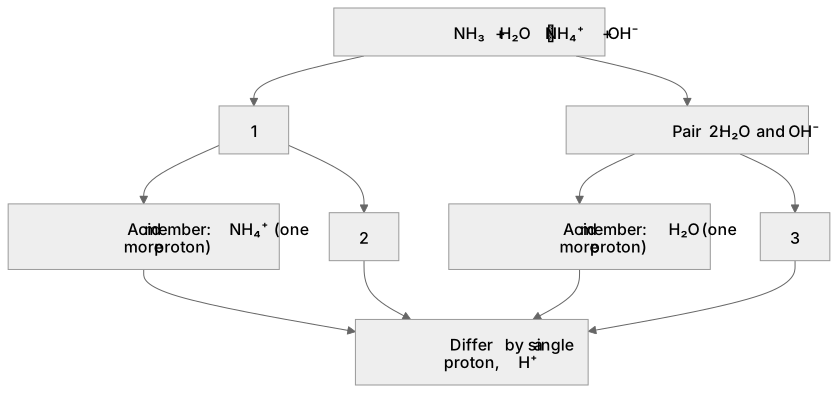
1Box 1
2Box 2
3Box 3
There is more to this lesson
The full lesson goes on to check your understanding and help you earn the marks. Create a free account to carry on, with your progress saved.
A week of Premium from your first lesson · Then the free plan continues · No card, no charge
Test your understanding of Acids, bases and buffers: (ii) use of the term conjugate acid–base pairs
Active recall beats re-reading. Take an instant quiz now to test what you’ve learned and lock it into long-term memory.
A week of Premium from your first lesson · Then the free plan continues · No card, no charge