OCR · A-Level · Chemistry
Course version: H432 · Version from Sept 2017
Alcohols: (b) combustion of alcohols
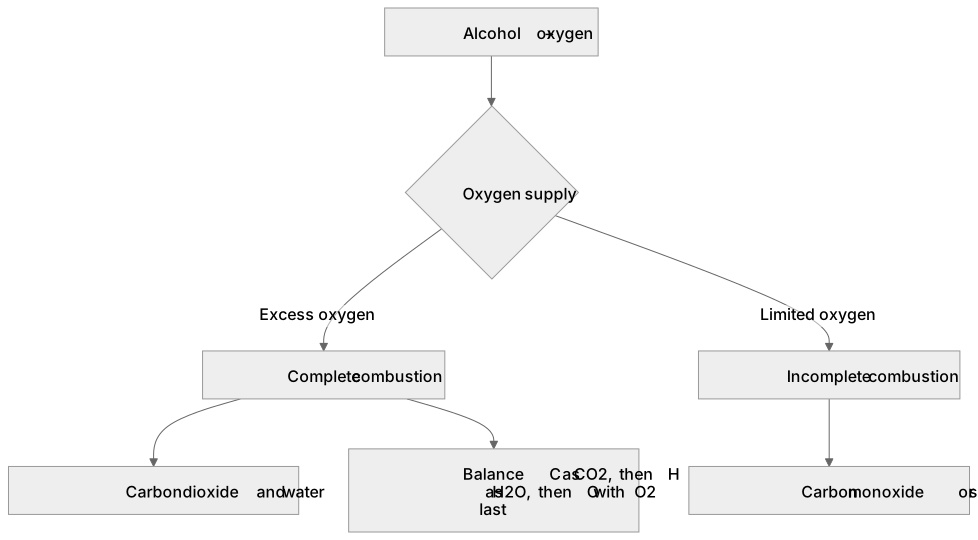
Combustion of alcohols means burning them in excess oxygen to give carbon dioxide and water, releasing energy.
- Point 4 of 10
- 4 key terms
Study notes
From the teaching notes for this specification point.
The idea
Combustion of alcohols means burning them in excess oxygen to give carbon dioxide and water, releasing energy. For a primary alcohol such as ethanol the equation is C₂H₅OH + 3O₂ → 2CO₂ + 3H₂O; check it by counting carbon, hydrogen and oxygen on each side. Learn to balance the equation for any given alcohol formula by first balancing carbon as CO₂, then hydrogen as H₂O, then oxygen with O₂, adjusting the O₂ coefficient last. Recognise that incomplete combustion in limited oxygen gives carbon monoxide or soot, and that alcohols are used as fuels because they burn cleanly.
What earns the marks
- Balances the combustion equation by matching carbon to CO₂, hydrogen to H₂O and then oxygen to O₂.
- States that complete combustion of an alcohol produces carbon dioxide and water only.
- Applies the correct mole ratio between the alcohol and oxygen or carbon dioxide from a balanced equation.
- Identifies carbon monoxide or carbon as the product of incomplete combustion in limited oxygen.
Common mistakes and how to put them right
Balances oxygen before carbon and hydrogen.
Put it right: Balance carbon and hydrogen first, then adjust the O₂ coefficient last.
Omits water from the products.
Put it right: Include both CO₂ and H₂O for complete combustion.
Treats incomplete combustion as producing the same products as complete combustion.
Put it right: Link limited oxygen to carbon monoxide or soot.
Exam tips
- Write the unbalanced skeleton first, then balance C, then H, then O, and recount every element at the end.
- In mole-ratio questions, divide by the coefficient of the alcohol to find moles of O₂ or CO₂ per mole of fuel.
- Read the stem carefully for 'excess oxygen' or 'limited oxygen', because that decides whether CO₂ and H₂O or CO and C are the products.
Try the lesson
The start of the Alcohols: (b) combustion of alcohols lesson, made from teaching notes for this specification point.
Listen
Combustion of alcohols means burning them in excess oxygen to give carbon dioxide and water, releasing energy. For a primary alcohol such as ethanol the equation is C₂H₅OH + 3O₂ → 2CO₂ + 3H₂O; check it by counting carbon, hydrogen and oxygen on each side. Learn to balance the equation for any given alcohol formula by first balancing carbon as CO₂, then hydrogen as H₂O, then oxygen with O₂, adjusting the O₂ coefficient last. Recognise that incomplete combustion in limited oxygen gives carbon monoxide or soot, and that alcohols are used as fuels because they burn cleanly. A strong answer earns marks for these points. Balances the combustion equation by matching carbon to CO₂, hydrogen to H₂O and then oxygen to O₂. States that complete combustion of an alcohol produces carbon dioxide and water only. Applies the correct mole ratio between the alcohol and oxygen or carbon dioxide from a balanced equation. Identifies carbon monoxide or carbon as the product of incomplete combustion in limited oxygen. A common slip: Balances oxygen before carbon and hydrogen. Instead, balance carbon and hydrogen first, then adjust the O₂ coefficient last. Exam tip: Write the unbalanced skeleton first, then balance C, then H, then O, and recount every element at the end.
See it
Key words
Say what each word means before you turn the card.
Complete combustion products of alcohols
Try answering aloud or in your head before turning the card.
Balancing organic combustion equations
Try answering aloud or in your head before turning the card.
Mole ratios from a balanced equation
Try answering aloud or in your head before turning the card.
Incomplete combustion in limited oxygen
Try answering aloud or in your head before turning the card.
See every definition
- Complete combustion products of alcohols
- Burning an alcohol in excess oxygen gives carbon dioxide and water only, releasing energy.
- Balancing organic combustion equations
- Balance carbon as CO₂ first, then hydrogen as H₂O, then oxygen with O₂, adjusting the O₂ coefficient last.
- Mole ratios from a balanced equation
- The correct mole ratio between the alcohol and oxygen or carbon dioxide is taken from a balanced equation.
- Incomplete combustion in limited oxygen
- In limited oxygen, incomplete combustion gives carbon monoxide or soot.
There is more to this lesson
The full lesson goes on to check your understanding and help you earn the marks. Create a free account to carry on, with your progress saved.
A week of Premium from your first lesson · Then the free plan continues · No card, no charge
Test your understanding of Alcohols: (b) combustion of alcohols
Active recall beats re-reading. Take an instant quiz now to test what you’ve learned and lock it into long-term memory.
A week of Premium from your first lesson · Then the free plan continues · No card, no charge