OCR · A-Level · Chemistry
Course version: H432 · Version from Sept 2017
(i) the oxidation of primary alcohols to form aldehydes and carboxylic…
Full specification wording
Alcohols: (i) the oxidation of primary alcohols to form aldehydes and carboxylic acids; the control of the oxidation product using different reaction conditions
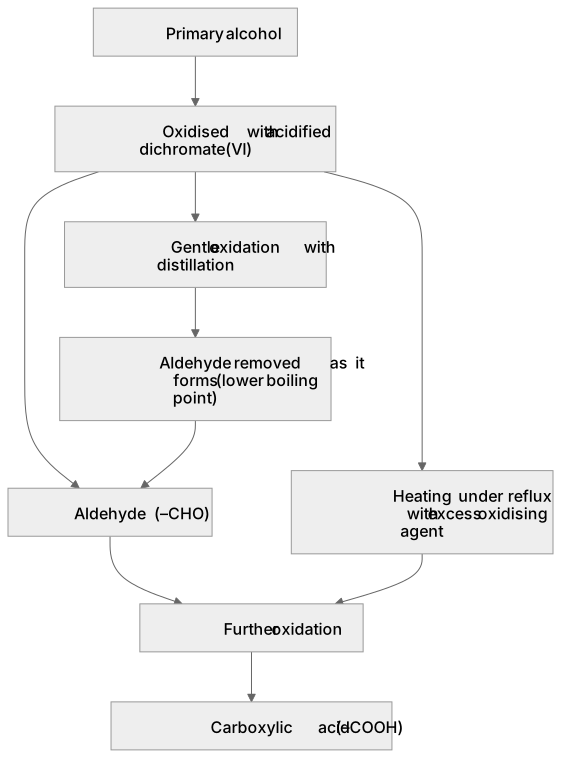
A primary alcohol such as ethanol can be oxidised by acidified dichromate(VI) to either an aldehyde or a carboxylic acid, and the product is controlled by the reaction conditions.
- Point 6 of 10
- 4 key terms
Study notes
From the teaching notes for this specification point.
The idea
A primary alcohol such as ethanol can be oxidised by acidified dichromate(VI) to either an aldehyde or a carboxylic acid, and the product is controlled by the reaction conditions. Gentle oxidation with distillation removes the aldehyde as it forms, because the aldehyde has a lower boiling point than the alcohol, so it escapes before further oxidation. Heating under reflux with excess oxidising agent keeps the aldehyde in contact with the reagent and oxidises it on to the carboxylic acid. Write the equations: ethanol to ethanal, CH₃CH₂OH + [O] → CH₃CHO + H₂O, and ethanal to ethanoic acid, CH₃CHO + [O] → CH₃COOH. The aldehyde functional group is –CHO and the carboxylic acid group is –COOH. Recognise that distillation gives the aldehyde and reflux with excess oxidising agent gives the carboxylic acid.
What earns the marks
- States that a primary alcohol is oxidised first to an aldehyde and then to a carboxylic acid.
- Explains that distillation removes the aldehyde as it forms, preventing further oxidation to the carboxylic acid.
- Explains that heating under reflux with excess acidified dichromate(VI) carries the oxidation through to the carboxylic acid.
- Writes the equation for oxidation of a primary alcohol to an aldehyde and for the aldehyde to a carboxylic acid.
- Identifies the aldehyde group –CHO and the carboxylic acid group –COOH in the products.
Common mistakes and how to put them right
Claims that reflux alone gives the aldehyde.
Put it right by stating that reflux with excess oxidising agent gives the carboxylic acid.
States that distillation gives the carboxylic acid.
Put it right by stating that distillation removes the lower-boiling aldehyde as it forms.
Writes the carboxylic acid product with an –OH group only.
Put it right: Correct it to the –COOH group.
Omits the water or oxygen in the oxidation equation.
Put it right: Balance the equation with [O] and H₂O correctly.
Exam tips
- Link each condition to its product: distillation gives the aldehyde, reflux with excess oxidising agent gives the carboxylic acid.
- Explain the control in terms of boiling point and removal of the aldehyde, not just by naming the apparatus.
- Check the functional group written in each product matches –CHO or –COOH.
Try the lesson
The start of the Alcohols: (i) the oxidation of primary alcohols to form aldehydes and carboxylic acids; the control of the oxidation product using different reaction conditions lesson, made from teaching notes for this specification point.
Listen
A primary alcohol such as ethanol can be oxidised by acidified dichromate(VI) to either an aldehyde or a carboxylic acid, and the product is controlled by the reaction conditions. Gentle oxidation with distillation removes the aldehyde as it forms, because the aldehyde has a lower boiling point than the alcohol, so it escapes before further oxidation. Heating under reflux with excess oxidising agent keeps the aldehyde in contact with the reagent and oxidises it on to the carboxylic acid. Write the equations: ethanol to ethanal, CH₃CH₂OH + [O] → CH₃CHO + H₂O, and ethanal to ethanoic acid, CH₃CHO + [O] → CH₃COOH. The aldehyde functional group is –CHO and the carboxylic acid group is –COOH. Recognise that distillation gives the aldehyde and reflux with excess oxidising agent gives the carboxylic acid. A strong answer earns marks for these points. States that a primary alcohol is oxidised first to an aldehyde and then to a carboxylic acid. Explains that distillation removes the aldehyde as it forms, preventing further oxidation to the carboxylic acid. Explains that heating under reflux with excess acidified dichromate(VI) carries the oxidation through to the carboxylic acid. Writes the equation for oxidation of a primary alcohol to an aldehyde and for the aldehyde to a carboxylic acid. A common slip: Claims that reflux alone gives the aldehyde. Instead, stating that reflux with excess oxidising agent gives the carboxylic acid. Exam tip: Link each condition to its product: distillation gives the aldehyde, reflux with excess oxidising agent gives the carboxylic acid.
See it
Key words
Say what each word means before you turn the card.
Controlling oxidation products
Try answering aloud or in your head before turning the card.
Distillation versus reflux
Try answering aloud or in your head before turning the card.
Functional groups of aldehydes and carboxylic acids
Try answering aloud or in your head before turning the card.
Writing organic oxidation equations
Try answering aloud or in your head before turning the card.
See every definition
- Controlling oxidation products
- The product of oxidising a primary alcohol is controlled by the reaction conditions, giving an aldehyde with distillation or a carboxylic acid with reflux and excess oxidising agent.
- Distillation versus reflux
- Distillation removes the lower-boiling aldehyde as it forms, preventing further oxidation, whereas heating under reflux with excess oxidising agent keeps the aldehyde in contact with the reagent and oxidises it on to the carboxylic acid.
- Functional groups of aldehydes and carboxylic acids
- The aldehyde functional group is –CHO and the carboxylic acid group is –COOH.
- Writing organic oxidation equations
- The equations are ethanol to ethanal, CH₃CH₂OH + [O] → CH₃CHO + H₂O, and ethanal to ethanoic acid, CH₃CHO + [O] → CH₃COOH.
Label the diagram
Some boxes have lost their names. Pick the right name for each number.
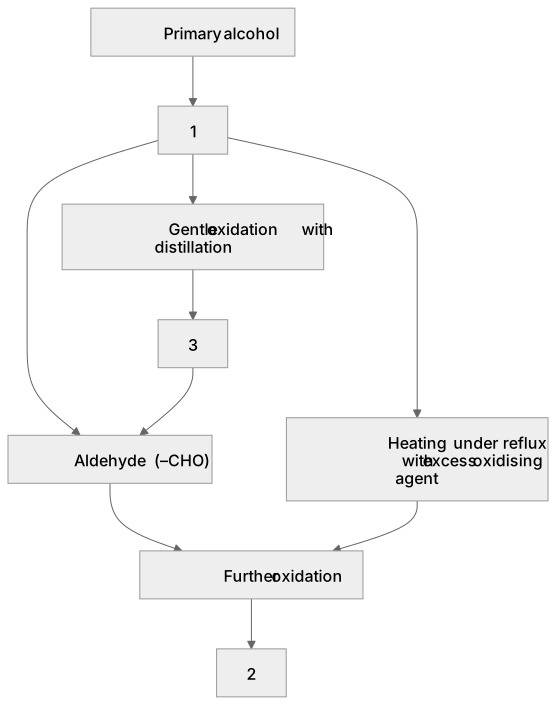
1Box 1
2Box 2
3Box 3
There is more to this lesson
The full lesson goes on to check your understanding and help you earn the marks. Create a free account to carry on, with your progress saved.
A week of Premium from your first lesson · Then the free plan continues · No card, no charge
Test your understanding of Alcohols: (i) the oxidation of primary alcohols to form aldehydes and carboxylic acids; the control of the oxidation product using different reaction conditions
Active recall beats re-reading. Take an instant quiz now to test what you’ve learned and lock it into long-term memory.
A week of Premium from your first lesson · Then the free plan continues · No card, no charge