OCR · A-Level · Chemistry
Course version: H432 · Version from Sept 2017
Alcohols: Properties of alcohols
Alcohols contain the hydroxyl group, written as −OH, covalently bonded to a carbon chain.
- Point 1 of 10
- 4 key terms
Study notes
From the teaching notes for this specification point.
The idea
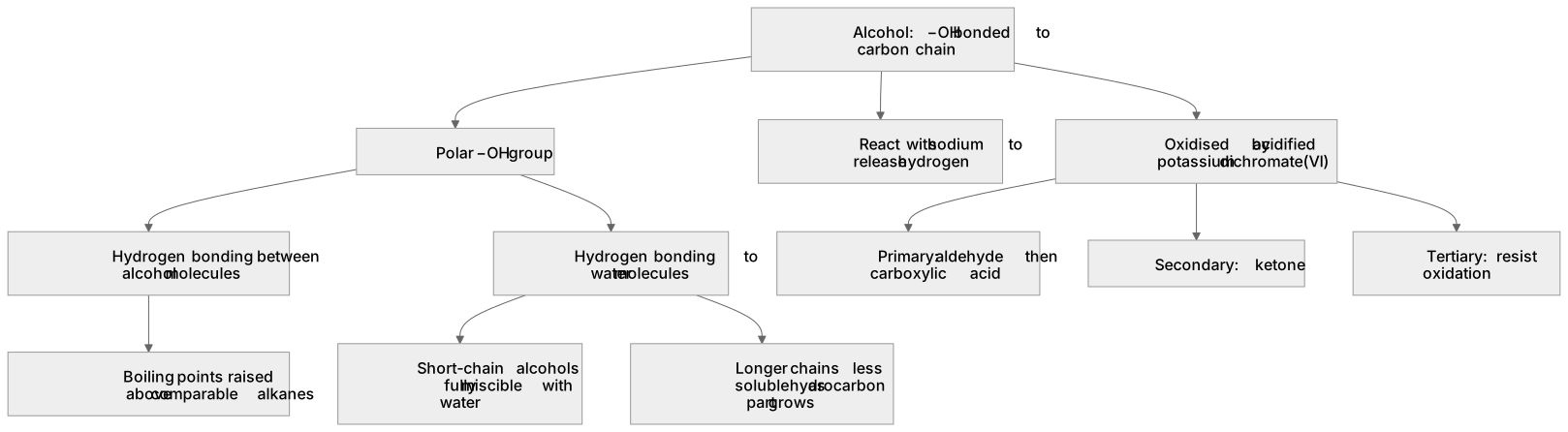
Alcohols contain the hydroxyl group, written as −OH, covalently bonded to a carbon chain. The −OH group is polar, so hydrogen bonding occurs between alcohol molecules, raising boiling points above those of comparable alkanes. Hydrogen bonding to water molecules also makes short-chain alcohols such as methanol and ethanol fully miscible with water, while longer chains become less soluble as the hydrocarbon part grows. Alcohols are neutral, unlike carboxylic acids, but they react with sodium to release hydrogen and can be oxidised by acidified potassium dichromate(VI). Primary alcohols oxidise to aldehydes and then carboxylic acids, secondary alcohols to ketones, and tertiary alcohols resist oxidation under these conditions.
What earns the marks
- Explains that hydrogen bonding between alcohol molecules raises boiling points relative to alkanes of similar mass.
- States that the polar −OH group allows hydrogen bonding with water, making short-chain alcohols soluble or miscible in water.
- Identifies that primary alcohols oxidise to aldehydes and then carboxylic acids with acidified potassium dichromate(VI).
- Distinguishes that secondary alcohols oxidise to ketones while tertiary alcohols are not readily oxidised under these conditions.
Common mistakes and how to put them right
Describes alcohols as acidic because of the −OH group.
Put it right by noting that alcohols are neutral and do not ionise like carboxylic acids.
Claims that all alcohols are equally soluble in water.
Put it right by explaining that solubility falls as the hydrocarbon chain lengthens.
States that tertiary alcohols oxidise to ketones.
Put it right by noting that tertiary alcohols resist oxidation under these conditions.
Exam tips
- Compare alcohol boiling points with alkanes of similar relative molecular mass to justify the hydrogen-bonding explanation.
- Check the class of alcohol (primary, secondary or tertiary) before predicting the oxidation product.
- Reject options that describe alcohols as acidic or that confuse aldehydes with ketones.
Try the lesson
The start of the Alcohols: Properties of alcohols lesson, made from teaching notes for this specification point.
Listen
Alcohols contain the hydroxyl group, written as −OH, covalently bonded to a carbon chain. The −OH group is polar, so hydrogen bonding occurs between alcohol molecules, raising boiling points above those of comparable alkanes. Hydrogen bonding to water molecules also makes short-chain alcohols such as methanol and ethanol fully miscible with water, while longer chains become less soluble as the hydrocarbon part grows. Alcohols are neutral, unlike carboxylic acids, but they react with sodium to release hydrogen and can be oxidised by acidified potassium dichromate(VI). Primary alcohols oxidise to aldehydes and then carboxylic acids, secondary alcohols to ketones, and tertiary alcohols resist oxidation under these conditions. A strong answer earns marks for these points. Explains that hydrogen bonding between alcohol molecules raises boiling points relative to alkanes of similar mass. States that the polar −OH group allows hydrogen bonding with water, making short-chain alcohols soluble or miscible in water. Identifies that primary alcohols oxidise to aldehydes and then carboxylic acids with acidified potassium dichromate(VI). Distinguishes that secondary alcohols oxidise to ketones while tertiary alcohols are not readily oxidised under these conditions. A common slip: Describes alcohols as acidic because of the −OH group. Instead, noting that alcohols are neutral and do not ionise like carboxylic acids. Exam tip: Compare alcohol boiling points with alkanes of similar relative molecular mass to justify the hydrogen-bonding explanation.
See it
Key words
Say what each word means before you turn the card.
The hydroxyl group and hydrogen bonding
Try answering aloud or in your head before turning the card.
Boiling points compared with alkanes
Try answering aloud or in your head before turning the card.
Solubility in water and chain length
Try answering aloud or in your head before turning the card.
Oxidation of primary, secondary and tertiary alcohols
Try answering aloud or in your head before turning the card.
See every definition
- The hydroxyl group and hydrogen bonding
- The −OH group is polar, so hydrogen bonding occurs between alcohol molecules, raising boiling points above those of comparable alkanes.
- Boiling points compared with alkanes
- Hydrogen bonding between alcohol molecules raises boiling points above those of comparable alkanes.
- Solubility in water and chain length
- Hydrogen bonding to water molecules makes short-chain alcohols fully miscible with water, while longer chains become less soluble as the hydrocarbon part grows.
- Oxidation of primary, secondary and tertiary alcohols
- Primary alcohols oxidise to aldehydes and then carboxylic acids, secondary alcohols to ketones, and tertiary alcohols resist oxidation under these conditions.
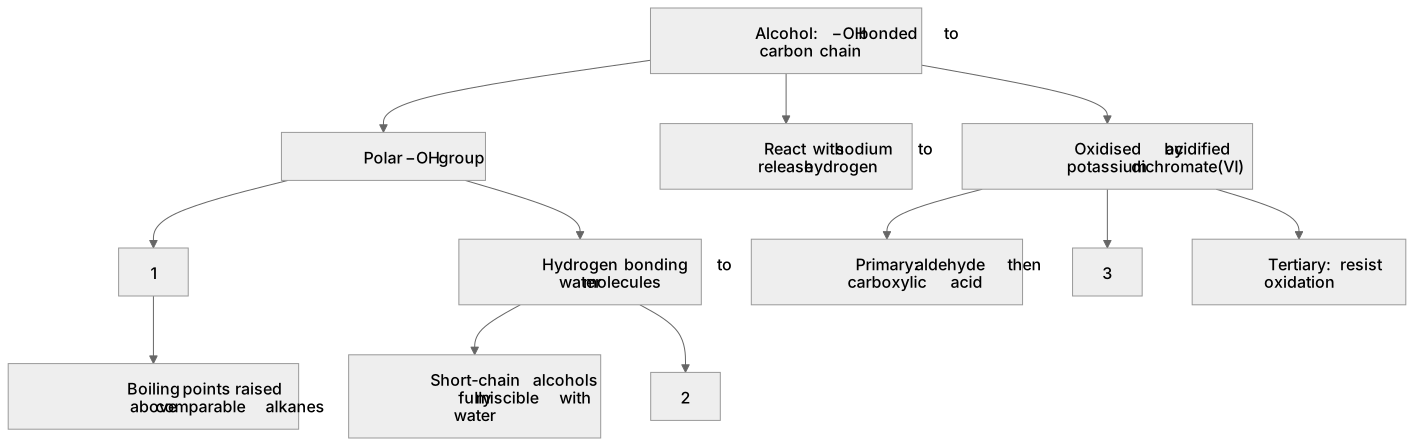
Label the diagram
Some boxes have lost their names. Pick the right name for each number.
1Box 1
2Box 2
3Box 3
There is more to this lesson
The full lesson goes on to check your understanding and help you earn the marks. Create a free account to carry on, with your progress saved.
A week of Premium from your first lesson · Then the free plan continues · No card, no charge
Test your understanding of Alcohols: Properties of alcohols
Active recall beats re-reading. Take an instant quiz now to test what you’ve learned and lock it into long-term memory.
A week of Premium from your first lesson · Then the free plan continues · No card, no charge