OCR · A-Level · Chemistry
Course version: H432 · Version from Sept 2017
(a) alkanes as saturated hydrocarbons containing single C–C and C–H bonds…
Full specification wording
Alkanes: (a) alkanes as saturated hydrocarbons containing single C–C and C–H bonds as σ-bonds (overlap of orbitals directly between the bonding atoms); free rotation of the σ-bond
Alkanes are saturated hydrocarbons: each carbon forms four single bonds, so the molecules contain only single C–C and C–H bonds with no C=C or C≡C. Each of these single bonds is a σ-bond, formed…
- Point 1 of 7
- 4 key terms
Study notes
From the teaching notes for this specification point.
The idea
Alkanes are saturated hydrocarbons: each carbon forms four single bonds, so the molecules contain only single C–C and C–H bonds with no C=C or C≡C. Each of these single bonds is a σ-bond, formed when orbitals on the two bonding atoms overlap directly along the line joining the nuclei (end-on overlap), giving a region of electron density concentrated between the atoms. Because the σ-bond electron density is symmetrical about the bond axis, rotation about a C–C σ-bond does not break the bond, so the groups can rotate freely relative to one another. In a multiple-choice question, expect options that test saturation, the identity of the bonds, the meaning of direct orbital overlap, or the consequence of free rotation. Read each option against all three ideas before choosing.
What earns the marks
- States that alkanes are saturated hydrocarbons containing only single C–C and C–H bonds.
- Identifies each single bond in an alkane as a σ-bond formed by direct (end-on) overlap of orbitals between the bonding atoms.
- Explains that the σ-bond allows free rotation about the C–C bond because rotation does not break the end-on overlap.
- Rejects options describing alkanes as unsaturated or as containing π-bonds, since alkanes have only single bonds.
- Distinguishes σ-bond formation by direct orbital overlap from sideways overlap that would give a π-bond.
Common mistakes and how to put them right
Describes alkanes as unsaturated.
Put it right by stating that alkanes contain only single bonds and are saturated.
Claims the σ-bond forms by sideways overlap of orbitals.
Put it right: State instead that σ-bonds form by direct, end-on overlap between the bonding atoms.
Says rotation about the C–C bond is restricted.
Put it right: Explain that the σ-bond allows free rotation because the direct overlap is not broken.
Treats every bond in an alkane as identical in length and strength.
Put it right: Recognise that C–C and C–H bonds differ even though both are σ-bonds.
Exam tips
- Check each option against all three clauses: saturation, σ-bond by direct overlap, and free rotation.
- Eliminate options that mention π-bonds or double bonds, because alkanes contain neither.
- When an option describes overlap, ask whether it is direct (end-on) or sideways before accepting it.
Try the lesson
The start of the Alkanes: (a) alkanes as saturated hydrocarbons containing single C–C and C–H bonds as σ-bonds (overlap of orbitals directly between the bonding atoms); free rotation of the σ-bond lesson, made from teaching notes for this specification point.
Listen
Alkanes are saturated hydrocarbons: each carbon forms four single bonds, so the molecules contain only single C–C and C–H bonds with no C=C or C≡C. Each of these single bonds is a σ-bond, formed when orbitals on the two bonding atoms overlap directly along the line joining the nuclei (end-on overlap), giving a region of electron density concentrated between the atoms. Because the σ-bond electron density is symmetrical about the bond axis, rotation about a C–C σ-bond does not break the bond, so the groups can rotate freely relative to one another. In a multiple-choice question, expect options that test saturation, the identity of the bonds, the meaning of direct orbital overlap, or the consequence of free rotation. Read each option against all three ideas before choosing. A strong answer earns marks for these points. States that alkanes are saturated hydrocarbons containing only single C–C and C–H bonds. Identifies each single bond in an alkane as a σ-bond formed by direct (end-on) overlap of orbitals between the bonding atoms. Explains that the σ-bond allows free rotation about the C–C bond because rotation does not break the end-on overlap. Rejects options describing alkanes as unsaturated or as containing π-bonds, since alkanes have only single bonds. A common slip: Describes alkanes as unsaturated. Instead, stating that alkanes contain only single bonds and are saturated. Exam tip: Check each option against all three clauses: saturation, σ-bond by direct overlap, and free rotation.
See it
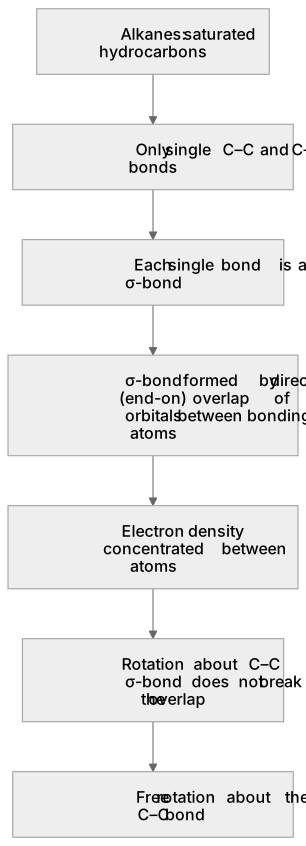
Put it in order
Put these steps in the order they happen.
- 1. Free rotation about the C–C bond
- 2. Rotation about C–C σ-bond does not break the overlap
- 3. Each single bond is a σ-bond
- 4. Electron density concentrated between the atoms
- 5. Alkanes: saturated hydrocarbons
- 6. Only single C–C and C–H bonds
- 7. σ-bond formed by direct (end-on) overlap of orbitals between bonding atoms
Key words
Say what each word means before you turn the card.
Saturation and single bonding in alkanes
Try answering aloud or in your head before turning the card.
σ-bond formation by direct orbital overlap
Try answering aloud or in your head before turning the card.
Free rotation about σ-bonds
Try answering aloud or in your head before turning the card.
Distinguishing σ-bonds from π-bonds
Try answering aloud or in your head before turning the card.
See every definition
- Saturation and single bonding in alkanes
- Alkanes are saturated hydrocarbons containing only single C–C and C–H bonds, with no C=C or C≡C.
- σ-bond formation by direct orbital overlap
- A σ-bond is formed when orbitals on the two bonding atoms overlap directly along the line joining the nuclei, giving a region of electron density concentrated between the atoms.
- Free rotation about σ-bonds
- Because the σ-bond electron density is symmetrical about the bond axis, rotation about a C–C σ-bond does not break the bond, so the groups can rotate freely relative to one another.
- Distinguishing σ-bonds from π-bonds
- σ-bonds form by direct, end-on overlap of orbitals between the bonding atoms, whereas sideways overlap would give a π-bond.
Label the diagram
Some boxes have lost their names. Pick the right name for each number.
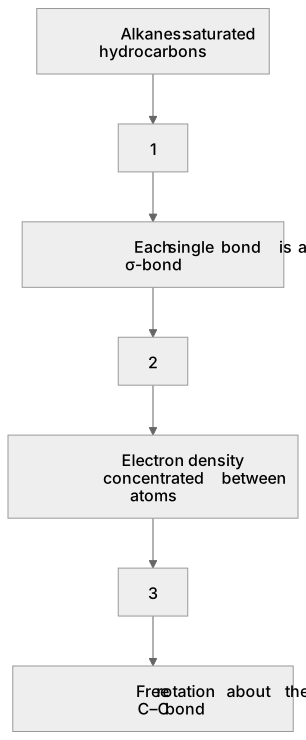
1Box 1
2Box 2
3Box 3
There is more to this lesson
The full lesson goes on to check your understanding and help you earn the marks. Create a free account to carry on, with your progress saved.
A week of Premium from your first lesson · Then the free plan continues · No card, no charge
Test your understanding of Alkanes: (a) alkanes as saturated hydrocarbons containing single C–C and C–H bonds as σ-bonds (overlap of orbitals directly between the bonding atoms); free rotation of the σ-bond
Active recall beats re-reading. Take an instant quiz now to test what you’ve learned and lock it into long-term memory.
A week of Premium from your first lesson · Then the free plan continues · No card, no charge