OCR · A-Level · Chemistry
Course version: H432 · Version from Sept 2017
(a) alkenes as unsaturated hydrocarbons containing a C=C bond comprising a…
Full specification wording
Alkenes: (a) alkenes as unsaturated hydrocarbons containing a C=C bond comprising a π-bond (sideways overlap of adjacent p-orbitals above and below the bonding C atoms) and a σ-bond (overlap of orbitals directly between the bonding atoms) (see also 4.1.2 a); restricted rotation of the π-bond
Alkenes are unsaturated hydrocarbons: their molecules contain only carbon and hydrogen and include at least one C=C double bond, so they hold fewer hydrogen atoms than the corresponding alkane.
- Point 1 of 27
- 4 key terms
Study notes
From the teaching notes for this specification point.
The idea
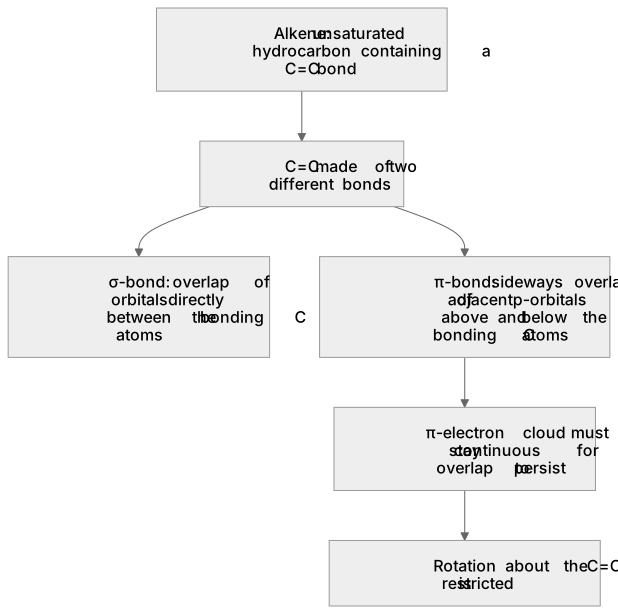
Alkenes are unsaturated hydrocarbons: their molecules contain only carbon and hydrogen and include at least one C=C double bond, so they hold fewer hydrogen atoms than the corresponding alkane. The C=C is not two identical bonds. One σ-bond forms by direct end-on overlap of orbitals along the line between the two carbon nuclei. The π-bond forms by sideways overlap of adjacent p-orbitals, giving electron density above and below the C–C axis. Because the π-electron cloud must stay continuous for overlap to persist, rotation about the C=C is restricted, which is why alkene stereoisomerism such as E/Z exists.
What earns the marks
- Identifies an alkene as a hydrocarbon that is unsaturated because it contains a C=C double bond.
- States that the C=C consists of one σ-bond and one π-bond.
- Describes the σ-bond as formed by overlap of orbitals directly between the bonding carbon atoms.
- Describes the π-bond as formed by sideways overlap of adjacent p-orbitals above and below the bonding carbon atoms.
- Explains that the π-bond restricts rotation about the C=C bond.
Common mistakes and how to put them right
Describes the C=C as two identical bonds.
Put it right: Distinguish one σ-bond and one π-bond.
Places the π-electron density along the internuclear axis.
Put it right: Locate it above and below the bonding carbon atoms.
Claims free rotation about the C=C.
Put it right: State that the π-bond restricts rotation.
Treats an alkene as saturated.
Put it right: State that the C=C makes it unsaturated.
Exam tips
- Learn the σ/π descriptions as spatial pictures: end-on overlap for σ, sideways p-orbital overlap above and below for π.
- Link restricted rotation directly to the need for continuous sideways overlap of the p-orbitals.
- Check that any hydrocarbon you name contains only C and H before calling it an alkene.
Try the lesson
The start of the Alkenes: (a) alkenes as unsaturated hydrocarbons containing a C=C bond comprising a π-bond (sideways overlap of adjacent p-orbitals above and below the bonding C atoms) and a σ-bond (overlap of orbitals directly between the bonding atoms) (see also 4.1.2 a); restricted rotation of the π-bond lesson, made from teaching notes for this specification point.
Listen
Alkenes are unsaturated hydrocarbons: their molecules contain only carbon and hydrogen and include at least one C=C double bond, so they hold fewer hydrogen atoms than the corresponding alkane. The C=C is not two identical bonds. One σ-bond forms by direct end-on overlap of orbitals along the line between the two carbon nuclei. The π-bond forms by sideways overlap of adjacent p-orbitals, giving electron density above and below the C–C axis. Because the π-electron cloud must stay continuous for overlap to persist, rotation about the C=C is restricted, which is why alkene stereoisomerism such as E/Z exists. A strong answer earns marks for these points. Identifies an alkene as a hydrocarbon that is unsaturated because it contains a C=C double bond. States that the C=C consists of one σ-bond and one π-bond. Describes the σ-bond as formed by overlap of orbitals directly between the bonding carbon atoms. Describes the π-bond as formed by sideways overlap of adjacent p-orbitals above and below the bonding carbon atoms. Exam tip: Learn the σ/π descriptions as spatial pictures: end-on overlap for σ, sideways p-orbital overlap above and below for π.
See it
Key words
Say what each word means before you turn the card.
Unsaturation and the C=C double bond
Try answering aloud or in your head before turning the card.
σ-bond formation by end-on orbital overlap
Try answering aloud or in your head before turning the card.
π-bond formation by sideways p-orbital overlap
Try answering aloud or in your head before turning the card.
Restricted rotation and its consequences
Try answering aloud or in your head before turning the card.
See every definition
- Unsaturation and the C=C double bond
- An alkene is a hydrocarbon that is unsaturated because it contains a C=C double bond, so it holds fewer hydrogen atoms than the corresponding alkane.
- σ-bond formation by end-on orbital overlap
- The σ-bond is formed by overlap of orbitals directly between the bonding carbon atoms, along the line between the two carbon nuclei.
- π-bond formation by sideways p-orbital overlap
- The π-bond is formed by sideways overlap of adjacent p-orbitals, giving electron density above and below the bonding carbon atoms.
- Restricted rotation and its consequences
- The π-bond restricts rotation about the C=C bond because the π-electron cloud must stay continuous for overlap to persist, which is why alkene stereoisomerism such as E/Z exists.
Label the diagram
Some boxes have lost their names. Pick the right name for each number.
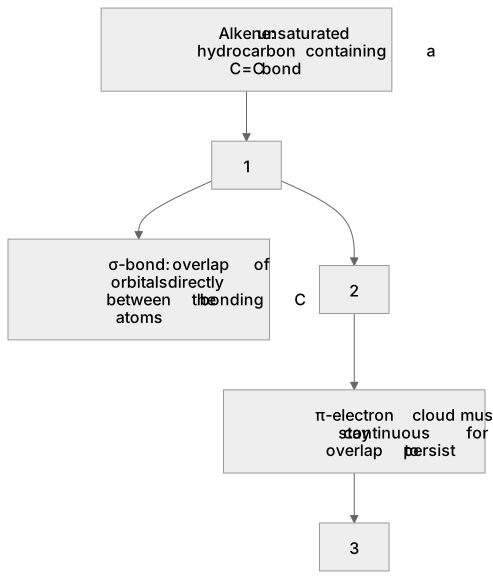
1Box 1
2Box 2
3Box 3
There is more to this lesson
The full lesson goes on to check your understanding and help you earn the marks. Create a free account to carry on, with your progress saved.
A week of Premium from your first lesson · Then the free plan continues · No card, no charge
Test your understanding of Alkenes: (a) alkenes as unsaturated hydrocarbons containing a C=C bond comprising a π-bond (sideways overlap of adjacent p-orbitals above and below the bonding C atoms) and a σ-bond (overlap of orbitals directly between the bonding atoms) (see also 4.1.2 a); restricted rotation of the π-bond
Active recall beats re-reading. Take an instant quiz now to test what you’ve learned and lock it into long-term memory.
A week of Premium from your first lesson · Then the free plan continues · No card, no charge