OCR · A-Level · Chemistry
Course version: H432 · Version from Sept 2017
Alkenes: Addition reactions of alkenes
Alkenes contain a C=C double bond made of a sigma bond and a pi bond.
- Point 9 of 27
- 3 key terms
Study notes
From the teaching notes for this specification point.
The idea
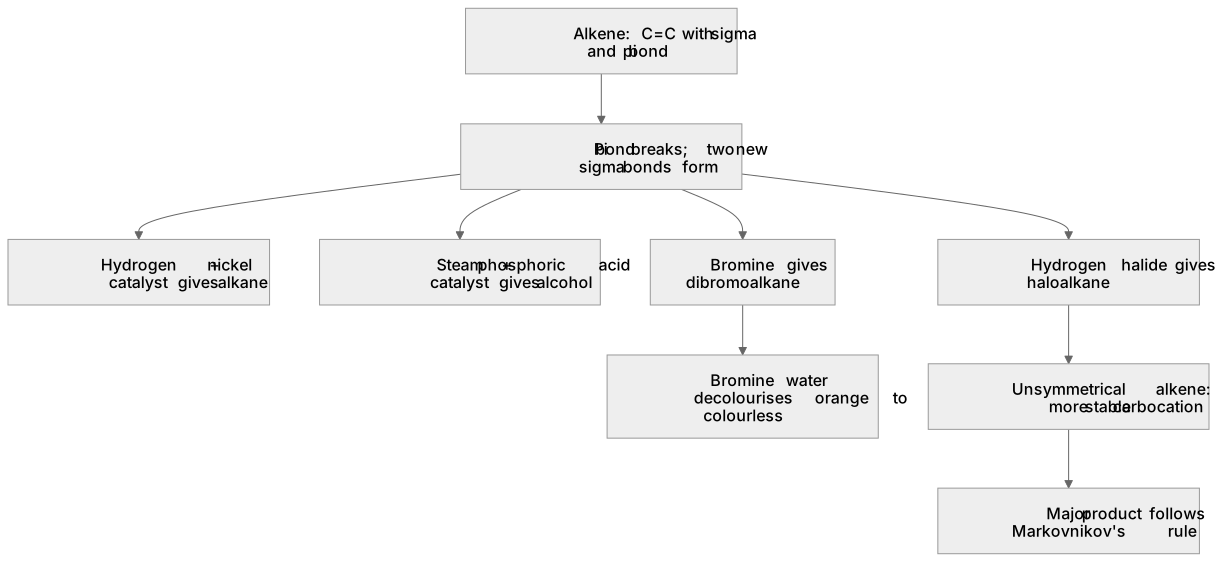
Alkenes contain a C=C double bond made of a sigma bond and a pi bond. The pi electrons are exposed above and below the molecular plane, so alkenes are nucleophiles and undergo electrophilic addition. In each addition reaction the pi bond breaks and two new sigma bonds form, converting the unsaturated alkene into a saturated product. Typical reagents include hydrogen with a nickel catalyst to give an alkane, steam with a phosphoric acid catalyst to give an alcohol, hydrogen halides to give a haloalkane, and bromine to give a dibromoalkane. Bromine water decolourises from orange to colourless, which is the standard test for a C=C bond. With an unsymmetrical alkene such as propene, the hydrogen halide adds to give the more stable carbocation intermediate, so the major product follows Markovnikov's rule. Write the balanced equation and name the product.
What earns the marks
- Describes electrophilic addition as the breaking of the pi bond and formation of two new sigma bonds.
- Identifies the alkene as a nucleophile that attracts an electrophile to the electron-rich double bond.
- Names a valid addition reagent and its product, such as hydrogen with a nickel catalyst giving an alkane.
- Explains that bromine water is decolourised by an alkene, confirming the presence of a C=C bond.
- Applies Markovnikov's rule to an unsymmetrical alkene by forming the more stable carbocation intermediate.
- Writes a balanced equation for the chosen addition reaction.
Common mistakes and how to put them right
Describes the reaction as substitution rather than addition.
Put it right: State that the pi bond opens and two groups add across the double bond.
Omits the catalyst when naming hydrogenation or hydration conditions.
Put it right: Include nickel for hydrogen and phosphoric acid for steam.
Predicts the minor product for an unsymmetrical alkene.
Put it right: Apply Markovnikov's rule to place hydrogen on the carbon with more hydrogens.
Claims bromine water stays orange with an alkene.
Put it right: State that it decolourises as bromine adds across the double bond.
Exam tips
- Learn the reagent and condition pair for each addition reaction so you can name the product quickly.
- Show the curly arrow mechanism from the pi bond to the electrophile when a mechanism is asked for.
- For unsymmetrical alkenes, draw the two possible carbocations and choose the more stable one before naming the major product.
- Use the bromine water test wording precisely: orange to colourless.
Try the lesson
The start of the Alkenes: Addition reactions of alkenes lesson, made from teaching notes for this specification point.
Listen
Alkenes contain a C=C double bond made of a sigma bond and a pi bond. The pi electrons are exposed above and below the molecular plane, so alkenes are nucleophiles and undergo electrophilic addition. In each addition reaction the pi bond breaks and two new sigma bonds form, converting the unsaturated alkene into a saturated product. Typical reagents include hydrogen with a nickel catalyst to give an alkane, steam with a phosphoric acid catalyst to give an alcohol, hydrogen halides to give a haloalkane, and bromine to give a dibromoalkane. Bromine water decolourises from orange to colourless, which is the standard test for a C=C bond. With an unsymmetrical alkene such as propene, the hydrogen halide adds to give the more stable carbocation intermediate, so the major product follows Markovnikov's rule. Write the balanced equation and name the product. A strong answer earns marks for these points. Describes electrophilic addition as the breaking of the pi bond and formation of two new sigma bonds. Identifies the alkene as a nucleophile that attracts an electrophile to the electron-rich double bond. Names a valid addition reagent and its product, such as hydrogen with a nickel catalyst giving an alkane. Explains that bromine water is decolourised by an alkene, confirming the presence of a C=C bond. Exam tip: Learn the reagent and condition pair for each addition reaction so you can name the product quickly.
See it
Key words
Say what each word means before you turn the card.
Electrophilic addition
Try answering aloud or in your head before turning the card.
Markovnikov's rule and carbocation stability
Try answering aloud or in your head before turning the card.
Bromine water test for unsaturation
Try answering aloud or in your head before turning the card.
See every definition
- Electrophilic addition
- A reaction in which the pi bond breaks and two new sigma bonds form, converting the unsaturated alkene into a saturated product.
- Markovnikov's rule and carbocation stability
- With an unsymmetrical alkene the hydrogen halide adds to give the more stable carbocation intermediate, so the major product follows this rule.
- Bromine water test for unsaturation
- Bromine water decolourises from orange to colourless, which is the standard test for a C=C bond.
Label the diagram
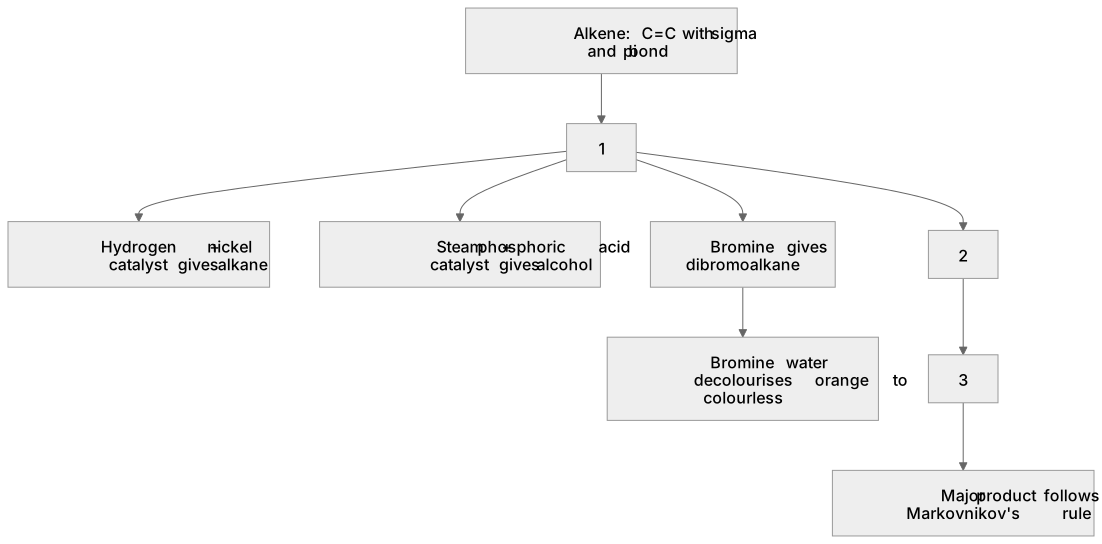
Some boxes have lost their names. Pick the right name for each number.
1Box 1
2Box 2
3Box 3
There is more to this lesson
The full lesson goes on to check your understanding and help you earn the marks. Create a free account to carry on, with your progress saved.
A week of Premium from your first lesson · Then the free plan continues · No card, no charge
Test your understanding of Alkenes: Addition reactions of alkenes
Active recall beats re-reading. Take an instant quiz now to test what you’ve learned and lock it into long-term memory.
A week of Premium from your first lesson · Then the free plan continues · No card, no charge