OCR · A-Level · Chemistry
Course version: H432 · Version from Sept 2017
• E/Z isomerism (an example of stereoisomerism, in terms of restricted…
Full specification wording
Alkenes: • E/Z isomerism (an example of stereoisomerism, in terms of restricted rotation about a double bond and the requirement for two different groups to be attached to each carbon atom of the C=C group)
E/Z isomerism is a form of stereoisomerism shown by alkenes.
- Point 5 of 27
- 4 key terms
Study notes
From the teaching notes for this specification point.
The idea
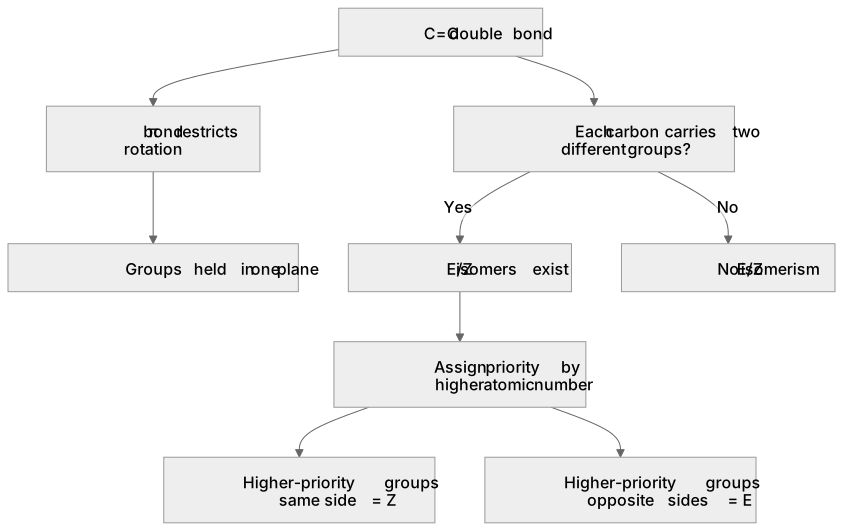
E/Z isomerism is a form of stereoisomerism shown by alkenes. Rotation about the C=C double bond is restricted because the π bond locks the two carbon atoms in one plane, so groups cannot swap sides by rotation. Each carbon atom of the C=C group must carry two different groups for E/Z isomers to exist; if either carbon carries two identical groups, the two arrangements are the same molecule. Assign priority at each carbon using Cahn–Ingold–Prelog rules: higher atomic number wins. The Z isomer has the higher-priority groups on the same side of the double bond; the E isomer has them on opposite sides.
For example: But-2-ene has a methyl and a hydrogen on each carbon, so E and Z forms exist.
What earns the marks
- Defines E/Z isomerism as stereoisomerism arising from restricted rotation about a C=C double bond.
- Explains that restricted rotation arises because the π bond prevents free rotation about the double bond.
- States that each carbon atom of the C=C group must carry two different groups for E/Z isomers to exist.
- Assigns priority at each carbon atom using higher atomic number of the directly attached atom.
- Identifies the Z isomer as having the higher-priority groups on the same side and the E isomer as having them on opposite sides.
Common mistakes and how to put them right
Compares 'like groups' on each side rather than the higher-priority groups.
Put it right: Assign priority by atomic number at each carbon and compare those.
Claims rotation about the C=C bond is free.
Put it right: State that the π bond restricts rotation and holds the groups in one plane.
Assigns E/Z to an alkene with two identical groups on one carbon.
Put it right: Check that each carbon carries two different groups first.
Exam tips
- Check both carbon atoms of the C=C group for two different substituents before assigning E or Z.
- Rank the two groups on each carbon by atomic number of the first atom attached, and go further along the chain only if those tie.
- Sketch the double bond with both higher-priority groups marked, then read off same side (Z) or opposite sides (E).
Try the lesson
The start of the Alkenes: • E/Z isomerism (an example of stereoisomerism, in terms of restricted rotation about a double bond and the requirement for two different groups to be attached to each carbon atom of the C=C group) lesson, made from teaching notes for this specification point.
Listen
E/Z isomerism is a form of stereoisomerism shown by alkenes. Rotation about the C=C double bond is restricted because the π bond locks the two carbon atoms in one plane, so groups cannot swap sides by rotation. Each carbon atom of the C=C group must carry two different groups for E/Z isomers to exist; if either carbon carries two identical groups, the two arrangements are the same molecule. Assign priority at each carbon using Cahn–Ingold–Prelog rules: higher atomic number wins. The Z isomer has the higher-priority groups on the same side of the double bond; the E isomer has them on opposite sides. For example, but-2-ene has a methyl and a hydrogen on each carbon, so E and Z forms exist. A strong answer earns marks for these points. Defines E/Z isomerism as stereoisomerism arising from restricted rotation about a C=C double bond. Explains that restricted rotation arises because the π bond prevents free rotation about the double bond. States that each carbon atom of the C=C group must carry two different groups for E/Z isomers to exist. Assigns priority at each carbon atom using higher atomic number of the directly attached atom. Exam tip: Check both carbon atoms of the C=C group for two different substituents before assigning E or Z.
See it
Key words
Say what each word means before you turn the card.
Stereoisomerism
Try answering aloud or in your head before turning the card.
Restricted rotation about C=C
Try answering aloud or in your head before turning the card.
CIP priority rules
Try answering aloud or in your head before turning the card.
E and Z configuration
Try answering aloud or in your head before turning the card.
See every definition
- Stereoisomerism
- A form of isomerism of which E/Z isomerism is an example, shown by alkenes.
- Restricted rotation about C=C
- Rotation about the double bond is restricted because the π bond locks the two carbon atoms in one plane, so groups cannot swap sides by rotation.
- CIP priority rules
- Priority at each carbon is assigned using Cahn–Ingold–Prelog rules, where the higher atomic number wins.
- E and Z configuration
- The Z isomer has the higher-priority groups on the same side of the double bond, while the E isomer has them on opposite sides.
Label the diagram
Some boxes have lost their names. Pick the right name for each number.
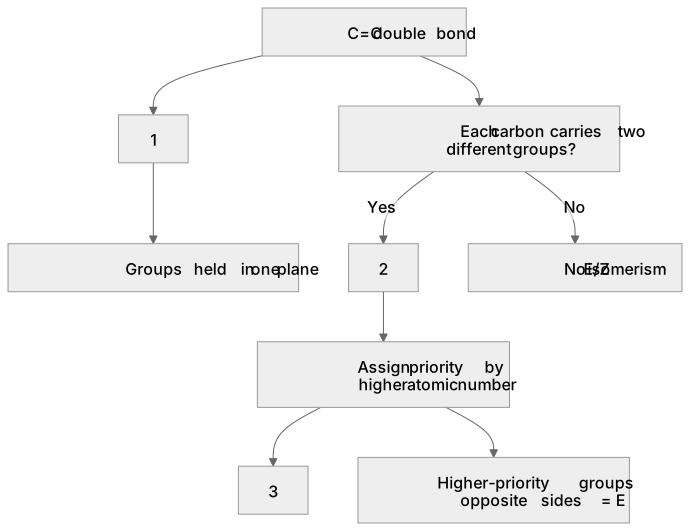
1Box 1
2Box 2
3Box 3
There is more to this lesson
The full lesson goes on to check your understanding and help you earn the marks. Create a free account to carry on, with your progress saved.
A week of Premium from your first lesson · Then the free plan continues · No card, no charge
Test your understanding of Alkenes: • E/Z isomerism (an example of stereoisomerism, in terms of restricted rotation about a double bond and the requirement for two different groups to be attached to each carbon atom of the C=C group)
Active recall beats re-reading. Take an instant quiz now to test what you’ve learned and lock it into long-term memory.
A week of Premium from your first lesson · Then the free plan continues · No card, no charge