OCR · A-Level · Chemistry
Course version: H432 · Version from Sept 2017
(i) the repeat unit of an addition polymer deduced from a given monomer
Full specification wording
Alkenes: (i) the repeat unit of an addition polymer deduced from a given monomer
To deduce a repeat unit from a monomer, locate the C=C double bond and open it so each of those two carbons forms a single bond to the next repeat unit.
- Point 20 of 27
- 4 key terms
Study notes
From the teaching notes for this specification point.
The idea
To deduce a repeat unit from a monomer, locate the C=C double bond and open it so each of those two carbons forms a single bond to the next repeat unit. The two carbons of the original double bond become the two-carbon backbone section enclosed in brackets, with the substituents carried over unchanged. For example, propene CH₂=CHCH₃ gives the repeat unit –CH₂–CH(CH₃)–, and chloroethene CH₂=CHCl gives –CH₂–CHCl–. Place the bracket lines through the single bonds that link one repeat unit to the next, and show the repeat unit with the correct number of hydrogen atoms and substituents. The empirical formula of the repeat unit must equal that of the monomer, which is a useful check. Naming follows by adding 'poly' to the monomer name.
What earns the marks
- Locates the C=C double bond in the monomer and converts it into two single bonds in the repeat unit.
- Draws the two-carbon backbone in brackets with extension bonds through the linking single bonds.
- Retains every substituent and hydrogen atom from the monomer so the repeat unit formula matches the monomer.
- Checks the repeat unit against the monomer empirical formula to confirm no atoms have been added or lost.
- Names the polymer by adding 'poly' to the monomer name in brackets.
Common mistakes and how to put them right
Leaves a C=C double bond inside the repeat unit.
Put it right: Show both original double-bond carbons forming single bonds to neighbours.
Places the extension bonds through the wrong atoms.
Put it right: Draw them through the single bonds joining one repeat unit to the next.
Omits a substituent such as Cl or CH₃.
Put it right: Copy every group from the monomer onto the correct backbone carbon.
Adds or removes hydrogen atoms.
Put it right: Keep the atom count identical to the monomer.
Exam tips
- Count the atoms in your repeat unit and compare with the monomer before moving on.
- Draw the bracket lines clearly through the linking single bonds so the examiner can see the repeating section.
- For substituted alkenes, keep the substituent on the same carbon as in the monomer to preserve the structure.
Try the lesson
The start of the Alkenes: (i) the repeat unit of an addition polymer deduced from a given monomer lesson, made from teaching notes for this specification point.
Listen
To deduce a repeat unit from a monomer, locate the C=C double bond and open it so each of those two carbons forms a single bond to the next repeat unit. The two carbons of the original double bond become the two-carbon backbone section enclosed in brackets, with the substituents carried over unchanged. For example, propene CH₂=CHCH₃ gives the repeat unit –CH₂–CH(CH₃)–, and chloroethene CH₂=CHCl gives –CH₂–CHCl–. Place the bracket lines through the single bonds that link one repeat unit to the next, and show the repeat unit with the correct number of hydrogen atoms and substituents. The empirical formula of the repeat unit must equal that of the monomer, which is a useful check. Naming follows by adding 'poly' to the monomer name. A strong answer earns marks for these points. Locates the C=C double bond in the monomer and converts it into two single bonds in the repeat unit. Draws the two-carbon backbone in brackets with extension bonds through the linking single bonds. Retains every substituent and hydrogen atom from the monomer so the repeat unit formula matches the monomer. Checks the repeat unit against the monomer empirical formula to confirm no atoms have been added or lost. Exam tip: Count the atoms in your repeat unit and compare with the monomer before moving on.
See it
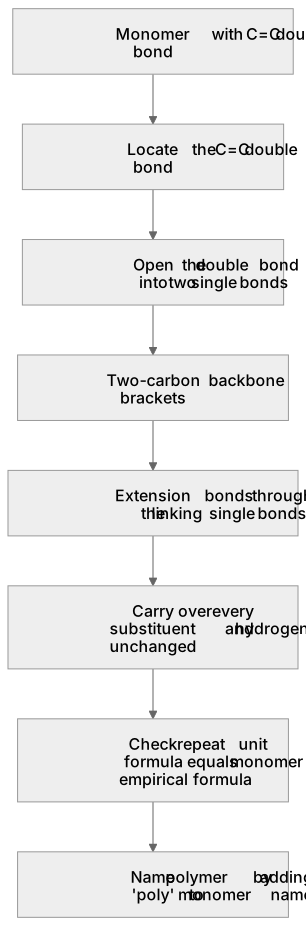
Put it in order
Put these steps in the order they happen.
- 1. Extension bonds through the linking single bonds
- 2. Name polymer by adding 'poly' to monomer name
- 3. Carry over every substituent and hydrogen unchanged
- 4. Monomer with C=C double bond
- 5. Locate the C=C double bond
- 6. Check repeat unit formula equals monomer empirical formula
- 7. Open the double bond into two single bonds
- 8. Two-carbon backbone in brackets
Key words
Say what each word means before you turn the card.
Repeat unit construction
Try answering aloud or in your head before turning the card.
Monomer-to-polymer deduction
Try answering aloud or in your head before turning the card.
Structural formulae
Try answering aloud or in your head before turning the card.
Polymer naming
Try answering aloud or in your head before turning the card.
See every definition
- Repeat unit construction
- Locate the C=C double bond and open it so each of those two carbons forms a single bond to the next repeat unit, with the two-carbon backbone section enclosed in brackets.
- Monomer-to-polymer deduction
- The repeat unit is deduced from a given monomer by converting the C=C double bond into two single bonds and retaining every substituent and hydrogen atom.
- Structural formulae
- The repeat unit is shown with the correct number of hydrogen atoms and substituents, with bracket lines through the single bonds that link one repeat unit to the next.
- Polymer naming
- Naming follows by adding 'poly' to the monomer name.
Label the diagram
Some boxes have lost their names. Pick the right name for each number.
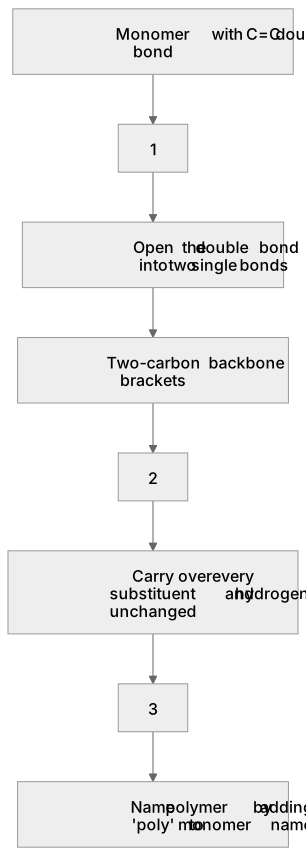
1Box 1
2Box 2
3Box 3
There is more to this lesson
The full lesson goes on to check your understanding and help you earn the marks. Create a free account to carry on, with your progress saved.
A week of Premium from your first lesson · Then the free plan continues · No card, no charge
Test your understanding of Alkenes: (i) the repeat unit of an addition polymer deduced from a given monomer
Active recall beats re-reading. Take an instant quiz now to test what you’ve learned and lock it into long-term memory.
A week of Premium from your first lesson · Then the free plan continues · No card, no charge