OCR · A-Level · Chemistry
Course version: H432 · Version from Sept 2017
(i) use of Markownikoff’s rule to predict formation of a major organic…
Full specification wording
Alkenes: (i) use of Markownikoff’s rule to predict formation of a major organic product in addition reactions of H–X to unsymmetrical alkenes, e.g. H–Br to propene, in terms of the relative stabilities of carbocation intermediates in the mechanism
Markownikoff's rule predicts the major product when a hydrogen halide H–X adds to an unsymmetrical alkene such as propene.
- Point 17 of 27
- 4 key terms
Study notes
From the teaching notes for this specification point.
The idea
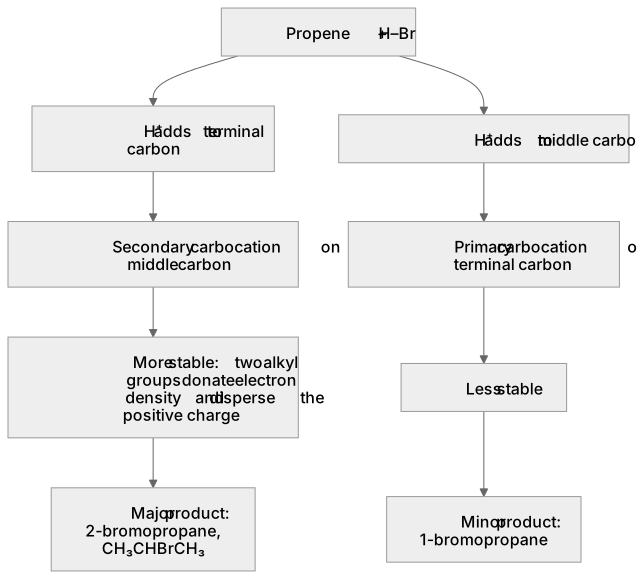
Markownikoff's rule predicts the major product when a hydrogen halide H–X adds to an unsymmetrical alkene such as propene. The rule works because the reaction proceeds through a carbocation intermediate, and the more stable carbocation forms faster. For propene, adding H⁺ to the terminal carbon gives a secondary carbocation on the middle carbon; adding H⁺ to the middle carbon gives a primary carbocation on the terminal carbon. The secondary carbocation is more stable because two alkyl groups donate electron density and disperse the positive charge, so the major product is 2-bromopropane, CH₃CHBrCH₃. The minor product is 1-bromopropane. Stability order is tertiary > secondary > primary. Predict the product by placing the halogen on the carbon that can best support the positive charge in the intermediate.
What earns the marks
- Places the hydrogen on the carbon of the double bond that leaves the more stable carbocation intermediate.
- Identifies the secondary carbocation as more stable than the primary carbocation for propene.
- States that the major product of H–Br addition to propene is 2-bromopropane.
- Explains carbocation stability in terms of electron-donating alkyl groups dispersing the positive charge.
- Applies the stability order tertiary > secondary > primary to select the major product.
Common mistakes and how to put them right
Places the halogen on the terminal carbon of propene.
Put it right by placing the halogen on the carbon that carries the more stable carbocation.
Claims the primary carbocation is more stable because it is less crowded.
Put it right by ranking stability tertiary > secondary > primary.
Treats Markownikoff's rule as a memorised phrase without linking it to carbocation stability.
Put it right by explaining the intermediate.
Exam tips
- Draw both possible carbocation intermediates before choosing the major product.
- Name the major product fully, for example 2-bromopropane, rather than only giving a structure.
- Link the answer explicitly to relative stability of the carbocation intermediates.
Try the lesson
The start of the Alkenes: (i) use of Markownikoff’s rule to predict formation of a major organic product in addition reactions of H–X to unsymmetrical alkenes, e.g. H–Br to propene, in terms of the relative stabilities of carbocation intermediates in the mechanism lesson, made from teaching notes for this specification point.
Listen
Markownikoff's rule predicts the major product when a hydrogen halide H–X adds to an unsymmetrical alkene such as propene. The rule works because the reaction proceeds through a carbocation intermediate, and the more stable carbocation forms faster. For propene, adding H⁺ to the terminal carbon gives a secondary carbocation on the middle carbon; adding H⁺ to the middle carbon gives a primary carbocation on the terminal carbon. The secondary carbocation is more stable because two alkyl groups donate electron density and disperse the positive charge, so the major product is 2-bromopropane, CH₃CHBrCH₃. The minor product is 1-bromopropane. Stability order is tertiary > secondary > primary. Predict the product by placing the halogen on the carbon that can best support the positive charge in the intermediate. A strong answer earns marks for these points. Places the hydrogen on the carbon of the double bond that leaves the more stable carbocation intermediate. Identifies the secondary carbocation as more stable than the primary carbocation for propene. States that the major product of H–Br addition to propene is 2-bromopropane. Explains carbocation stability in terms of electron-donating alkyl groups dispersing the positive charge. A common slip: Places the halogen on the terminal carbon of propene. Instead, placing the halogen on the carbon that carries the more stable carbocation. Exam tip: Draw both possible carbocation intermediates before choosing the major product.
See it
Key words
Say what each word means before you turn the card.
Markownikoff's rule
Try answering aloud or in your head before turning the card.
Carbocation intermediates and stability
Try answering aloud or in your head before turning the card.
Predicting major and minor organic products
Try answering aloud or in your head before turning the card.
Electrophilic addition of H–X to alkenes
Try answering aloud or in your head before turning the card.
See every definition
- Markownikoff's rule
- Used to predict formation of a major organic product in addition reactions of H–X to unsymmetrical alkenes, in terms of the relative stabilities of carbocation intermediates in the mechanism.
- Carbocation intermediates and stability
- The more stable carbocation forms faster, and the secondary carbocation is more stable because two alkyl groups donate electron density and disperse the positive charge.
- Predicting major and minor organic products
- Predict the product by placing the halogen on the carbon that can best support the positive charge in the intermediate, giving the major product and the minor product.
- Electrophilic addition of H–X to alkenes
- Addition reactions of H–X to unsymmetrical alkenes such as propene proceed through a carbocation intermediate, with the more stable carbocation forming faster.
Label the diagram
Some boxes have lost their names. Pick the right name for each number.
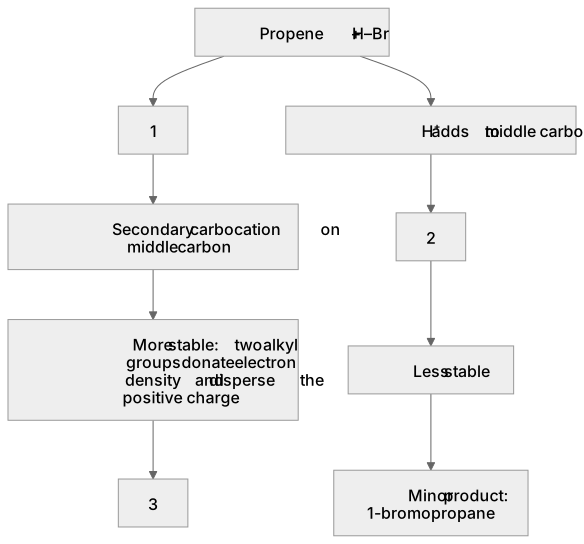
1Box 1
2Box 2
3Box 3
There is more to this lesson
The full lesson goes on to check your understanding and help you earn the marks. Create a free account to carry on, with your progress saved.
A week of Premium from your first lesson · Then the free plan continues · No card, no charge
Test your understanding of Alkenes: (i) use of Markownikoff’s rule to predict formation of a major organic product in addition reactions of H–X to unsymmetrical alkenes, e.g. H–Br to propene, in terms of the relative stabilities of carbocation intermediates in the mechanism
Active recall beats re-reading. Take an instant quiz now to test what you’ve learned and lock it into long-term memory.
A week of Premium from your first lesson · Then the free plan continues · No card, no charge