OCR · A-Level · Chemistry
Course version: H432 · Version from Sept 2017
Alkenes: Stereoisomerism in alkenes
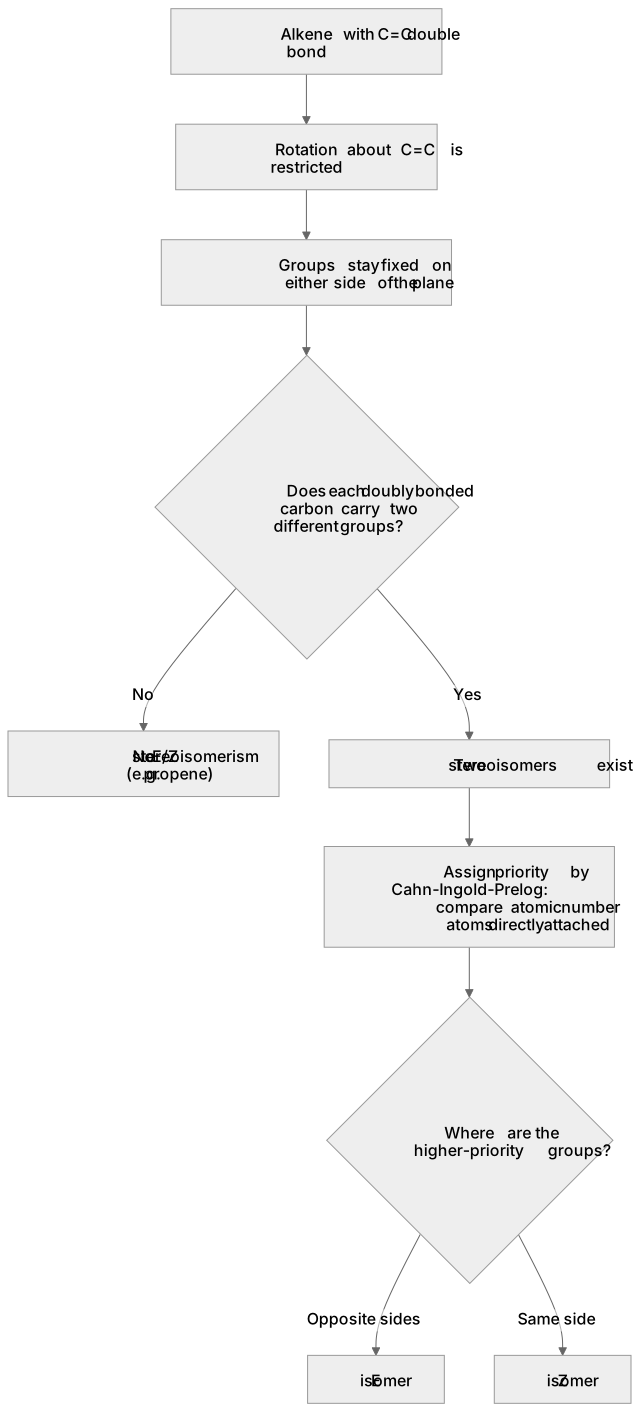
Alkene stereoisomerism arises because rotation about the C=C double bond is restricted, so groups attached to each carbon stay on fixed sides of the plane.
- Point 3 of 27
- 4 key terms
Study notes
From the teaching notes for this specification point.
The idea
Alkene stereoisomerism arises because rotation about the C=C double bond is restricted, so groups attached to each carbon stay on fixed sides of the plane. If each doubly bonded carbon carries two different groups, two stereoisomers exist: the E isomer has the higher-priority groups on opposite sides, the Z isomer has them on the same side. Priority follows Cahn–Ingold–Prelog rules: compare atoms directly attached by atomic number, and if tied, work outward along the chain. A molecule such as but-2-ene, CH₃CH=CHCH₃, shows this: each carbon holds H and CH₃, so E and Z forms occur. Where one carbon carries two identical groups, for example in propene, no stereoisomerism is possible. Distinguish this geometric (E/Z) isomerism from optical isomerism, which needs a chiral centre.
What earns the marks
- States that rotation about the C=C double bond is restricted, fixing groups on either side of the plane.
- Identifies that E/Z stereoisomerism requires each doubly bonded carbon to carry two different groups.
- Applies Cahn–Ingold–Prelog priority by comparing atomic number of atoms directly attached to each alkene carbon.
- Assigns E when the higher-priority groups lie on opposite sides and Z when they lie on the same side.
- Recognises that a molecule with two identical groups on one alkene carbon, such as propene, shows no E/Z isomerism.
Common mistakes and how to put them right
Confuses E/Z with optical isomerism.
Put it right: Keep geometric isomerism tied to the restricted C=C bond and a chiral centre to optical isomerism.
Assigns priority by group size or mass rather than atomic number.
Put it right: Compare atoms directly attached first, then work outward.
Labels a molecule such as propene as showing E/Z isomerism.
Put it right: Check that each alkene carbon carries two different groups.
Reverses the E and Z labels.
Put it right: Place higher-priority groups opposite for E and same side for Z.
Exam tips
- Draw the alkene with the C=C horizontal and mark the two groups on each carbon before assigning priority.
- State the priority rule explicitly: higher atomic number wins, and move outward along the chain only when atoms are identical.
- Check the condition first — two different groups on each carbon — before attempting any E/Z label.
Try the lesson
The start of the Alkenes: Stereoisomerism in alkenes lesson, made from teaching notes for this specification point.
Listen
Alkene stereoisomerism arises because rotation about the C=C double bond is restricted, so groups attached to each carbon stay on fixed sides of the plane. If each doubly bonded carbon carries two different groups, two stereoisomers exist: the E isomer has the higher-priority groups on opposite sides, the Z isomer has them on the same side. Priority follows Cahn–Ingold–Prelog rules: compare atoms directly attached by atomic number, and if tied, work outward along the chain. A molecule such as but-2-ene, CH₃CH=CHCH₃, shows this: each carbon holds H and CH₃, so E and Z forms occur. Where one carbon carries two identical groups, for example in propene, no stereoisomerism is possible. Distinguish this geometric (E/Z) isomerism from optical isomerism, which needs a chiral centre. A strong answer earns marks for these points. States that rotation about the C=C double bond is restricted, fixing groups on either side of the plane. Identifies that E/Z stereoisomerism requires each doubly bonded carbon to carry two different groups. Applies Cahn–Ingold–Prelog priority by comparing atomic number of atoms directly attached to each alkene carbon. Assigns E when the higher-priority groups lie on opposite sides and Z when they lie on the same side. Exam tip: Draw the alkene with the C=C horizontal and mark the two groups on each carbon before assigning priority.
See it
Key words
Say what each word means before you turn the card.
Restricted rotation about the C=C double bond
Try answering aloud or in your head before turning the card.
E/Z geometric isomerism
Try answering aloud or in your head before turning the card.
Cahn–Ingold–Prelog priority rules
Try answering aloud or in your head before turning the card.
Distinguishing geometric from optical isomerism
Try answering aloud or in your head before turning the card.
See every definition
- Restricted rotation about the C=C double bond
- Rotation about the C=C double bond is restricted, so groups attached to each carbon stay on fixed sides of the plane.
- E/Z geometric isomerism
- Two stereoisomers exist where each doubly bonded carbon carries two different groups: the E isomer has the higher-priority groups on opposite sides, the Z isomer has them on the same side.
- Cahn–Ingold–Prelog priority rules
- Priority follows these rules: compare atoms directly attached by atomic number, and if tied, work outward along the chain.
- Distinguishing geometric from optical isomerism
- Geometric (E/Z) isomerism is tied to the restricted C=C bond, whereas optical isomerism needs a chiral centre.
Label the diagram
Some boxes have lost their names. Pick the right name for each number.
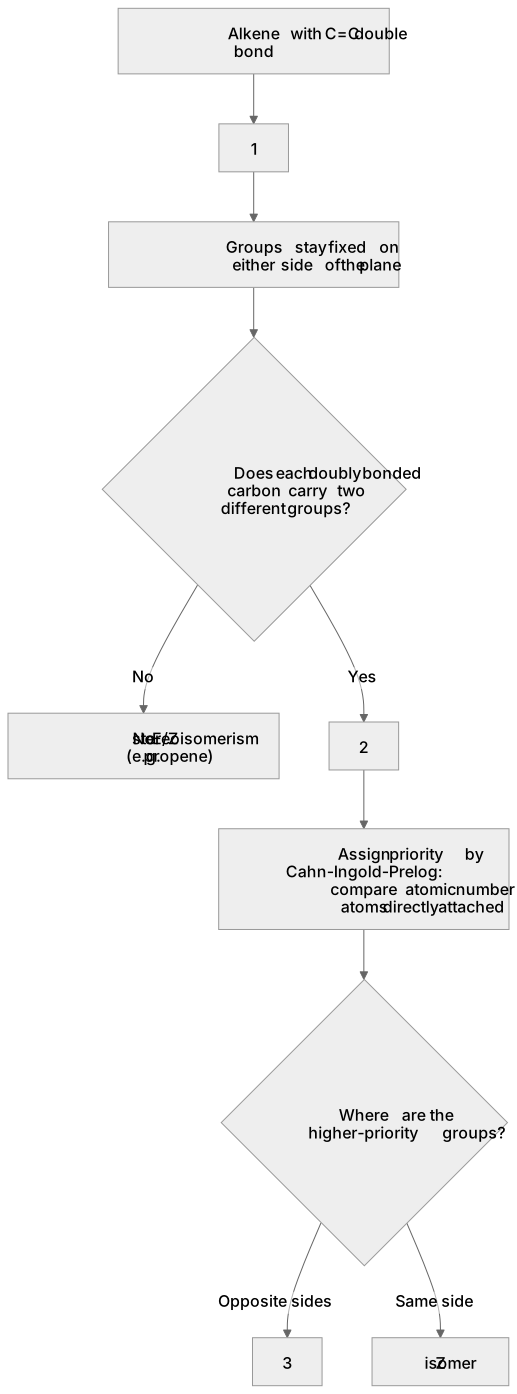
1Box 1
2Box 2
3Box 3
There is more to this lesson
The full lesson goes on to check your understanding and help you earn the marks. Create a free account to carry on, with your progress saved.
A week of Premium from your first lesson · Then the free plan continues · No card, no charge
Test your understanding of Alkenes: Stereoisomerism in alkenes
Active recall beats re-reading. Take an instant quiz now to test what you’ve learned and lock it into long-term memory.
A week of Premium from your first lesson · Then the free plan continues · No card, no charge