OCR · A-Level · Chemistry
Course version: H432 · Version from Sept 2017
Alkenes: Waste polymers and alternatives
Addition polymers are chemically inert and non-biodegradable because their saturated carbon backbones resist attack, so waste polymers persist in landfill and can pollute land and water.
- Point 22 of 27
- 4 key terms
Study notes
From the teaching notes for this specification point.
The idea
Addition polymers are chemically inert and non-biodegradable because their saturated carbon backbones resist attack, so waste polymers persist in landfill and can pollute land and water. Burning polymers releases carbon dioxide and can release toxic gases unless controlled. Common responses are to recycle polymers by sorting and reprocessing, to recover energy by controlled combustion, and to develop alternatives. Alternatives include biodegradable polymers such as poly(lactic acid) made from renewable plant material, and polymers designed to degrade. Feedstock recycling breaks polymers back into useful small molecules. When answering, link each problem to a specific property of the polymer and match each alternative to the problem it addresses, rather than listing options without justification.
What earns the marks
- Explains that addition polymers are unreactive and non-biodegradable, so they persist in the environment and accumulate in landfill.
- Describes recycling as collecting, sorting and reprocessing waste polymers into new products, reducing the volume sent to landfill.
- Describes controlled combustion for energy recovery and notes that toxic gases must be prevented or removed.
- Identifies a biodegradable or plant-derived alternative polymer and links it to reduced persistence in the environment.
Common mistakes and how to put them right
States that addition polymers biodegrade quickly.
Put it right: Explain that their saturated backbones make them unreactive and persistent.
Claims burning waste polymers is always harmless.
Put it right: Note that controlled combustion is needed and toxic gases must be managed.
Lists alternatives without linking each to a specific problem.
Put it right: Connect each alternative to the waste or pollution issue it addresses.
Assumes all recycling is simple.
Put it right: Recognise that sorting mixed polymers is a practical difficulty.
Exam tips
- Link each problem to a polymer property, such as inertness or non-biodegradability, before naming a solution.
- Use precise terms such as feedstock recycling, energy recovery and biodegradable polymer rather than vague phrases.
- Check whether the question asks for a problem, a solution or both, and answer only what is asked.
Try the lesson
The start of the Alkenes: Waste polymers and alternatives lesson, made from teaching notes for this specification point.
Listen
Addition polymers are chemically inert and non-biodegradable because their saturated carbon backbones resist attack, so waste polymers persist in landfill and can pollute land and water. Burning polymers releases carbon dioxide and can release toxic gases unless controlled. Common responses are to recycle polymers by sorting and reprocessing, to recover energy by controlled combustion, and to develop alternatives. Alternatives include biodegradable polymers such as poly(lactic acid) made from renewable plant material, and polymers designed to degrade. Feedstock recycling breaks polymers back into useful small molecules. When answering, link each problem to a specific property of the polymer and match each alternative to the problem it addresses, rather than listing options without justification. A strong answer earns marks for these points. Explains that addition polymers are unreactive and non-biodegradable, so they persist in the environment and accumulate in landfill. Describes recycling as collecting, sorting and reprocessing waste polymers into new products, reducing the volume sent to landfill. Describes controlled combustion for energy recovery and notes that toxic gases must be prevented or removed. Identifies a biodegradable or plant-derived alternative polymer and links it to reduced persistence in the environment. Exam tip: Link each problem to a polymer property, such as inertness or non-biodegradability, before naming a solution.
See it
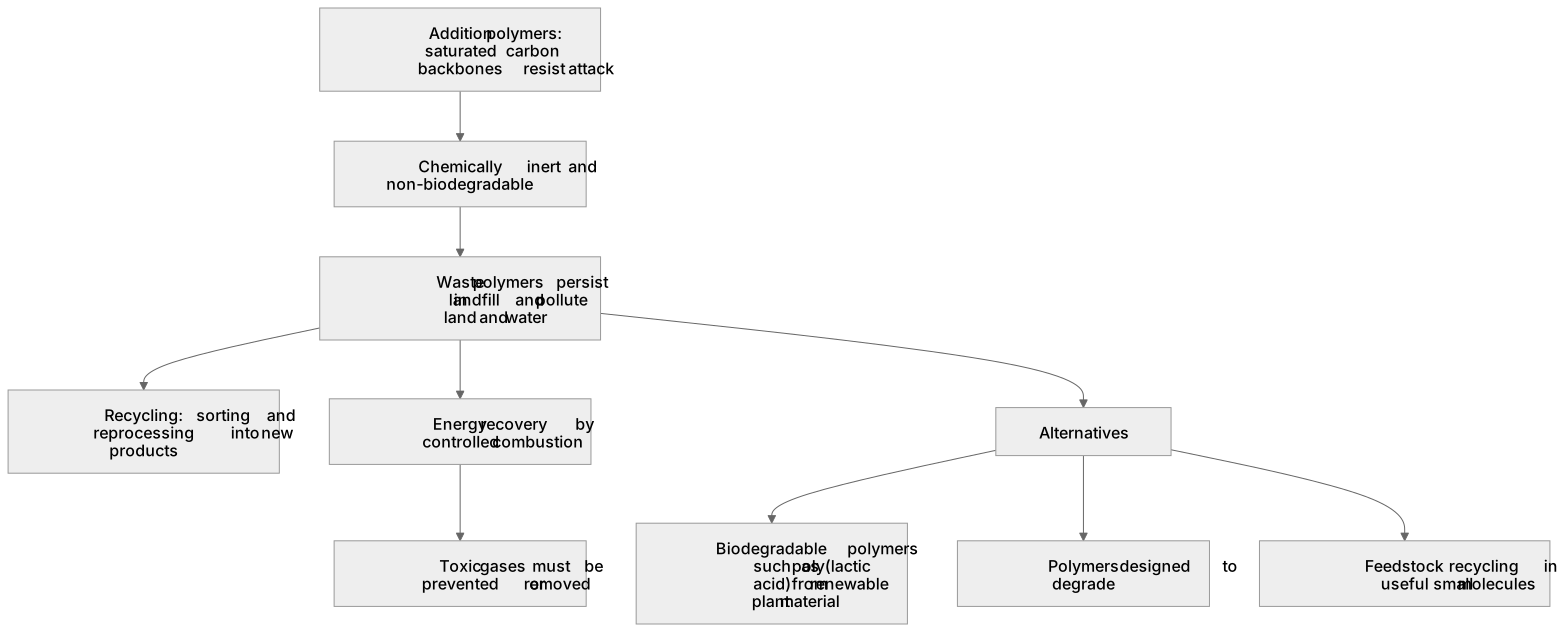
Key words
Say what each word means before you turn the card.
Non-biodegradability of addition polymers
Try answering aloud or in your head before turning the card.
Recycling and energy recovery
Try answering aloud or in your head before turning the card.
Biodegradable and renewable alternatives
Try answering aloud or in your head before turning the card.
Environmental impact of polymer waste
Try answering aloud or in your head before turning the card.
See every definition
- Non-biodegradability of addition polymers
- Addition polymers are chemically inert and non-biodegradable because their saturated carbon backbones resist attack, so waste polymers persist in landfill and can pollute land and water.
- Recycling and energy recovery
- Common responses are to recycle polymers by sorting and reprocessing, and to recover energy by controlled combustion, in which toxic gases must be prevented or removed.
- Biodegradable and renewable alternatives
- Alternatives include biodegradable polymers such as poly(lactic acid) made from renewable plant material, and polymers designed to degrade.
- Environmental impact of polymer waste
- Waste polymers persist in landfill and can pollute land and water, and burning polymers releases carbon dioxide and can release toxic gases unless controlled.
Label the diagram
Some boxes have lost their names. Pick the right name for each number.
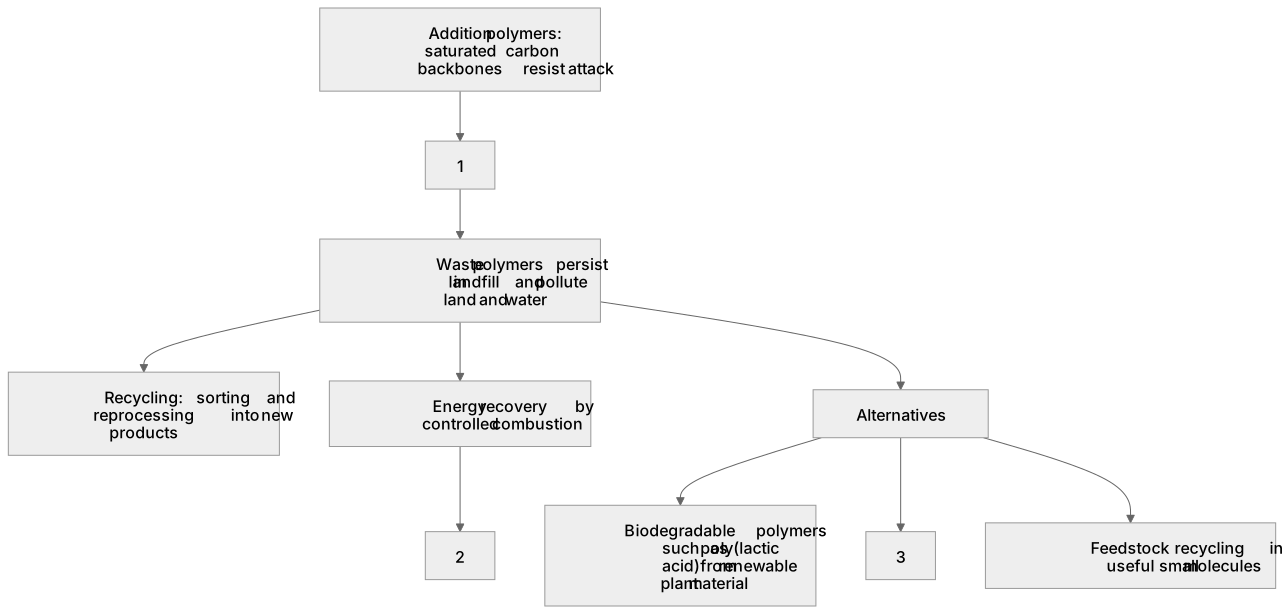
1Box 1
2Box 2
3Box 3
There is more to this lesson
The full lesson goes on to check your understanding and help you earn the marks. Create a free account to carry on, with your progress saved.
A week of Premium from your first lesson · Then the free plan continues · No card, no charge
Test your understanding of Alkenes: Waste polymers and alternatives
Active recall beats re-reading. Take an instant quiz now to test what you’ve learned and lock it into long-term memory.
A week of Premium from your first lesson · Then the free plan continues · No card, no charge