OCR · A-Level · Chemistry
Course version: H432 · Version from Sept 2017
(ii) aromatic amines by reduction of nitroarenes using tin and…
Full specification wording
Amines: (ii) aromatic amines by reduction of nitroarenes using tin and concentrated hydrochloric acid.
Nitroarenes such as nitrobenzene can be reduced to aromatic amines such as phenylamine.
- Point 5 of 5
- 4 key terms
Study notes
From the teaching notes for this specification point.
The idea
Nitroarenes such as nitrobenzene can be reduced to aromatic amines such as phenylamine. The standard laboratory route uses tin metal with concentrated hydrochloric acid: the tin is oxidised and supplies electrons, the acid provides protons, and the nitro group is reduced. The initial product in strong acid is the protonated amine (anilinium-type ion), so the mixture is then treated with alkali, typically sodium hydroxide, to liberate the free aromatic amine, which can be separated by steam distillation. Learners should track oxidation states: the nitrogen in the nitro group is reduced, while tin is oxidised from 0 to +2 (as Sn²⁺) or +4 (as Sn⁴⁺). Recognising which species is oxidised and which is reduced, and why the alkaline step is needed, is the core of this item.
What earns the marks
- Identifies tin and concentrated hydrochloric acid as the reducing system that converts a nitroarene into an aromatic amine.
- States that the nitro group is reduced while the tin metal is oxidised, giving tin ions in solution.
- Explains that the amine forms initially as a protonated salt in the acidic mixture and requires addition of alkali to release the free amine.
- Recognises that the aromatic ring is retained during reduction, so nitrobenzene gives phenylamine rather than an aliphatic amine.
Common mistakes and how to put them right
Claims that the acid alone reduces the nitroarene.
Put it right: State that tin supplies the reducing power and the acid provides protons.
Omits the alkaline work-up.
Put it right: Explain that sodium hydroxide is added to liberate the free aromatic amine from its salt.
Describes the nitrogen as oxidised.
Put it right by showing the nitro nitrogen is reduced while tin is oxidised.
Exam tips
- Write the oxidation-state change for nitrogen and for tin before choosing an answer, so the redox direction is fixed.
- Check whether an option accounts for the acidic salt stage and the later alkaline step, since a complete route includes both.
- Distinguish aromatic amines from aliphatic amines by confirming the nitrogen is attached directly to the ring.
- Read each option for the exact reagent pair, because substituting a different metal or acid changes the chemistry.
Try the lesson
The start of the Amines: (ii) aromatic amines by reduction of nitroarenes using tin and concentrated hydrochloric acid. lesson, made from teaching notes for this specification point.
Listen
Nitroarenes such as nitrobenzene can be reduced to aromatic amines such as phenylamine. The standard laboratory route uses tin metal with concentrated hydrochloric acid: the tin is oxidised and supplies electrons, the acid provides protons, and the nitro group is reduced. The initial product in strong acid is the protonated amine (anilinium-type ion), so the mixture is then treated with alkali, typically sodium hydroxide, to liberate the free aromatic amine, which can be separated by steam distillation. Learners should track oxidation states: the nitrogen in the nitro group is reduced, while tin is oxidised from 0 to +2 (as Sn²⁺) or +4 (as Sn⁴⁺). Recognising which species is oxidised and which is reduced, and why the alkaline step is needed, is the core of this item. A strong answer earns marks for these points. Identifies tin and concentrated hydrochloric acid as the reducing system that converts a nitroarene into an aromatic amine. States that the nitro group is reduced while the tin metal is oxidised, giving tin ions in solution. Explains that the amine forms initially as a protonated salt in the acidic mixture and requires addition of alkali to release the free amine. Recognises that the aromatic ring is retained during reduction, so nitrobenzene gives phenylamine rather than an aliphatic amine. A common slip: Describes the nitrogen as oxidised. Instead, showing the nitro nitrogen is reduced while tin is oxidised. Exam tip: Write the oxidation-state change for nitrogen and for tin before choosing an answer, so the redox direction is fixed.
See it
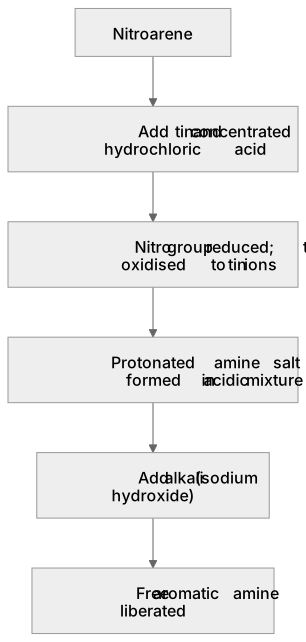
Put it in order
Put these steps in the order they happen.
- 1. Nitro group reduced; tin oxidised to tin ions
- 2. Add tin and concentrated hydrochloric acid
- 3. Nitroarene
- 4. Free aromatic amine liberated
- 5. Add alkali (sodium hydroxide)
- 6. Protonated amine salt formed in acidic mixture
Key words
Say what each word means before you turn the card.
Reduction of nitroarenes to aromatic amines
Try answering aloud or in your head before turning the card.
Redox roles of tin and hydrochloric acid
Try answering aloud or in your head before turning the card.
Protonated amine salt and alkaline liberation
Try answering aloud or in your head before turning the card.
Retention of the aromatic ring
Try answering aloud or in your head before turning the card.
See every definition
- Reduction of nitroarenes to aromatic amines
- Nitroarenes such as nitrobenzene can be reduced to aromatic amines such as phenylamine using tin and concentrated hydrochloric acid.
- Redox roles of tin and hydrochloric acid
- The tin is oxidised and supplies electrons, the acid provides protons, and the nitro group is reduced.
- Protonated amine salt and alkaline liberation
- The initial product in strong acid is the protonated amine, so alkali is added to liberate the free aromatic amine.
- Retention of the aromatic ring
- The aromatic ring is retained during reduction, so nitrobenzene gives phenylamine rather than an aliphatic amine.
Label the diagram
Some boxes have lost their names. Pick the right name for each number.
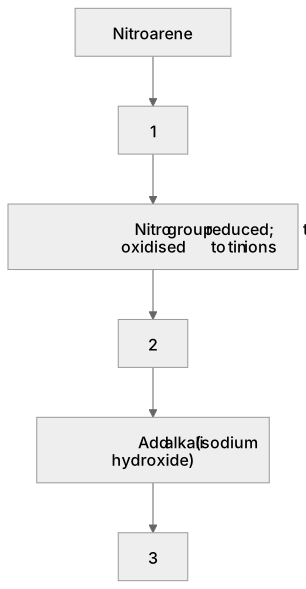
1Box 1
2Box 2
3Box 3
There is more to this lesson
The full lesson goes on to check your understanding and help you earn the marks. Create a free account to carry on, with your progress saved.
A week of Premium from your first lesson · Then the free plan continues · No card, no charge
Test your understanding of Amines: (ii) aromatic amines by reduction of nitroarenes using tin and concentrated hydrochloric acid.
Active recall beats re-reading. Take an instant quiz now to test what you’ve learned and lock it into long-term memory.
A week of Premium from your first lesson · Then the free plan continues · No card, no charge