OCR · A-Level · Chemistry
Course version: H432 · Version from Sept 2017
Amino acids, amides and chirality: Chirality
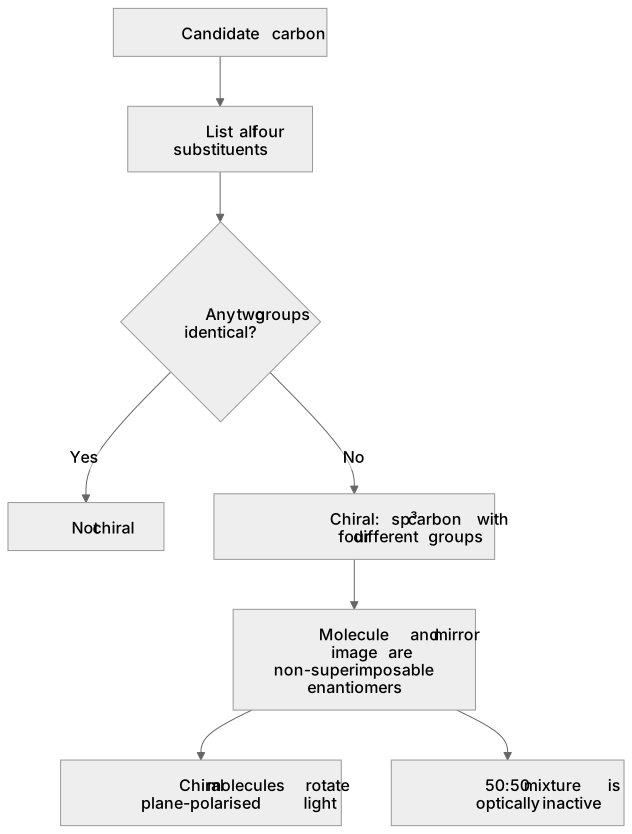
A chiral carbon is an sp³ carbon bonded to four different groups, so the molecule and its mirror image cannot be superimposed.
- Point 7 of 9
- 3 key terms
Study notes
From the teaching notes for this specification point.
The idea
A chiral carbon is an sp³ carbon bonded to four different groups, so the molecule and its mirror image cannot be superimposed. In 2-hydroxypropanoic acid the central carbon carries –H, –CH₃, –OH and –COOH, four different groups, so it is chiral. In amino acids such as 2-aminopropanoic acid the alpha carbon carries –H, –NH₂, –CH₃ and –COOH, again four different groups. To test a candidate carbon, list all four substituents and check none repeats; a carbon with two identical groups, such as two hydrogens, is not chiral. Chiral molecules rotate plane-polarised light and exist as two enantiomers, but a 50:50 mixture is optically inactive.
What earns the marks
- Identifies a chiral centre as an sp³ carbon bonded to four different groups.
- Lists the four substituents on a candidate carbon and rejects it when two groups are identical.
- Recognises the alpha carbon of 2-aminopropanoic acid as chiral because it carries –H, –NH₂, –CH₃ and –COOH.
- Explains that a chiral molecule and its mirror image are non-superimposable enantiomers.
- States that a racemic 50:50 mixture of enantiomers is optically inactive.
Common mistakes and how to put them right
Treats any carbon in a chain as chiral.
Put it right: Check that the specific carbon carries four different groups.
Accepts a carbon bearing two hydrogen atoms as chiral.
Put it right: Reject it because two groups are identical.
Assumes a molecule with a chiral centre always rotates light in a sample.
Put it right: Recognise that an equal mixture of enantiomers is optically inactive.
Exam tips
- Write out the four groups on the carbon explicitly before deciding whether it is chiral.
- Look for repeated atoms or groups such as two hydrogens, which immediately rule out chirality.
- Link chirality to non-superimposable mirror images rather than to the presence of a double bond.
Try the lesson
The start of the Amino acids, amides and chirality: Chirality lesson, made from teaching notes for this specification point.
Listen
A chiral carbon is an sp³ carbon bonded to four different groups, so the molecule and its mirror image cannot be superimposed. In 2-hydroxypropanoic acid the central carbon carries –H, –CH₃, –OH and –COOH, four different groups, so it is chiral. In amino acids such as 2-aminopropanoic acid the alpha carbon carries –H, –NH₂, –CH₃ and –COOH, again four different groups. To test a candidate carbon, list all four substituents and check none repeats; a carbon with two identical groups, such as two hydrogens, is not chiral. Chiral molecules rotate plane-polarised light and exist as two enantiomers, but a 50:50 mixture is optically inactive. A strong answer earns marks for these points. Identifies a chiral centre as an sp³ carbon bonded to four different groups. Lists the four substituents on a candidate carbon and rejects it when two groups are identical. Recognises the alpha carbon of 2-aminopropanoic acid as chiral because it carries –H, –NH₂, –CH₃ and –COOH. Explains that a chiral molecule and its mirror image are non-superimposable enantiomers. Exam tip: Write out the four groups on the carbon explicitly before deciding whether it is chiral.
See it
Key words
Say what each word means before you turn the card.
Chiral centre
Try answering aloud or in your head before turning the card.
Enantiomers
Try answering aloud or in your head before turning the card.
Racemic mixture
Try answering aloud or in your head before turning the card.
See every definition
- Chiral centre
- An sp³ carbon bonded to four different groups, so the molecule and its mirror image cannot be superimposed.
- Enantiomers
- Two forms of a chiral molecule that are non-superimposable mirror images of each other.
- Racemic mixture
- A 50:50 mixture of enantiomers, which is optically inactive.
Label the diagram
Some boxes have lost their names. Pick the right name for each number.
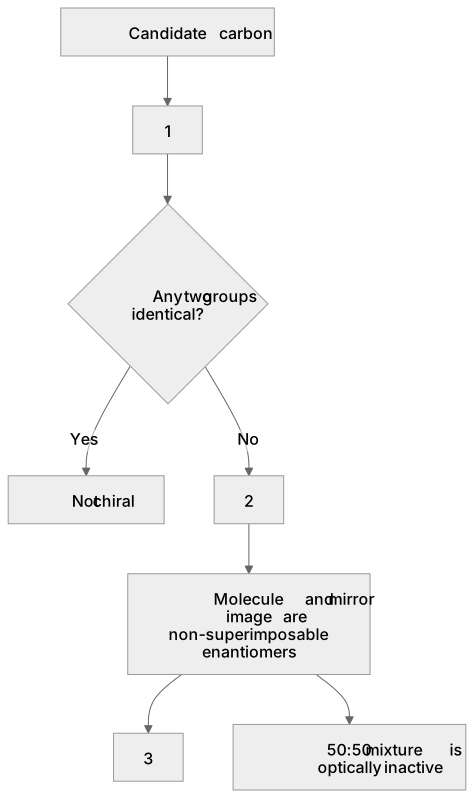
1Box 1
2Box 2
3Box 3
There is more to this lesson
The full lesson goes on to check your understanding and help you earn the marks. Create a free account to carry on, with your progress saved.
A week of Premium from your first lesson · Then the free plan continues · No card, no charge
Test your understanding of Amino acids, amides and chirality: Chirality
Active recall beats re-reading. Take an instant quiz now to test what you’ve learned and lock it into long-term memory.
A week of Premium from your first lesson · Then the free plan continues · No card, no charge