OCR · A-Level · Chemistry
Course version: H432 · Version from Sept 2017
(d) identification of chiral centres in a molecule of any organic compound.
Full specification wording
Amino acids, amides and chirality: (d) identification of chiral centres in a molecule of any organic compound.
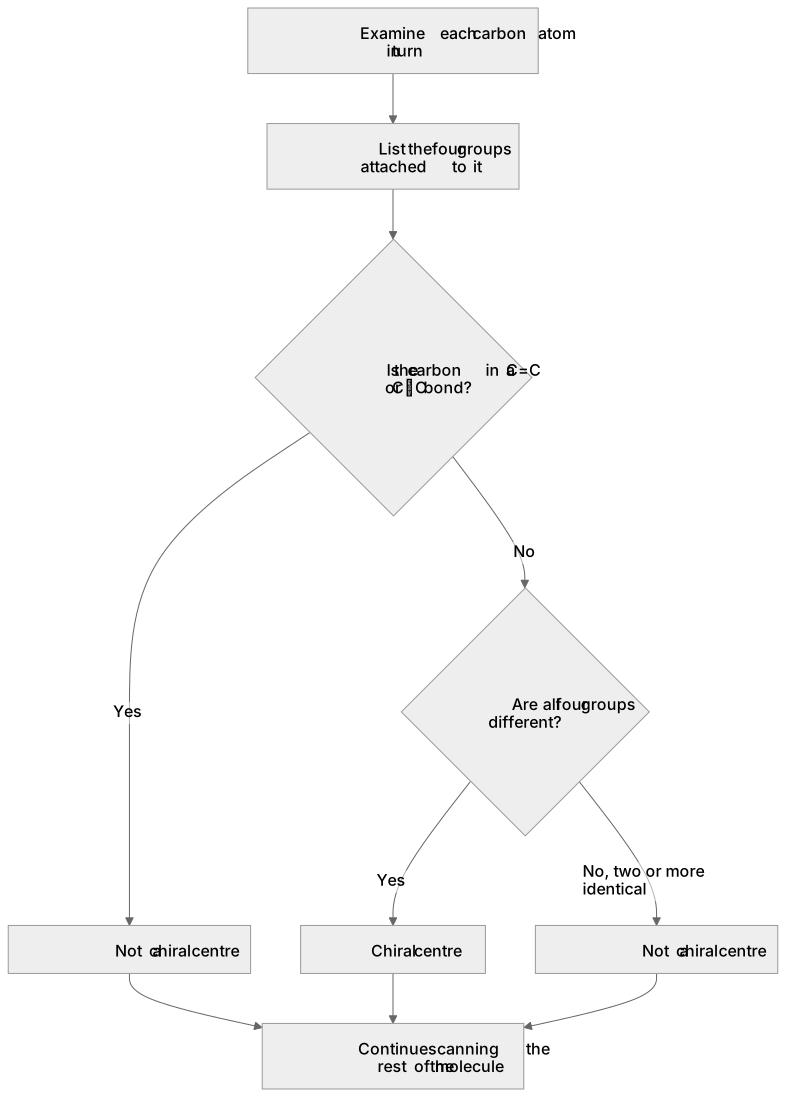
To find a chiral centre, examine each carbon atom in turn and list the four groups attached to it.
- Point 9 of 9
Study notes
From the teaching notes for this specification point.
The idea
To find a chiral centre, examine each carbon atom in turn and list the four groups attached to it. A chiral centre is a carbon bonded to four different groups; if any two groups match, that carbon is not chiral. Work through a molecule systematically: in 2-chlorobutane, CH₃CHClCH₂CH₃, the carbon bearing chlorine also carries H, CH₃ and C₂H₅, so it is chiral. In 2-chloropropane, CH₃CHClCH₃, the same carbon carries two identical CH₃ groups, so it is not chiral. Remember that carbon atoms in a C=C double bond or a C≡C triple bond cannot be chiral centres because they do not carry four separate groups. Apply the same test to any organic compound, including amino acids, alcohols and halogenoalkanes.
What earns the marks
- Examines each carbon atom and lists the four groups attached to it.
- Identifies a chiral centre as a carbon bonded to four different groups.
- Rejects a candidate carbon when two or more attached groups are identical.
- Excludes carbon atoms in double or triple bonds from being chiral centres.
- Applies the test correctly to a named organic compound such as an amino acid or halogenoalkane.
Common mistakes and how to put them right
Counts a carbon with two identical alkyl groups as chiral.
Put it right: Check that all four groups differ.
Overlooks hydrogen as one of the four groups.
Put it right: Include every atom or group shown.
Selects a carbon in a C=C double bond.
Put it right: Note that such a carbon carries only three groups.
Stops after finding one candidate without checking the rest of the molecule.
Put it right: Scan every carbon.
Exam tips
- Write out the four groups beside each candidate carbon before deciding.
- Circle the chiral centre on the displayed formula so the examiner can see your choice.
- Check for hidden symmetry, such as two methyl groups, that removes chirality.
- In multiple-choice items, eliminate options that name a carbon with two identical substituents.
Try the lesson
The start of the Amino acids, amides and chirality: (d) identification of chiral centres in a molecule of any organic compound. lesson, made from teaching notes for this specification point.
Listen
To find a chiral centre, examine each carbon atom in turn and list the four groups attached to it. A chiral centre is a carbon bonded to four different groups; if any two groups match, that carbon is not chiral. Work through a molecule systematically: in 2-chlorobutane, CH₃CHClCH₂CH₃, the carbon bearing chlorine also carries H, CH₃ and C₂H₅, so it is chiral. In 2-chloropropane, CH₃CHClCH₃, the same carbon carries two identical CH₃ groups, so it is not chiral. Remember that carbon atoms in a C=C double bond or a C≡C triple bond cannot be chiral centres because they do not carry four separate groups. Apply the same test to any organic compound, including amino acids, alcohols and halogenoalkanes. A strong answer earns marks for these points. Examines each carbon atom and lists the four groups attached to it. Identifies a chiral centre as a carbon bonded to four different groups. Rejects a candidate carbon when two or more attached groups are identical. Excludes carbon atoms in double or triple bonds from being chiral centres. Exam tip: Write out the four groups beside each candidate carbon before deciding.
See it
There is more to this lesson
The full lesson goes on to check your understanding and help you earn the marks. Create a free account to carry on, with your progress saved.
A week of Premium from your first lesson · Then the free plan continues · No card, no charge
Test your understanding of Amino acids, amides and chirality: (d) identification of chiral centres in a molecule of any organic compound.
Active recall beats re-reading. Take an instant quiz now to test what you’ve learned and lock it into long-term memory.
A week of Premium from your first lesson · Then the free plan continues · No card, no charge