OCR · A-Level · Chemistry
Course version: H432 · Version from Sept 2017
Amount of substance: (i) amount of substance
Amount of substance is the quantity that counts how many specified entities a sample contains, and its unit is the mole.
- Point 1 of 21
- 4 key terms
Study notes
From the teaching notes for this specification point.
The idea
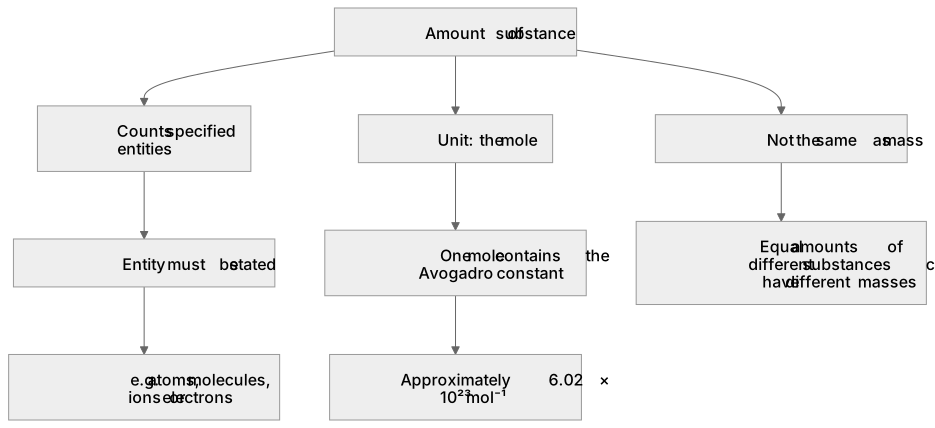
Amount of substance is the quantity that counts how many specified entities a sample contains, and its unit is the mole. One mole contains the Avogadro constant of entities, approximately 6.02 × 10²³ mol⁻¹, so 0.50 mol of water contains about 3.01 × 10²³ water molecules. The entities must be stated, because a mole of chlorine atoms differs from a mole of chlorine molecules. Amount of substance is not the same as mass: 1.0 mol of helium has a mass of about 4.0 g, while 1.0 mol of carbon has a mass of about 12.0 g. In multiple-choice questions, decide whether the option names the correct quantity, the correct unit or the correct number of entities, and eliminate options that confuse mass with amount or that omit the entity.
What earns the marks
- States that amount of substance counts specified entities and is measured in moles.
- Identifies the mole as the unit containing the Avogadro constant, approximately 6.02 × 10²³ mol⁻¹, of entities.
- Distinguishes amount of substance from mass by noting that equal amounts of different substances can have different masses.
- Specifies the entity being counted, such as atoms, molecules, ions or electrons, when interpreting a given amount.
Common mistakes and how to put them right
Confuses amount of substance with mass.
Put it right by stating that amount is measured in moles while mass is measured in grams.
Omits the entity when counting particles.
Put it right by naming the species, for example molecules of water rather than particles in general.
Treats the Avogadro constant as a plain number of particles.
Put it right by giving its unit as mol⁻¹ so it converts moles to entities.
Exam tips
- Read each option for the quantity, the unit and the entity, and reject any option that gets one of these wrong.
- Recall that 1 mol contains about 6.02 × 10²³ entities, then scale by the amount given in the question.
- Where an option gives a mass, check whether the question asked about amount of substance before choosing it.
Try the lesson
The start of the Amount of substance: (i) amount of substance lesson, made from teaching notes for this specification point.
Listen
Amount of substance is the quantity that counts how many specified entities a sample contains, and its unit is the mole. One mole contains the Avogadro constant of entities, approximately 6.02 × 10²³ mol⁻¹, so 0.50 mol of water contains about 3.01 × 10²³ water molecules. The entities must be stated, because a mole of chlorine atoms differs from a mole of chlorine molecules. Amount of substance is not the same as mass: 1.0 mol of helium has a mass of about 4.0 g, while 1.0 mol of carbon has a mass of about 12.0 g. In multiple-choice questions, decide whether the option names the correct quantity, the correct unit or the correct number of entities, and eliminate options that confuse mass with amount or that omit the entity. A strong answer earns marks for these points. States that amount of substance counts specified entities and is measured in moles. Identifies the mole as the unit containing the Avogadro constant, approximately 6.02 × 10²³ mol⁻¹, of entities. Distinguishes amount of substance from mass by noting that equal amounts of different substances can have different masses. Specifies the entity being counted, such as atoms, molecules, ions or electrons, when interpreting a given amount. A common slip: Confuses amount of substance with mass. Instead, stating that amount is measured in moles while mass is measured in grams. Exam tip: Read each option for the quantity, the unit and the entity, and reject any option that gets one of these wrong.
See it
Key words
Say what each word means before you turn the card.
Amount of substance
Try answering aloud or in your head before turning the card.
The mole and the Avogadro constant
Try answering aloud or in your head before turning the card.
Distinguishing amount from mass
Try answering aloud or in your head before turning the card.
Specifying the entity being counted
Try answering aloud or in your head before turning the card.
See every definition
- Amount of substance
- The quantity that counts how many specified entities a sample contains, and its unit is the mole.
- The mole and the Avogadro constant
- The mole is the unit of amount of substance, and one mole contains the Avogadro constant of entities, approximately 6.02 × 10²³ mol⁻¹.
- Distinguishing amount from mass
- Amount of substance is not the same as mass, since equal amounts of different substances can have different masses.
- Specifying the entity being counted
- The entities must be stated, because a mole of chlorine atoms differs from a mole of chlorine molecules.
Label the diagram
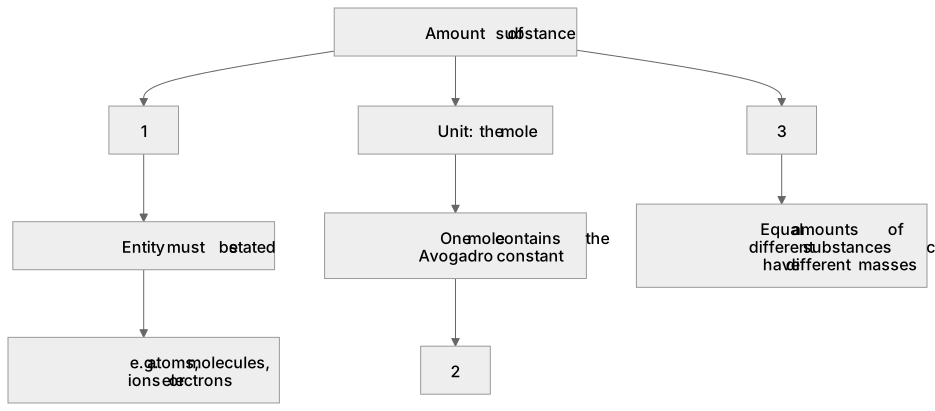
Some boxes have lost their names. Pick the right name for each number.
1Box 1
2Box 2
3Box 3
There is more to this lesson
The full lesson goes on to check your understanding and help you earn the marks. Create a free account to carry on, with your progress saved.
A week of Premium from your first lesson · Then the free plan continues · No card, no charge
Test your understanding of Amount of substance: (i) amount of substance
Active recall beats re-reading. Take an instant quiz now to test what you’ve learned and lock it into long-term memory.
A week of Premium from your first lesson · Then the free plan continues · No card, no charge