OCR · A-Level · Chemistry
Course version: H432 · Version from Sept 2017
Amount of substance: (ii) the atom economy of a reaction
Atom economy measures how much of the total mass of reactants ends up in the desired product, expressed as a percentage.
- Point 19 of 21
- 3 key terms
Study notes
From the teaching notes for this specification point.
The idea
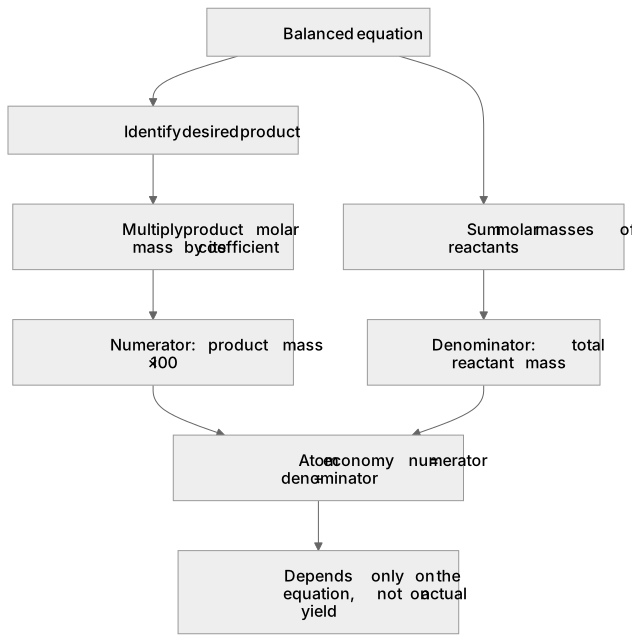
Atom economy measures how much of the total mass of reactants ends up in the desired product, expressed as a percentage. Calculate it as (molar mass of desired product × 100) ÷ total molar mass of all reactants, using the balanced equation and relative formula masses. For example, in the reaction N₂ + 3H₂ → 2NH₃, the desired product is ammonia: (2 × 17.0 × 100) ÷ (28.0 + 3 × 2.0) = 3400 ÷ 34.0 = 100%, because all reactant atoms appear in the product. A reaction producing a useful product alongside a waste by-product has a lower atom economy. Atom economy depends only on the equation, not on the actual yield obtained, so a reaction can have high atom economy but low percentage yield.
What earns the marks
- Calculates atom economy as (molar mass of desired product × 100) divided by the total molar mass of all reactants.
- Uses the balanced equation to identify the desired product and to sum the molar masses of every reactant.
- Multiplies the molar mass of the desired product by its stoichiometric coefficient before dividing.
- Distinguishes atom economy, which depends only on the equation, from percentage yield, which depends on the actual mass obtained.
Common mistakes and how to put them right
Divides by the mass of only one reactant instead of the total mass of all reactants.
Put it right: Sum every reactant's contribution.
Confuses atom economy with percentage yield.
Put it right: Keep atom economy based on the equation alone.
Omits the stoichiometric coefficient of the product.
Put it right: Multiply the product's molar mass by its coefficient.
Reports atom economy as a fraction rather than a percentage.
Put it right: Multiply the ratio by 100.
Exam tips
- Write out the balanced equation and label the desired product before substituting any numbers.
- Show the numerator and denominator separately so an arithmetic slip is easy to spot.
- Check whether the question asks for atom economy or percentage yield, since the two use different data.
Try the lesson
The start of the Amount of substance: (ii) the atom economy of a reaction lesson, made from teaching notes for this specification point.
Listen
Atom economy measures how much of the total mass of reactants ends up in the desired product, expressed as a percentage. Calculate it as (molar mass of desired product × 100) ÷ total molar mass of all reactants, using the balanced equation and relative formula masses. For example, in the reaction N₂ + 3H₂ → 2NH₃, the desired product is ammonia: (2 × 17.0 × 100) ÷ (28.0 + 3 × 2.0) = 3400 ÷ 34.0 = 100%, because all reactant atoms appear in the product. A reaction producing a useful product alongside a waste by-product has a lower atom economy. Atom economy depends only on the equation, not on the actual yield obtained, so a reaction can have high atom economy but low percentage yield. A strong answer earns marks for these points. Calculates atom economy as (molar mass of desired product × 100) divided by the total molar mass of all reactants. Uses the balanced equation to identify the desired product and to sum the molar masses of every reactant. Multiplies the molar mass of the desired product by its stoichiometric coefficient before dividing. Distinguishes atom economy, which depends only on the equation, from percentage yield, which depends on the actual mass obtained. Exam tip: Write out the balanced equation and label the desired product before substituting any numbers.
See it
Key words
Say what each word means before you turn the card.
Atom economy
Try answering aloud or in your head before turning the card.
Balanced equations and molar mass
Try answering aloud or in your head before turning the card.
Percentage yield versus atom economy
Try answering aloud or in your head before turning the card.
See every definition
- Atom economy
- A measure of how much of the total mass of reactants ends up in the desired product, expressed as a percentage.
- Balanced equations and molar mass
- The balanced equation identifies the desired product and is used to sum the molar masses of every reactant.
- Percentage yield versus atom economy
- Atom economy depends only on the equation, not on the actual yield obtained, so a reaction can have high atom economy but low percentage yield.
Label the diagram
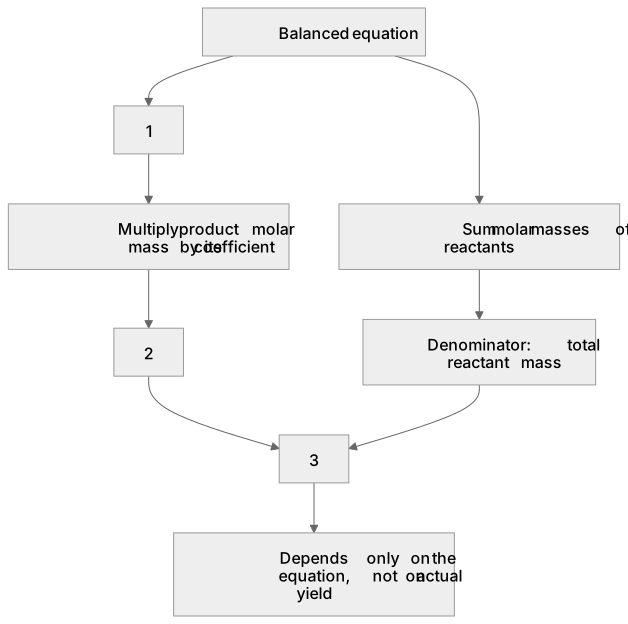
Some boxes have lost their names. Pick the right name for each number.
1Box 1
2Box 2
3Box 3
There is more to this lesson
The full lesson goes on to check your understanding and help you earn the marks. Create a free account to carry on, with your progress saved.
A week of Premium from your first lesson · Then the free plan continues · No card, no charge
Test your understanding of Amount of substance: (ii) the atom economy of a reaction
Active recall beats re-reading. Take an instant quiz now to test what you’ve learned and lock it into long-term memory.
A week of Premium from your first lesson · Then the free plan continues · No card, no charge