OCR · A-Level · Chemistry
Course version: H432 · Version from Sept 2017
Amount of substance: (iv) molar mass (mass per mole, units g mol⁻¹),
Molar mass is the mass of one mole of a substance, quoted in g mol⁻¹.
- Point 4 of 21
- 4 key terms
Study notes
From the teaching notes for this specification point.
The idea
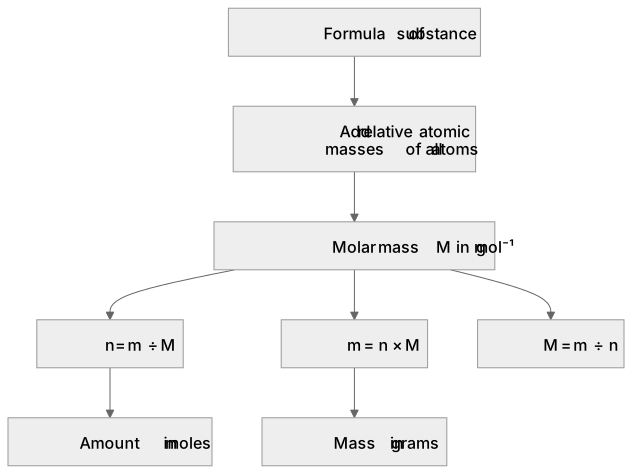
Molar mass is the mass of one mole of a substance, quoted in g mol⁻¹. You find it by adding the relative atomic masses of every atom in the formula, so H₂O is (2 × 1.0) + 16.0 = 18.0 g mol⁻¹ and CO₂ is 12.0 + (2 × 16.0) = 44.0 g mol⁻¹. The number is the same as the relative molecular or formula mass, but the unit changes from none to g mol⁻¹. To convert between mass and moles use n = m ÷ M, rearranged as m = n × M or M = m ÷ n. A question may give a mass in grams and ask for moles, or give moles and ask for the mass in grams; always check the unit you are asked for. Keep the distinction clear: molar mass is a fixed property of the substance, whereas the actual mass in grams depends on how much you have.
What earns the marks
- Adds the relative atomic masses of all atoms in the formula to obtain the molar mass in g mol⁻¹.
- States the unit as g mol⁻¹ rather than leaving the value unitless.
- Uses n = m ÷ M to convert a given mass in grams into an amount in moles.
- Rearranges to m = n × M to convert an amount in moles into a mass in grams.
- Distinguishes molar mass, a fixed property, from the actual mass of a sample.
Common mistakes and how to put them right
Omits the unit and gives the molar mass as a bare number.
Put it right: Attach g mol⁻¹ to the value.
Doubles or halves a subscript incorrectly when adding atomic masses.
Put it right: Count each atom in the formula carefully.
Divides moles by mass instead of mass by molar mass.
Put it right: Use n = m ÷ M with mass on top.
Treats the mass of a sample as the molar mass.
Put it right: Recognise that molar mass is per mole.
Exam tips
- Write the formula, list each element's relative atomic mass, then total them before substituting into n = m ÷ M.
- Check the requested unit in the question and give g mol⁻¹ for molar mass and mol for amount.
- Show the substitution with units so an arithmetic slip is easy to spot and correct.
Try the lesson
The start of the Amount of substance: (iv) molar mass (mass per mole, units g mol⁻¹), lesson, made from teaching notes for this specification point.
Listen
Molar mass is the mass of one mole of a substance, quoted in g mol⁻¹. You find it by adding the relative atomic masses of every atom in the formula, so H₂O is (2 × 1.0) + 16.0 = 18.0 g mol⁻¹ and CO₂ is 12.0 + (2 × 16.0) = 44.0 g mol⁻¹. The number is the same as the relative molecular or formula mass, but the unit changes from none to g mol⁻¹. To convert between mass and moles use n = m ÷ M, rearranged as m = n × M or M = m ÷ n. A question may give a mass in grams and ask for moles, or give moles and ask for the mass in grams; always check the unit you are asked for. Keep the distinction clear: molar mass is a fixed property of the substance, whereas the actual mass in grams depends on how much you have. A strong answer earns marks for these points. Adds the relative atomic masses of all atoms in the formula to obtain the molar mass in g mol⁻¹. States the unit as g mol⁻¹ rather than leaving the value unitless. Uses n = m ÷ M to convert a given mass in grams into an amount in moles. Rearranges to m = n × M to convert an amount in moles into a mass in grams. Exam tip: Write the formula, list each element's relative atomic mass, then total them before substituting into n = m ÷ M.
See it
Key words
Say what each word means before you turn the card.
molar mass
Try answering aloud or in your head before turning the card.
units of molar mass
Try answering aloud or in your head before turning the card.
calculating molar mass
Try answering aloud or in your head before turning the card.
converting between mass and moles
Try answering aloud or in your head before turning the card.
See every definition
- molar mass
- The mass per mole of a substance, found by adding the relative atomic masses of every atom in the formula.
- units of molar mass
- The value is quoted in g mol⁻¹ rather than left as a bare number.
- calculating molar mass
- Adding the relative atomic masses of all atoms in the formula gives the molar mass in g mol⁻¹.
- converting between mass and moles
- Use n = m ÷ M, rearranged as m = n × M or M = m ÷ n, checking the unit asked for.
Label the diagram
Some boxes have lost their names. Pick the right name for each number.
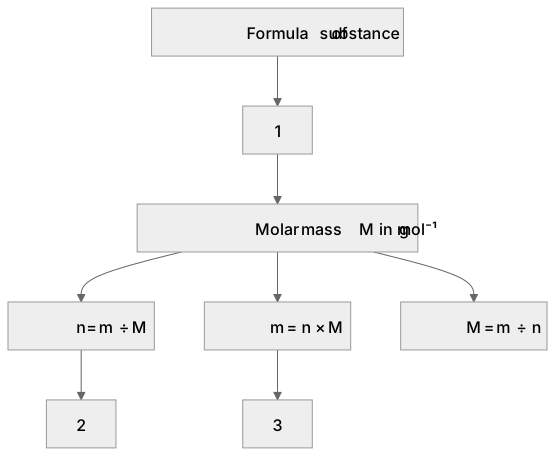
1Box 1
2Box 2
3Box 3
There is more to this lesson
The full lesson goes on to check your understanding and help you earn the marks. Create a free account to carry on, with your progress saved.
A week of Premium from your first lesson · Then the free plan continues · No card, no charge
Test your understanding of Amount of substance: (iv) molar mass (mass per mole, units g mol⁻¹),
Active recall beats re-reading. Take an instant quiz now to test what you’ve learned and lock it into long-term memory.
A week of Premium from your first lesson · Then the free plan continues · No card, no charge