OCR · A-Level · Chemistry
Course version: H432 · Version from Sept 2017
(j) the benefits for sustainability of developing chemical processes with…
Full specification wording
Amount of substance: (j) the benefits for sustainability of developing chemical processes with a high atom economy.
Atom economy compares the mass of atoms in the desired product with the total mass of atoms in all products, expressed as a percentage.
- Point 21 of 21
- 4 key terms
Study notes
From the teaching notes for this specification point.
The idea
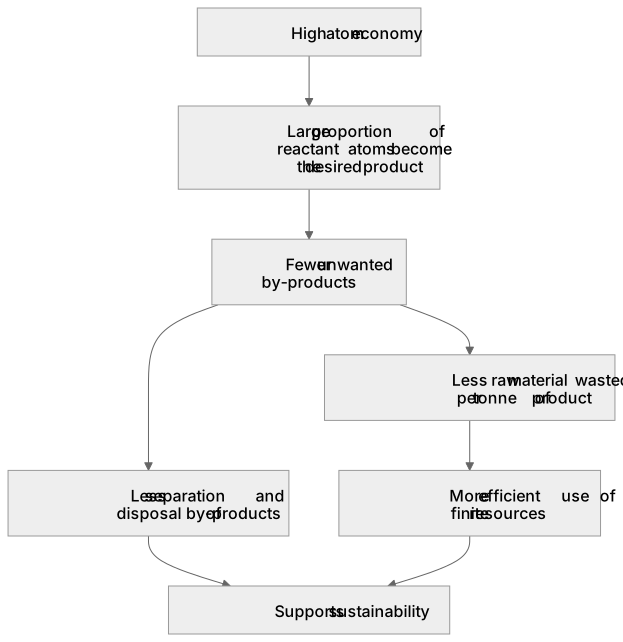
Atom economy compares the mass of atoms in the desired product with the total mass of atoms in all products, expressed as a percentage. A process with high atom economy converts most reactant atoms into the wanted product, so fewer atoms end up in unwanted by-products. This supports sustainability because fewer raw materials are wasted per tonne of product, less separation and disposal of by-products is needed, and the process makes more efficient use of finite resources. For example, an addition reaction that gives a single product has 100% atom economy, whereas a substitution that also produces a large unwanted co-product has a lower value. A multiple-choice question may ask you to identify which statement is a genuine sustainability benefit, so link the high atom economy to reduced waste and efficient use of resources rather than to reaction rate or yield.
What earns the marks
- Identifies that high atom economy means a large proportion of reactant atoms become the desired product.
- Explains that fewer unwanted by-products reduce waste and the need for separation or disposal.
- Links efficient use of raw materials to conservation of finite resources and sustainability.
- Distinguishes atom economy from percentage yield, which measures how much product is actually obtained.
- Selects the option that connects high atom economy to reduced waste rather than to faster reactions.
Common mistakes and how to put them right
Confuses atom economy with percentage yield.
Put it right: Keep atom economy as the proportion of reactant mass in the desired product.
Assumes high atom economy guarantees a fast reaction.
Put it right: Treat rate as a separate factor.
Claims high atom economy means no by-products are possible.
Put it right: Recognise that it means fewer or less massive by-products.
Ignores the disposal and separation costs of by-products.
Put it right: Include reduced waste processing as a sustainability benefit.
Exam tips
- Read each option and check whether it describes waste reduction or resource efficiency, which are the sustainability benefits.
- Recall the atom economy formula and use it to test whether a stated benefit is plausible.
- Eliminate options that describe rate, equilibrium position or catalyst effects, which are not atom economy benefits.
- Link the chosen answer explicitly to sustainability, such as conserving finite raw materials.
Try the lesson
The start of the Amount of substance: (j) the benefits for sustainability of developing chemical processes with a high atom economy. lesson, made from teaching notes for this specification point.
Listen
Atom economy compares the mass of atoms in the desired product with the total mass of atoms in all products, expressed as a percentage. A process with high atom economy converts most reactant atoms into the wanted product, so fewer atoms end up in unwanted by-products. This supports sustainability because fewer raw materials are wasted per tonne of product, less separation and disposal of by-products is needed, and the process makes more efficient use of finite resources. For example, an addition reaction that gives a single product has 100% atom economy, whereas a substitution that also produces a large unwanted co-product has a lower value. A multiple-choice question may ask you to identify which statement is a genuine sustainability benefit, so link the high atom economy to reduced waste and efficient use of resources rather than to reaction rate or yield. A strong answer earns marks for these points. Identifies that high atom economy means a large proportion of reactant atoms become the desired product. Explains that fewer unwanted by-products reduce waste and the need for separation or disposal. Links efficient use of raw materials to conservation of finite resources and sustainability. Distinguishes atom economy from percentage yield, which measures how much product is actually obtained. Exam tip: Read each option and check whether it describes waste reduction or resource efficiency, which are the sustainability benefits.
See it
Key words
Say what each word means before you turn the card.
Atom economy
Try answering aloud or in your head before turning the card.
Sustainability
Try answering aloud or in your head before turning the card.
Percentage yield
Try answering aloud or in your head before turning the card.
By-products
Try answering aloud or in your head before turning the card.
See every definition
- Atom economy
- Compares the mass of atoms in the desired product with the total mass of atoms in all products, expressed as a percentage.
- Sustainability
- Supported by high atom economy because fewer raw materials are wasted per tonne of product and the process makes more efficient use of finite resources.
- Percentage yield
- Measures how much product is actually obtained, and is distinguished from atom economy.
- By-products
- Unwanted products; fewer of them reduce waste and the need for separation or disposal.
Label the diagram
Some boxes have lost their names. Pick the right name for each number.
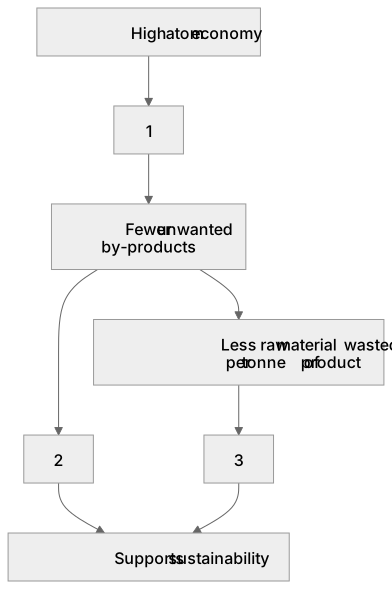
1Box 1
2Box 2
3Box 3
There is more to this lesson
The full lesson goes on to check your understanding and help you earn the marks. Create a free account to carry on, with your progress saved.
A week of Premium from your first lesson · Then the free plan continues · No card, no charge
Test your understanding of Amount of substance: (j) the benefits for sustainability of developing chemical processes with a high atom economy.
Active recall beats re-reading. Take an instant quiz now to test what you’ve learned and lock it into long-term memory.
A week of Premium from your first lesson · Then the free plan continues · No card, no charge