OCR · A-Level · Chemistry
Course version: H432 · Version from Sept 2017
(i) general formula (the simplest algebraic formula of a member of a…
Full specification wording
Basic concepts of organic chemistry: (i) general formula (the simplest algebraic formula of a member of a homologous series) e.g. for an alkane: CₙH₂ₙ₊₂
A general formula is the simplest algebraic expression that represents every member of a homologous series, using the letter n for the number of carbon atoms.
- Point 4 of 21
- 4 key terms
Study notes
From the teaching notes for this specification point.
The idea
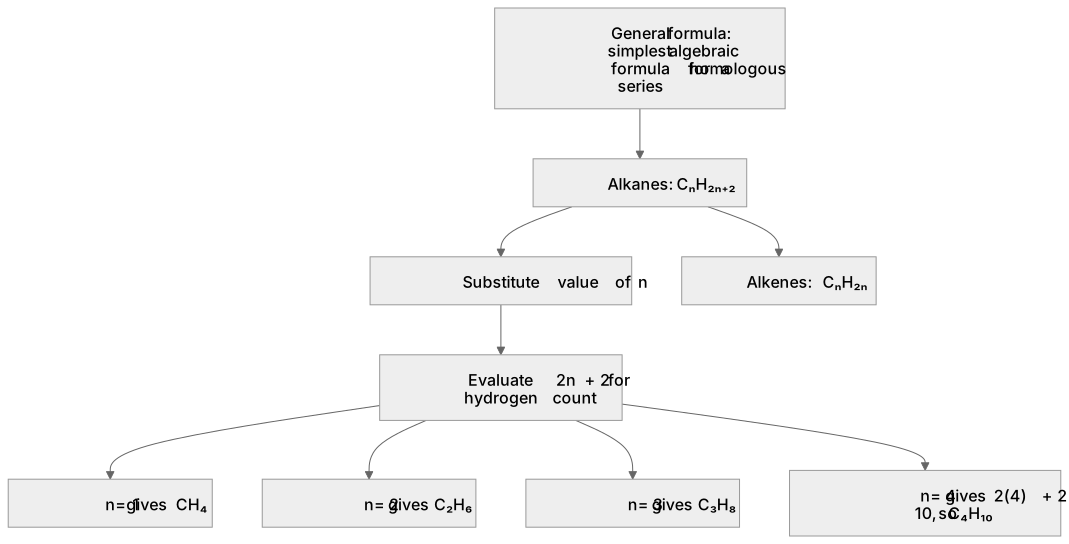
A general formula is the simplest algebraic expression that represents every member of a homologous series, using the letter n for the number of carbon atoms. For alkanes it is CₙH₂ₙ₊₂, so with n = 1 you get CH₄, with n = 2 you get C₂H₆ and with n = 3 you get C₃H₈. To use it, substitute the value of n and evaluate the hydrogen subscript: for n = 4, 2n + 2 = 10, giving C₄H₁₀. The formula must hold for every member of the series, which is why it is written algebraically rather than as a single molecular formula. Practise substituting several values of n and checking that each result matches a real alkane, and be ready to recognise the general formula of other series such as alkenes, CₙH₂ₙ.
What earns the marks
- States that a general formula is the simplest algebraic formula representing all members of a homologous series.
- Applies CₙH₂ₙ₊₂ to an alkane by substituting a value of n and evaluating 2n + 2 for the hydrogen count.
- Calculates correctly, for example n = 4 giving 2(4) + 2 = 10 and therefore C₄H₁₀.
- Recognises that the same general formula applies to every member of the series, so it is not tied to one compound.
Common mistakes and how to put them right
Substitutes n but forgets to add 2, giving too few hydrogen atoms.
Put it right: Evaluate 2n + 2 in full.
Writes a molecular formula when a general formula is requested.
Put it right: Use the algebraic form with n.
Applies the alkane general formula to an alkene.
Put it right: Use CₙH₂ₙ for alkenes and CₙH₂ₙ₊₂ for alkanes.
Exam tips
- Substitute the value of n step by step, writing 2n + 2 before evaluating, so arithmetic errors are easy to spot.
- Check your answer against a known member of the series, such as methane for n = 1.
- Read whether the question wants a general formula or a molecular formula before you write your answer.
Try the lesson
The start of the Basic concepts of organic chemistry: (i) general formula (the simplest algebraic formula of a member of a homologous series) e.g. for an alkane: CₙH₂ₙ₊₂ lesson, made from teaching notes for this specification point.
Listen
A general formula is the simplest algebraic expression that represents every member of a homologous series, using the letter n for the number of carbon atoms. For alkanes it is CₙH₂ₙ₊₂, so with n = 1 you get CH₄, with n = 2 you get C₂H₆ and with n = 3 you get C₃H₈. To use it, substitute the value of n and evaluate the hydrogen subscript: for n = 4, 2n + 2 = 10, giving C₄H₁₀. The formula must hold for every member of the series, which is why it is written algebraically rather than as a single molecular formula. Practise substituting several values of n and checking that each result matches a real alkane, and be ready to recognise the general formula of other series such as alkenes, CₙH₂ₙ. A strong answer earns marks for these points. States that a general formula is the simplest algebraic formula representing all members of a homologous series. Applies CₙH₂ₙ₊₂ to an alkane by substituting a value of n and evaluating 2n + 2 for the hydrogen count. Calculates correctly, for example n = 4 giving 2(4) + 2 = 10 and therefore C₄H₁₀. Recognises that the same general formula applies to every member of the series, so it is not tied to one compound. Exam tip: Substitute the value of n step by step, writing 2n + 2 before evaluating, so arithmetic errors are easy to spot.
See it
Key words
Say what each word means before you turn the card.
General formula
Try answering aloud or in your head before turning the card.
Alkane general formula
Try answering aloud or in your head before turning the card.
Substituting n
Try answering aloud or in your head before turning the card.
Homologous series
Try answering aloud or in your head before turning the card.
See every definition
- General formula
- The simplest algebraic formula of a member of a homologous series, written using the letter n for the number of carbon atoms.
- Alkane general formula
- CₙH₂ₙ₊₂, which holds for every member of the alkane series rather than a single molecular formula.
- Substituting n
- Replacing n with a value and evaluating 2n + 2 in full to find the hydrogen count, for example n = 4 giving C₄H₁₀.
- Homologous series
- A series whose members are all represented by the same general formula, which is why it is written algebraically rather than as a single molecular formula.
Label the diagram
Some boxes have lost their names. Pick the right name for each number.
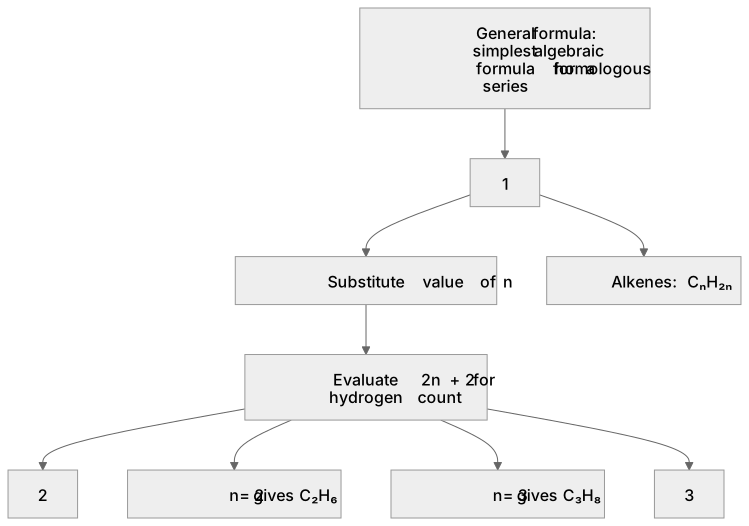
1Box 1
2Box 2
3Box 3
There is more to this lesson
The full lesson goes on to check your understanding and help you earn the marks. Create a free account to carry on, with your progress saved.
A week of Premium from your first lesson · Then the free plan continues · No card, no charge
Test your understanding of Basic concepts of organic chemistry: (i) general formula (the simplest algebraic formula of a member of a homologous series) e.g. for an alkane: CₙH₂ₙ₊₂
Active recall beats re-reading. Take an instant quiz now to test what you’ve learned and lock it into long-term memory.
A week of Premium from your first lesson · Then the free plan continues · No card, no charge