OCR · A-Level · Chemistry
Course version: H432 · Version from Sept 2017
(ii) heterolytic fission (in terms of one bonding atom receiving both…
Full specification wording
Basic concepts of organic chemistry: (ii) heterolytic fission (in terms of one bonding atom receiving both electrons from the bonded pair)
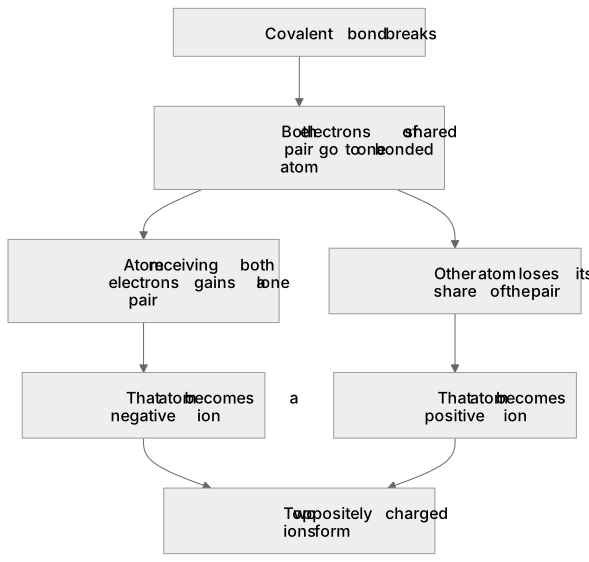
Heterolytic fission is the breaking of a covalent bond in which both electrons of the shared pair move to one of the two bonded atoms.
- Point 18 of 21
- 3 key terms
Study notes
From the teaching notes for this specification point.
The idea
Heterolytic fission is the breaking of a covalent bond in which both electrons of the shared pair move to one of the two bonded atoms. The bond splits unequally, so the atom that keeps the electron pair gains a lone pair and becomes negatively charged, while the other atom loses its share and becomes positively charged. For example, when the C–Br bond in bromoethane breaks heterolytically, the more electronegative bromine takes both electrons and forms Br⁻, and the carbon becomes a carbocation, C₂H₅⁺. Contrast this with homolytic fission, where each atom takes one electron and two radicals form. Recognise heterolytic fission by the paired-electron transfer and by the resulting ions of opposite charge.
What earns the marks
- Identifies heterolytic fission as bond breaking in which one bonded atom receives both electrons of the shared pair.
- States that the atom receiving both electrons becomes a negative ion and the other atom becomes a positive ion.
- Distinguishes heterolytic fission from homolytic fission, in which each atom receives one electron and radicals form.
- Applies the idea to a named example, such as a C–Br bond splitting to give Br⁻ and a carbocation.
Common mistakes and how to put them right
Describes the shared pair as splitting one electron to each atom.
Put it right by stating that both electrons go to a single atom in heterolytic fission.
Claims that heterolytic fission produces two radicals.
Put it right by noting that two oppositely charged ions form instead.
Omits the charges on the products.
Put it right by assigning a negative charge to the electron-rich atom and a positive charge to the electron-poor atom.
Exam tips
- Read the stem for the words 'both electrons' or 'one atom receives the pair' as the signal for heterolytic fission.
- Check each option for the correct pairing of a negative ion with a positive ion rather than two species of the same type.
- Link the answer to electronegativity: the more electronegative atom is the one that keeps the electron pair.
Try the lesson
The start of the Basic concepts of organic chemistry: (ii) heterolytic fission (in terms of one bonding atom receiving both electrons from the bonded pair) lesson, made from teaching notes for this specification point.
Listen
Heterolytic fission is the breaking of a covalent bond in which both electrons of the shared pair move to one of the two bonded atoms. The bond splits unequally, so the atom that keeps the electron pair gains a lone pair and becomes negatively charged, while the other atom loses its share and becomes positively charged. For example, when the C–Br bond in bromoethane breaks heterolytically, the more electronegative bromine takes both electrons and forms Br⁻, and the carbon becomes a carbocation, C₂H₅⁺. Contrast this with homolytic fission, where each atom takes one electron and two radicals form. Recognise heterolytic fission by the paired-electron transfer and by the resulting ions of opposite charge. A strong answer earns marks for these points. Identifies heterolytic fission as bond breaking in which one bonded atom receives both electrons of the shared pair. States that the atom receiving both electrons becomes a negative ion and the other atom becomes a positive ion. Distinguishes heterolytic fission from homolytic fission, in which each atom receives one electron and radicals form. Applies the idea to a named example, such as a C–Br bond splitting to give Br⁻ and a carbocation. A common slip: Describes the shared pair as splitting one electron to each atom. Instead, stating that both electrons go to a single atom in heterolytic fission. Exam tip: Read the stem for the words 'both electrons' or 'one atom receives the pair' as the signal for heterolytic fission.
See it
Key words
Say what each word means before you turn the card.
Heterolytic fission
Try answering aloud or in your head before turning the card.
Ion formation
Try answering aloud or in your head before turning the card.
Contrast with homolytic fission
Try answering aloud or in your head before turning the card.
See every definition
- Heterolytic fission
- Bond breaking in which one bonding atom receives both electrons of the bonded pair.
- Ion formation
- The atom receiving both electrons becomes a negative ion and the other atom becomes a positive ion.
- Contrast with homolytic fission
- In homolytic fission each atom receives one electron and radicals form, rather than two oppositely charged ions.
Label the diagram
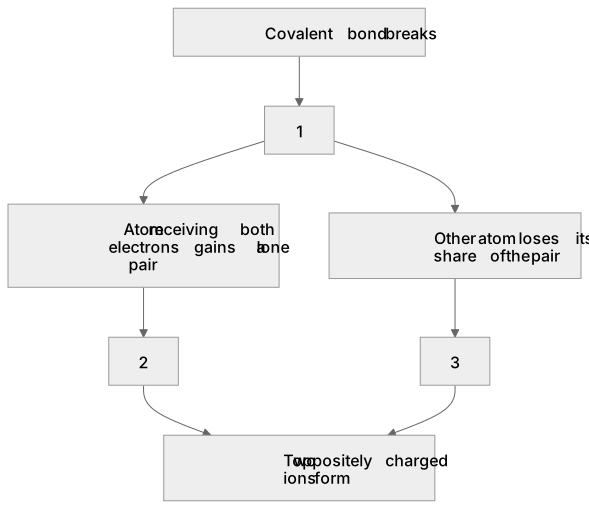
Some boxes have lost their names. Pick the right name for each number.
1Box 1
2Box 2
3Box 3
There is more to this lesson
The full lesson goes on to check your understanding and help you earn the marks. Create a free account to carry on, with your progress saved.
A week of Premium from your first lesson · Then the free plan continues · No card, no charge
Test your understanding of Basic concepts of organic chemistry: (ii) heterolytic fission (in terms of one bonding atom receiving both electrons from the bonded pair)
Active recall beats re-reading. Take an instant quiz now to test what you’ve learned and lock it into long-term memory.
A week of Premium from your first lesson · Then the free plan continues · No card, no charge