OCR · A-Level · Chemistry
Course version: H432 · Version from Sept 2017
(b) explanation of the solid structures of giant ionic lattices, resulting…
Full specification wording
Bonding and structure: (b) explanation of the solid structures of giant ionic lattices, resulting from oppositely charged ions strongly attracted in all directions e.g. NaCl
A giant ionic lattice forms when oppositely charged ions pack in a regular three-dimensional array, as in sodium chloride where Na⁺ and Cl⁻ alternate.
- Point 3 of 24
- 4 key terms
Study notes
From the teaching notes for this specification point.
The idea
A giant ionic lattice forms when oppositely charged ions pack in a regular three-dimensional array, as in sodium chloride where Na⁺ and Cl⁻ alternate. Each ion is surrounded by ions of opposite charge, and the electrostatic attraction acts strongly in all directions, not just towards one neighbour. This extended attraction gives high melting and boiling points because many strong attractions must be overcome. The lattice is brittle: when a layer is displaced, ions of like charge are brought alongside each other, and the resulting repulsion splits the crystal. Solid lattices do not conduct because the ions are held in fixed positions, but the melt or aqueous solution conducts as ions become mobile.
What earns the marks
- Describes the lattice as a regular three-dimensional array of alternating oppositely charged ions, as in NaCl.
- Explains that each ion is surrounded by ions of opposite charge and is strongly attracted in all directions.
- Links the many strong electrostatic attractions throughout the lattice to high melting and boiling points.
- Explains brittleness by describing displacement of a layer so that like charges come into contact and repel.
- States that the solid does not conduct because ions are fixed, whereas the molten or aqueous form conducts because ions are mobile.
Common mistakes and how to put them right
Attributes brittleness to strong attraction in all directions.
Put it right: Explain instead that sliding a layer brings like charges together and causes repulsion.
Describes ionic bonding as a pair of ions attracting only each other.
Put it right: Show that attraction operates in all directions throughout the lattice.
Claims solid sodium chloride conducts electricity.
Put it right: State that ions are fixed in the solid and mobile only when molten or dissolved.
Says melting breaks covalent bonds within the lattice.
Put it right: Describe the overcoming of electrostatic attractions between ions instead.
Exam tips
- Use the phrase 'electrostatic attraction between oppositely charged ions in all directions' to capture the lattice model precisely.
- Separate the properties clearly: melting point from many strong attractions, brittleness from like-charge repulsion, conductivity from ion mobility.
- Refer to a named example such as NaCl and state the charges Na⁺ and Cl⁻ with correct superscripts.
Try the lesson
The start of the Bonding and structure: (b) explanation of the solid structures of giant ionic lattices, resulting from oppositely charged ions strongly attracted in all directions e.g. NaCl lesson, made from teaching notes for this specification point.
Listen
A giant ionic lattice forms when oppositely charged ions pack in a regular three-dimensional array, as in sodium chloride where Na⁺ and Cl⁻ alternate. Each ion is surrounded by ions of opposite charge, and the electrostatic attraction acts strongly in all directions, not just towards one neighbour. This extended attraction gives high melting and boiling points because many strong attractions must be overcome. The lattice is brittle: when a layer is displaced, ions of like charge are brought alongside each other, and the resulting repulsion splits the crystal. Solid lattices do not conduct because the ions are held in fixed positions, but the melt or aqueous solution conducts as ions become mobile. A strong answer earns marks for these points. Describes the lattice as a regular three-dimensional array of alternating oppositely charged ions, as in NaCl. Explains that each ion is surrounded by ions of opposite charge and is strongly attracted in all directions. Links the many strong electrostatic attractions throughout the lattice to high melting and boiling points. Explains brittleness by describing displacement of a layer so that like charges come into contact and repel. Exam tip: Use the phrase 'electrostatic attraction between oppositely charged ions in all directions' to capture the lattice model precisely.
See it
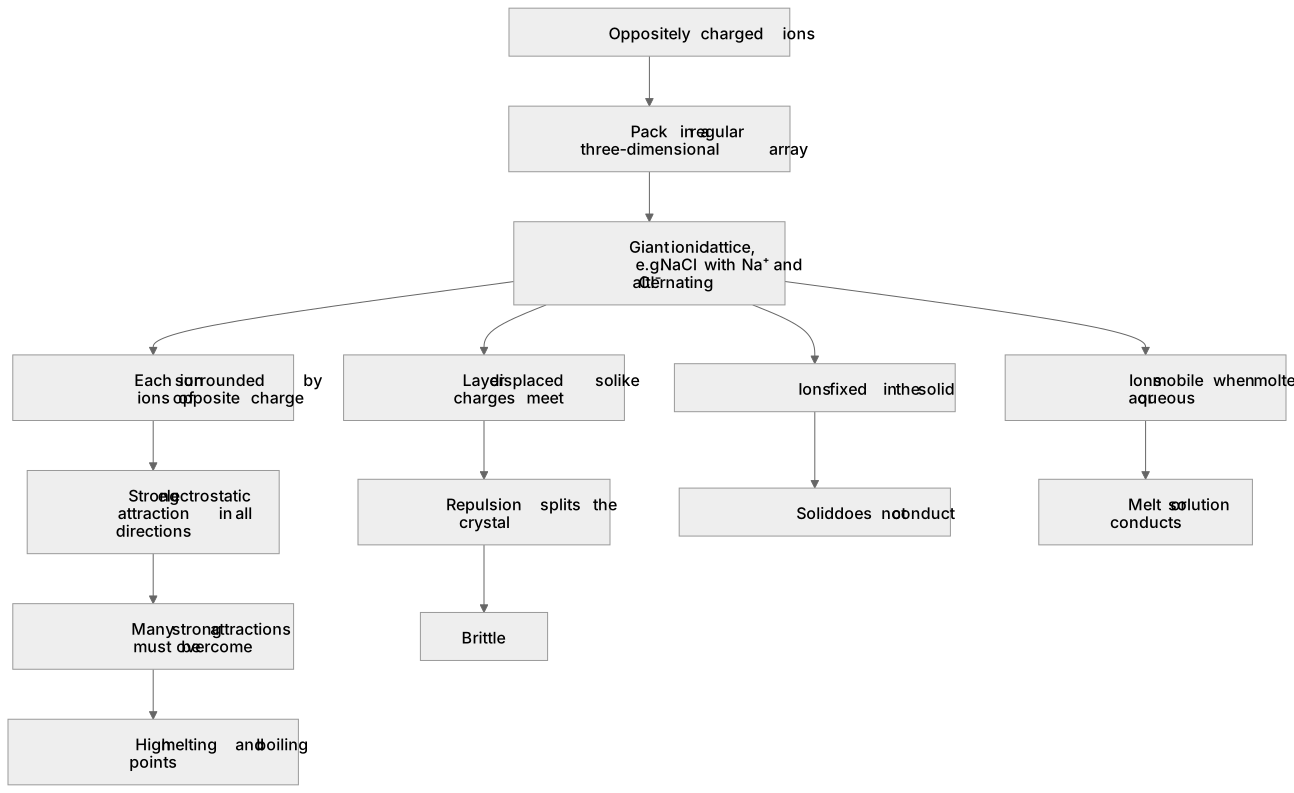
Key words
Say what each word means before you turn the card.
Giant ionic lattice structure
Try answering aloud or in your head before turning the card.
Electrostatic attraction in all directions
Try answering aloud or in your head before turning the card.
Melting point and brittleness explained by the model
Try answering aloud or in your head before turning the card.
Electrical conductivity and ion mobility
Try answering aloud or in your head before turning the card.
See every definition
- Giant ionic lattice structure
- A regular three-dimensional array of alternating oppositely charged ions, as in sodium chloride where Na⁺ and Cl⁻ alternate.
- Electrostatic attraction in all directions
- Each ion is surrounded by ions of opposite charge and is strongly attracted in all directions, not just towards one neighbour.
- Melting point and brittleness explained by the model
- Many strong electrostatic attractions throughout the lattice must be overcome to melt it, while sliding a layer brings like charges together and causes repulsion.
- Electrical conductivity and ion mobility
- The solid does not conduct because ions are fixed, whereas the molten or aqueous form conducts because ions are mobile.
Label the diagram
Some boxes have lost their names. Pick the right name for each number.
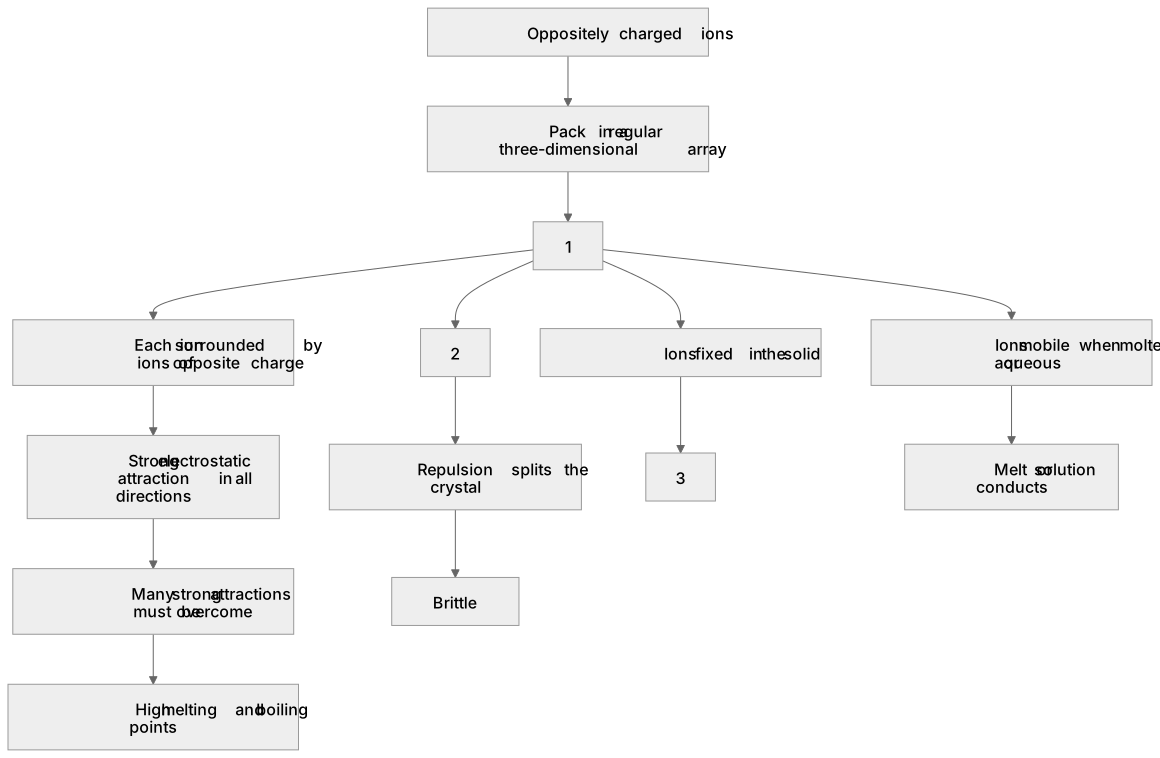
1Box 1
2Box 2
3Box 3
There is more to this lesson
The full lesson goes on to check your understanding and help you earn the marks. Create a free account to carry on, with your progress saved.
A week of Premium from your first lesson · Then the free plan continues · No card, no charge
Test your understanding of Bonding and structure: (b) explanation of the solid structures of giant ionic lattices, resulting from oppositely charged ions strongly attracted in all directions e.g. NaCl
Active recall beats re-reading. Take an instant quiz now to test what you’ve learned and lock it into long-term memory.
A week of Premium from your first lesson · Then the free plan continues · No card, no charge