OCR · A-Level · Chemistry
Course version: H432 · Version from Sept 2017
Bonding and structure: Covalent bonding
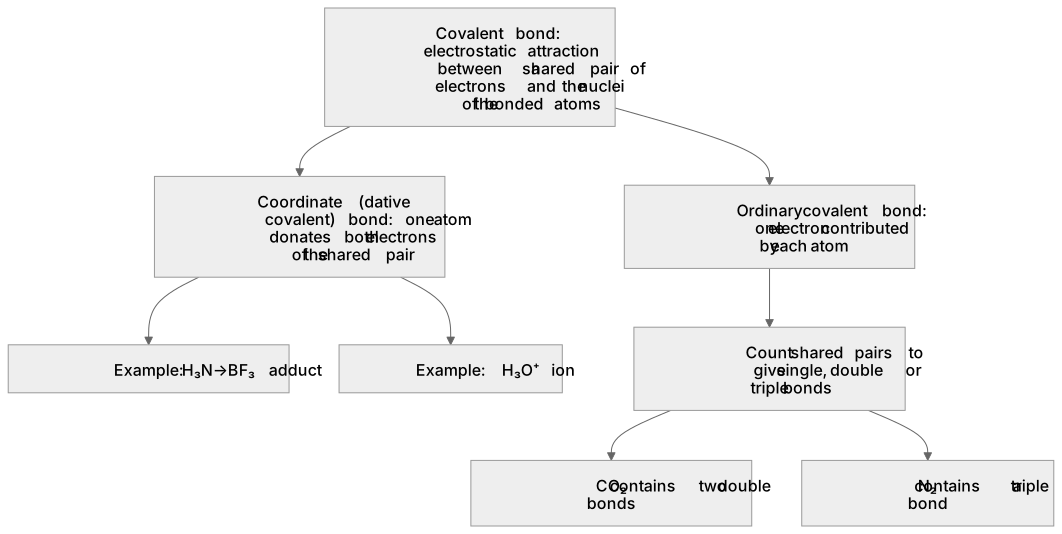
Covalent bonding is the electrostatic attraction between a shared pair of electrons and the nuclei of the two bonded atoms.
- Point 5 of 24
- 3 key terms
Study notes
From the teaching notes for this specification point.
The idea
Covalent bonding is the electrostatic attraction between a shared pair of electrons and the nuclei of the two bonded atoms. Each atom contributes one electron to the shared pair, giving both atoms a full outer shell in most simple molecules such as H₂, Cl₂, H₂O and CH₄. A coordinate (dative covalent) bond forms when one atom donates both electrons of the shared pair, as in the H₃N→BF₃ adduct or the H₃O⁺ ion, so a shared pair need not come from one electron per atom. Learners should draw dot-and-cross diagrams, count shared pairs to give single, double or triple bonds, and explain why molecules such as CO₂ contain two double bonds while N₂ contains a triple bond.
What earns the marks
- States that a covalent bond is the electrostatic attraction between a shared pair of electrons and the nuclei of the bonded atoms.
- Shows one electron contributed by each atom in an ordinary covalent bond and both electrons donated by one atom in a coordinate bond.
- Draws dot-and-cross diagrams that give each atom a full outer shell where the octet rule applies.
- Distinguishes single, double and triple bonds by counting the number of shared pairs between the atoms.
- Identifies a coordinate bond in an example such as the H₃N→BF₃ adduct or the H₃O⁺ ion.
Common mistakes and how to put them right
Claims that atoms share only unpaired outer-shell electrons.
Put it right by noting that a coordinate bond uses a donated lone pair, so a shared pair can come from one atom.
Describes the bond as a sharing of nuclei rather than electrons.
Put it right by stating that nuclei are attracted to the shared pair.
Omits the electrostatic attraction and describes covalent bonding as mere sharing.
Put it right by naming the attraction between the shared pair and both nuclei.
Exam tips
- Read each option fully before choosing, because distractors often swap 'shared pair' for 'transferred electron'.
- When a diagram is offered, check that every atom reaches a full outer shell before selecting it.
- Recall one coordinate-bond example so you can reject options that deny lone-pair donation.
Try the lesson
The start of the Bonding and structure: Covalent bonding lesson, made from teaching notes for this specification point.
Listen
Covalent bonding is the electrostatic attraction between a shared pair of electrons and the nuclei of the two bonded atoms. Each atom contributes one electron to the shared pair, giving both atoms a full outer shell in most simple molecules such as H₂, Cl₂, H₂O and CH₄. A coordinate (dative covalent) bond forms when one atom donates both electrons of the shared pair, as in the H₃N→BF₃ adduct or the H₃O⁺ ion, so a shared pair need not come from one electron per atom. Learners should draw dot-and-cross diagrams, count shared pairs to give single, double or triple bonds, and explain why molecules such as CO₂ contain two double bonds while N₂ contains a triple bond. A strong answer earns marks for these points. States that a covalent bond is the electrostatic attraction between a shared pair of electrons and the nuclei of the bonded atoms. Shows one electron contributed by each atom in an ordinary covalent bond and both electrons donated by one atom in a coordinate bond. Draws dot-and-cross diagrams that give each atom a full outer shell where the octet rule applies. Distinguishes single, double and triple bonds by counting the number of shared pairs between the atoms. A common slip: Claims that atoms share only unpaired outer-shell electrons. Instead, noting that a coordinate bond uses a donated lone pair, so a shared pair can come from one atom. Exam tip: Read each option fully before choosing, because distractors often swap 'shared pair' for 'transferred electron'.
See it
Key words
Say what each word means before you turn the card.
Electrostatic nature of the covalent bond
Try answering aloud or in your head before turning the card.
Shared electron pairs and the octet rule
Try answering aloud or in your head before turning the card.
Coordinate (dative covalent) bonding
Try answering aloud or in your head before turning the card.
See every definition
- Electrostatic nature of the covalent bond
- The electrostatic attraction between a shared pair of electrons and the nuclei of the two bonded atoms.
- Shared electron pairs and the octet rule
- Each atom contributes one electron to the shared pair, giving both atoms a full outer shell in most simple molecules.
- Coordinate (dative covalent) bonding
- A bond that forms when one atom donates both electrons of the shared pair, so a shared pair need not come from one electron per atom.
Label the diagram
Some boxes have lost their names. Pick the right name for each number.
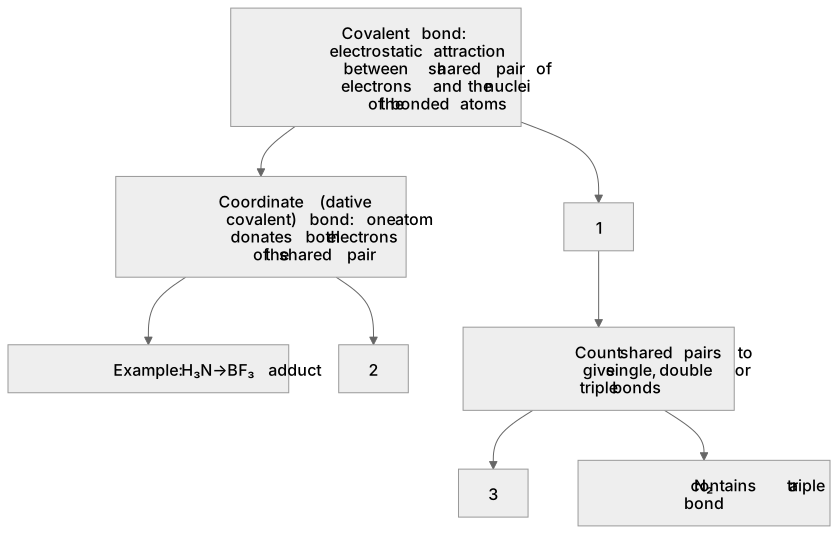
1Box 1
2Box 2
3Box 3
There is more to this lesson
The full lesson goes on to check your understanding and help you earn the marks. Create a free account to carry on, with your progress saved.
A week of Premium from your first lesson · Then the free plan continues · No card, no charge
Test your understanding of Bonding and structure: Covalent bonding
Active recall beats re-reading. Take an instant quiz now to test what you’ve learned and lock it into long-term memory.
A week of Premium from your first lesson · Then the free plan continues · No card, no charge