OCR · A-Level · Chemistry
Course version: H432 · Version from Sept 2017
Bonding and structure: Electronegativity and bond polarity
Electronegativity measures how strongly an atom attracts the bonding electrons in a covalent bond.
- Point 15 of 24
- 4 key terms
Study notes
From the teaching notes for this specification point.
The idea
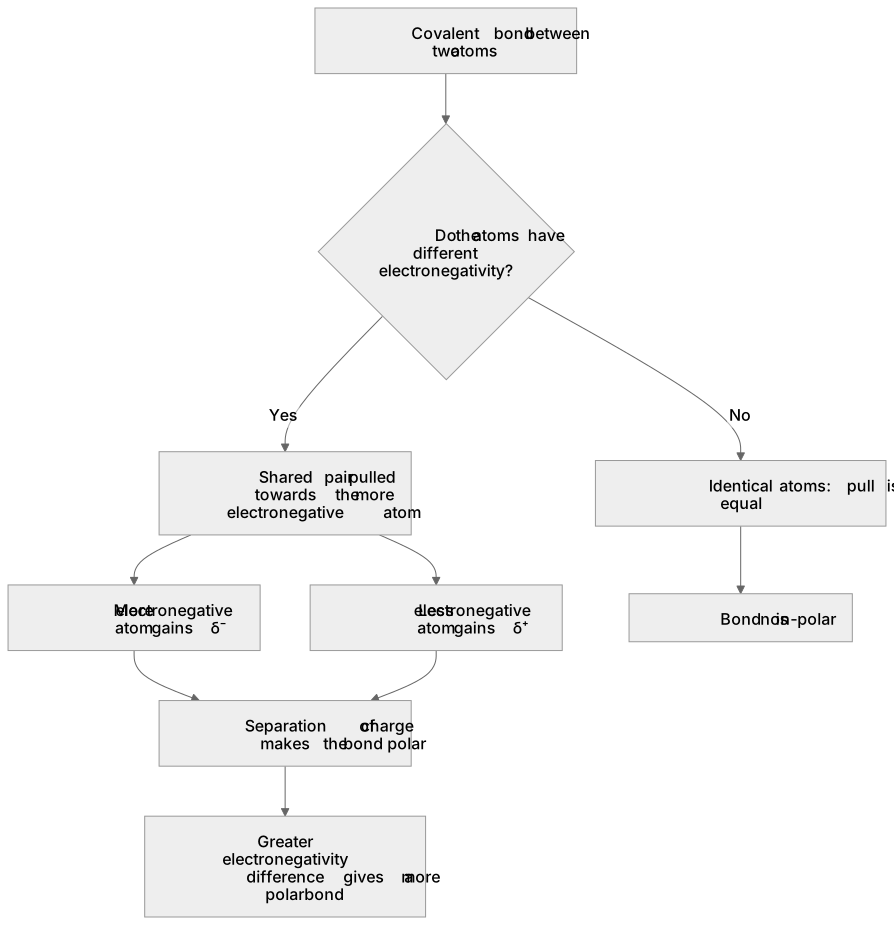
Electronegativity measures how strongly an atom attracts the bonding electrons in a covalent bond. In a bond between two atoms of different electronegativity, the shared pair is pulled towards the more electronegative atom, which gains a partial negative charge (δ⁻) while the less electronegative atom gains a partial positive charge (δ⁺). This separation of charge makes the bond polar. A bond between identical atoms, such as in Cl₂ or H₂, is non-polar because the pull is equal. The greater the difference in electronegativity, the more polar the bond. For example, in HCl chlorine is more electronegative than hydrogen, so chlorine carries δ⁻ and hydrogen carries δ⁺. Bond polarity is a property of a bond; whether a whole molecule is polar also depends on its shape and on whether the individual bond dipoles cancel.
What earns the marks
- Identifies electronegativity as the ability of an atom to attract the bonding electrons in a covalent bond.
- Explains that unequal attraction pulls the shared electron pair towards the more electronegative atom.
- Assigns δ⁻ to the more electronegative atom and δ⁺ to the less electronegative atom.
- States that a bond between identical atoms is non-polar because the attraction is equal.
- Relates a larger electronegativity difference to a more polar bond.
- Distinguishes bond polarity from overall molecular polarity, which also depends on shape.
Common mistakes and how to put them right
Confuses electronegativity with electron affinity.
Put it right: Keep electronegativity as attraction for bonding electrons within a covalent bond.
Treats a polar bond as automatically making the whole molecule polar.
Put it right: Check shape and whether bond dipoles cancel.
Assigns δ⁻ to the less electronegative atom.
Put it right: Place δ⁻ on the atom that attracts the bonding electrons more strongly.
Assumes all covalent bonds are non-polar.
Put it right: Compare the electronegativity of the two bonded atoms.
Exam tips
- Learn the precise definition word for word, including the phrase bonding electrons in a covalent bond.
- Use δ⁺ and δ⁻ rather than full charges when describing polar covalent bonds.
- When asked about molecular polarity, state the bond dipoles and then say whether the shape lets them cancel.
- Check the direction of the dipole: the arrow or δ⁻ points to the more electronegative atom.
Try the lesson
The start of the Bonding and structure: Electronegativity and bond polarity lesson, made from teaching notes for this specification point.
Listen
Electronegativity measures how strongly an atom attracts the bonding electrons in a covalent bond. In a bond between two atoms of different electronegativity, the shared pair is pulled towards the more electronegative atom, which gains a partial negative charge (δ⁻) while the less electronegative atom gains a partial positive charge (δ⁺). This separation of charge makes the bond polar. A bond between identical atoms, such as in Cl₂ or H₂, is non-polar because the pull is equal. The greater the difference in electronegativity, the more polar the bond. For example, in HCl chlorine is more electronegative than hydrogen, so chlorine carries δ⁻ and hydrogen carries δ⁺. Bond polarity is a property of a bond; whether a whole molecule is polar also depends on its shape and on whether the individual bond dipoles cancel. A strong answer earns marks for these points. Identifies electronegativity as the ability of an atom to attract the bonding electrons in a covalent bond. Explains that unequal attraction pulls the shared electron pair towards the more electronegative atom. Assigns δ⁻ to the more electronegative atom and δ⁺ to the less electronegative atom. States that a bond between identical atoms is non-polar because the attraction is equal. Exam tip: Learn the precise definition word for word, including the phrase bonding electrons in a covalent bond.
See it
Key words
Say what each word means before you turn the card.
Electronegativity
Try answering aloud or in your head before turning the card.
Unequal sharing of bonding electrons
Try answering aloud or in your head before turning the card.
Partial charges δ⁺ and δ⁻
Try answering aloud or in your head before turning the card.
Bond polarity versus molecular polarity
Try answering aloud or in your head before turning the card.
See every definition
- Electronegativity
- Measures how strongly an atom attracts the bonding electrons in a covalent bond.
- Unequal sharing of bonding electrons
- In a bond between two atoms of different electronegativity, the shared pair is pulled towards the more electronegative atom.
- Partial charges δ⁺ and δ⁻
- The more electronegative atom gains a partial negative charge (δ⁻) while the less electronegative atom gains a partial positive charge (δ⁺).
- Bond polarity versus molecular polarity
- Bond polarity is a property of a bond, whereas whether a whole molecule is polar also depends on its shape and on whether the individual bond dipoles cancel.
There is more to this lesson
The full lesson goes on to check your understanding and help you earn the marks. Create a free account to carry on, with your progress saved.
A week of Premium from your first lesson · Then the free plan continues · No card, no charge
Test your understanding of Bonding and structure: Electronegativity and bond polarity
Active recall beats re-reading. Take an instant quiz now to test what you’ve learned and lock it into long-term memory.
A week of Premium from your first lesson · Then the free plan continues · No card, no charge