OCR · A-Level · Chemistry
Course version: H432 · Version from Sept 2017
Bonding and structure: (i) the density of ice compared with water
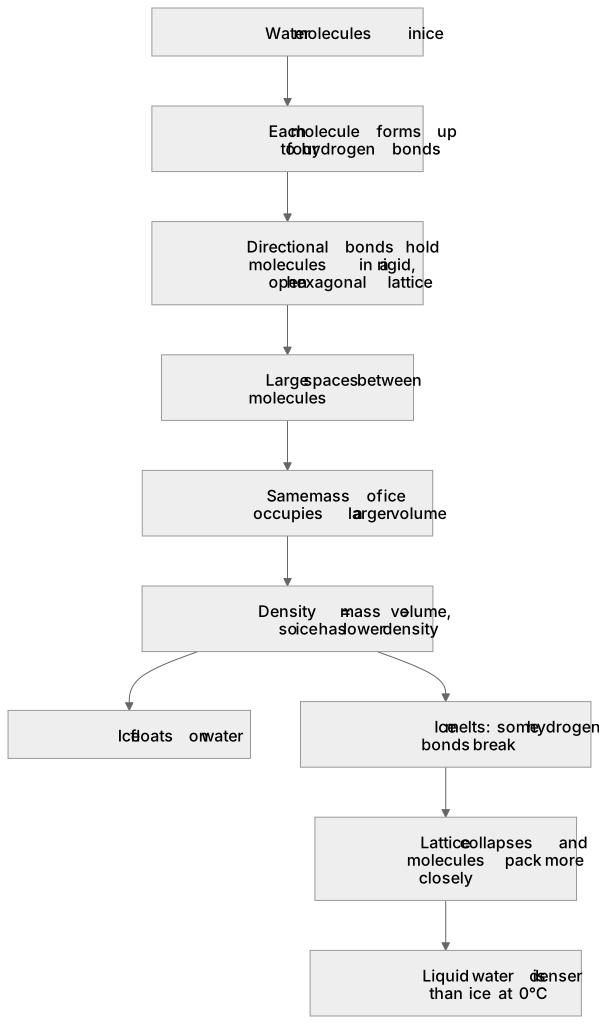
In ice, each water molecule forms up to four hydrogen bonds, two through its hydrogen atoms and two through the lone pairs on oxygen.
- Point 21 of 24
- 4 key terms
Study notes
From the teaching notes for this specification point.
The idea
In ice, each water molecule forms up to four hydrogen bonds, two through its hydrogen atoms and two through the lone pairs on oxygen. These directional bonds hold the molecules in a rigid, open hexagonal lattice with large spaces between them, so a given mass of ice occupies a larger volume than the same mass of liquid water. Density is mass divided by volume, so the lower density of ice follows directly from that larger volume. When ice melts, some hydrogen bonds break and the lattice collapses, allowing molecules to pack more closely, so liquid water is denser than ice at 0 °C. This is why ice floats on water.
What earns the marks
- States that ice is less dense than liquid water at the same temperature.
- Explains that hydrogen bonds in ice hold molecules in a rigid, open lattice with large spaces between them.
- Links the larger volume occupied by a fixed mass of ice to its lower density using density = mass ÷ volume.
- Explains that on melting some hydrogen bonds break and molecules pack more closely, making liquid water denser than ice.
Common mistakes and how to put them right
States that ice is denser than water because it is a solid.
Put it right: Recognise instead that the open hydrogen-bonded lattice makes ice less dense than liquid water.
Claims that hydrogen bonds are broken completely on melting.
Put it right: Explain that only some hydrogen bonds break, allowing closer packing while many remain.
Attributes the lower density of ice to heavier molecules or greater mass.
Put it right: Explain instead that the same mass occupies a larger volume in the open lattice.
Describes the lattice as closely packed.
Put it right: Describe it instead as open and rigid with large spaces between molecules.
Exam tips
- Use the relationship density = mass ÷ volume to connect the open lattice to the lower density of ice.
- Name the hydrogen-bonded open lattice explicitly rather than referring vaguely to 'the structure of ice'.
- Explain that melting breaks only some hydrogen bonds, allowing molecules to pack more closely and increasing density.
- Link the answer to the everyday observation that ice floats on water to confirm the direction of the density comparison.
Try the lesson
The start of the Bonding and structure: (i) the density of ice compared with water lesson, made from teaching notes for this specification point.
Listen
In ice, each water molecule forms up to four hydrogen bonds, two through its hydrogen atoms and two through the lone pairs on oxygen. These directional bonds hold the molecules in a rigid, open hexagonal lattice with large spaces between them, so a given mass of ice occupies a larger volume than the same mass of liquid water. Density is mass divided by volume, so the lower density of ice follows directly from that larger volume. When ice melts, some hydrogen bonds break and the lattice collapses, allowing molecules to pack more closely, so liquid water is denser than ice at 0 °C. This is why ice floats on water. A strong answer earns marks for these points. States that ice is less dense than liquid water at the same temperature. Explains that hydrogen bonds in ice hold molecules in a rigid, open lattice with large spaces between them. Links the larger volume occupied by a fixed mass of ice to its lower density using density = mass ÷ volume. Explains that on melting some hydrogen bonds break and molecules pack more closely, making liquid water denser than ice. Exam tip: Use the relationship density = mass ÷ volume to connect the open lattice to the lower density of ice.
See it
Key words
Say what each word means before you turn the card.
Hydrogen bonding in ice
Try answering aloud or in your head before turning the card.
Open rigid lattice structure
Try answering aloud or in your head before turning the card.
Density as mass per unit volume
Try answering aloud or in your head before turning the card.
Closer packing in liquid water
Try answering aloud or in your head before turning the card.
See every definition
- Hydrogen bonding in ice
- Each water molecule forms up to four hydrogen bonds, two through its hydrogen atoms and two through the lone pairs on oxygen.
- Open rigid lattice structure
- Directional bonds hold the molecules in a rigid, open hexagonal lattice with large spaces between them.
- Density as mass per unit volume
- Density is mass divided by volume, so the lower density of ice follows directly from its larger volume.
- Closer packing in liquid water
- When ice melts, some hydrogen bonds break and the lattice collapses, allowing molecules to pack more closely.
Label the diagram
Some boxes have lost their names. Pick the right name for each number.
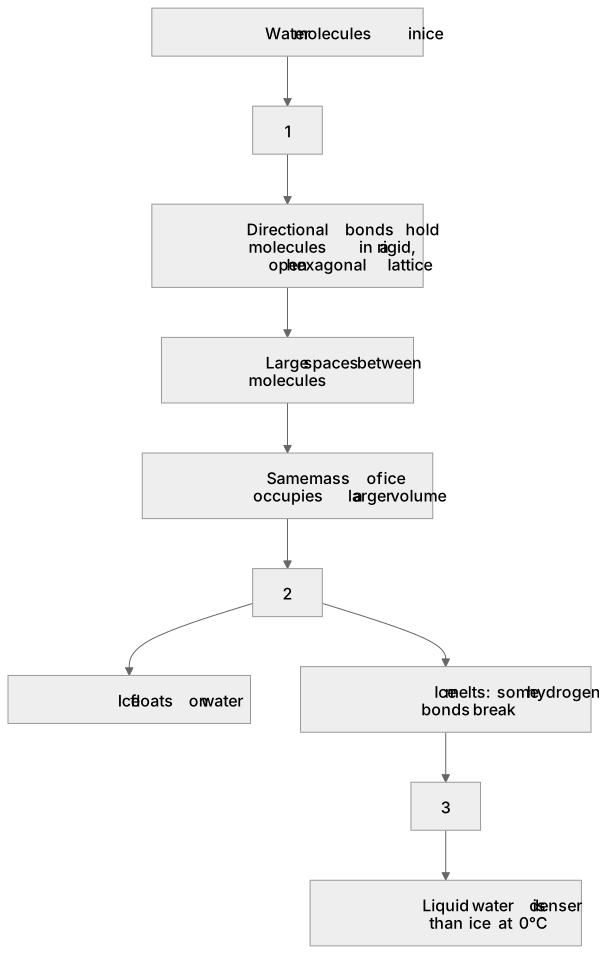
1Box 1
2Box 2
3Box 3
There is more to this lesson
The full lesson goes on to check your understanding and help you earn the marks. Create a free account to carry on, with your progress saved.
A week of Premium from your first lesson · Then the free plan continues · No card, no charge
Test your understanding of Bonding and structure: (i) the density of ice compared with water
Active recall beats re-reading. Take an instant quiz now to test what you’ve learned and lock it into long-term memory.
A week of Premium from your first lesson · Then the free plan continues · No card, no charge