OCR · A-Level · Chemistry
Course version: H432 · Version from Sept 2017
(d) formation of a substituted aromatic C–C by alkylation (using a…
Full specification wording
Carbon–carbon bond formation: (d) formation of a substituted aromatic C–C by alkylation (using a haloalkane) and acylation (using an acyl chloride) in the presence of a halogen carrier (Friedel–Crafts reaction) (see also 6.1.1 d).
This statement covers Friedel–Crafts chemistry, in which a benzene ring gains a new carbon–carbon bond to a substituent.
- Point 9 of 9
- 4 key terms
Study notes
From the teaching notes for this specification point.
The idea
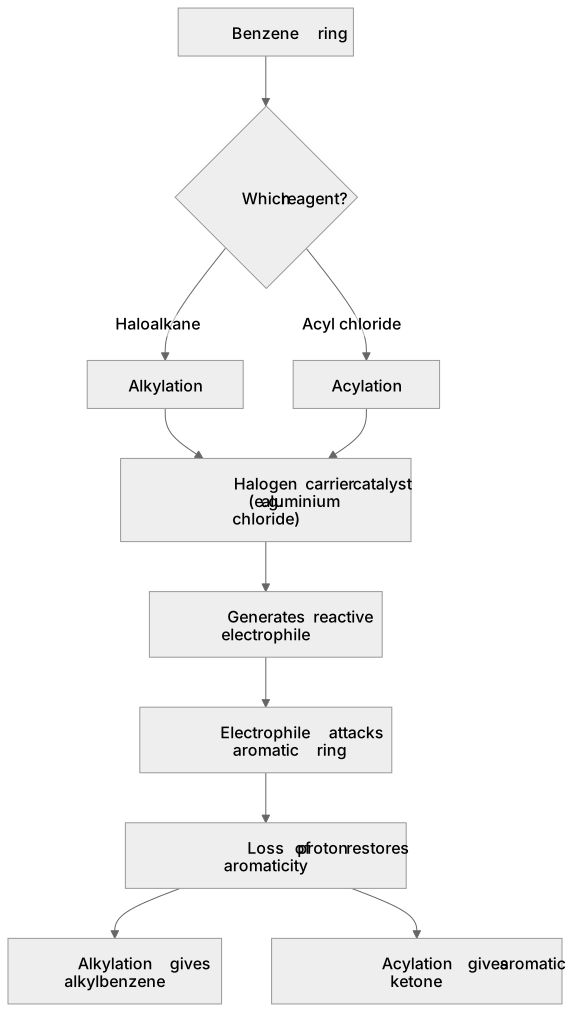
This statement covers Friedel–Crafts chemistry, in which a benzene ring gains a new carbon–carbon bond to a substituent. In alkylation a haloalkane such as chloroethane reacts with benzene, and in acylation an acyl chloride such as ethanoyl chloride reacts with benzene. Neither reaction proceeds usefully without a halogen carrier, a Lewis acid catalyst such as aluminium chloride or iron(III) chloride, which accepts a chloride ion from the haloalkane or acyl chloride to generate a reactive electrophile. The electrophile attacks the electron-rich ring, and loss of a proton restores aromaticity, giving an alkylbenzene or a ketone respectively. Alkylation attaches an alkyl group; acylation attaches an acyl group, forming an aromatic ketone such as phenylethanone.
What earns the marks
- Identifies alkylation as reaction of benzene with a haloalkane to attach an alkyl group.
- Identifies acylation as reaction of benzene with an acyl chloride to attach an acyl group.
- States that a halogen carrier such as aluminium chloride is required as a catalyst.
- Explains that the halogen carrier generates a reactive electrophile that attacks the aromatic ring.
- Recognises that acylation produces an aromatic ketone whereas alkylation produces an alkylbenzene.
Common mistakes and how to put them right
Omits the halogen carrier and treats the haloalkane or acyl chloride as reacting alone.
Put it right by naming aluminium chloride as the required catalyst.
Confuses the two routes and expects an acyl chloride to give an alkylbenzene.
Put it right by matching acyl chloride to acylation and haloalkane to alkylation.
Describes the halogen carrier as a reactant consumed stoichiometrically.
Put it right by describing it as a catalyst that is regenerated.
Exam tips
- Check whether the stem names a haloalkane or an acyl chloride before deciding between alkylation and acylation.
- Name a specific halogen carrier such as aluminium chloride rather than saying only 'a catalyst'.
- Link the role of the halogen carrier to generating the electrophile that attacks the ring.
Try the lesson
The start of the Carbon–carbon bond formation: (d) formation of a substituted aromatic C–C by alkylation (using a haloalkane) and acylation (using an acyl chloride) in the presence of a halogen carrier (Friedel–Crafts reaction) (see also 6.1.1 d). lesson, made from teaching notes for this specification point.
Listen
This statement covers Friedel–Crafts chemistry, in which a benzene ring gains a new carbon–carbon bond to a substituent. In alkylation a haloalkane such as chloroethane reacts with benzene, and in acylation an acyl chloride such as ethanoyl chloride reacts with benzene. Neither reaction proceeds usefully without a halogen carrier, a Lewis acid catalyst such as aluminium chloride or iron(III) chloride, which accepts a chloride ion from the haloalkane or acyl chloride to generate a reactive electrophile. The electrophile attacks the electron-rich ring, and loss of a proton restores aromaticity, giving an alkylbenzene or a ketone respectively. Alkylation attaches an alkyl group; acylation attaches an acyl group, forming an aromatic ketone such as phenylethanone. A strong answer earns marks for these points. Identifies alkylation as reaction of benzene with a haloalkane to attach an alkyl group. Identifies acylation as reaction of benzene with an acyl chloride to attach an acyl group. States that a halogen carrier such as aluminium chloride is required as a catalyst. Explains that the halogen carrier generates a reactive electrophile that attacks the aromatic ring. A common slip: Omits the halogen carrier and treats the haloalkane or acyl chloride as reacting alone. Instead, naming aluminium chloride as the required catalyst. Exam tip: Check whether the stem names a haloalkane or an acyl chloride before deciding between alkylation and acylation.
See it
Key words
Say what each word means before you turn the card.
Friedel–Crafts reactions
Try answering aloud or in your head before turning the card.
Alkylation
Try answering aloud or in your head before turning the card.
Acylation
Try answering aloud or in your head before turning the card.
Halogen carrier
Try answering aloud or in your head before turning the card.
See every definition
- Friedel–Crafts reactions
- Reactions in which a benzene ring gains a new carbon–carbon bond to a substituent, either by alkylation using a haloalkane or by acylation using an acyl chloride.
- Alkylation
- Reaction of benzene with a haloalkane to attach an alkyl group, giving an alkylbenzene.
- Acylation
- Reaction of benzene with an acyl chloride to attach an acyl group, forming an aromatic ketone such as phenylethanone.
- Halogen carrier
- A Lewis acid catalyst such as aluminium chloride or iron(III) chloride that accepts a chloride ion from the haloalkane or acyl chloride to generate a reactive electrophile.
There is more to this lesson
The full lesson goes on to check your understanding and help you earn the marks. Create a free account to carry on, with your progress saved.
A week of Premium from your first lesson · Then the free plan continues · No card, no charge
Test your understanding of Carbon–carbon bond formation: (d) formation of a substituted aromatic C–C by alkylation (using a haloalkane) and acylation (using an acyl chloride) in the presence of a halogen carrier (Friedel–Crafts reaction) (see also 6.1.1 d).
Active recall beats re-reading. Take an instant quiz now to test what you’ve learned and lock it into long-term memory.
A week of Premium from your first lesson · Then the free plan continues · No card, no charge